
Feb 29th, 2012
Anyone who didn’t make it to Chicago last fall to see the exhibit spanning the career of conceptual artist Iain 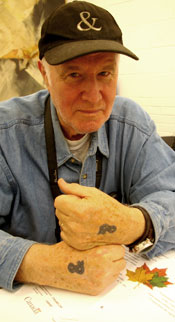 Baxter& will soon be able to view it a little closer to home.
Anyone who didn’t make it to Chicago last fall to see the exhibit spanning the career of conceptual artist Iain Baxter& will soon be able to view it a little closer to home.
Engineers of the near future will have plenty of simple solutions at their disposal to help solve environmental and health problems related to poor sanitation in developing countries, according to a visiting lecturer who will speak here today.
Every year between May and July, billions of sardines “run” up the coast of southeast Africa, creating a massive feeding frenzy for the predators that devour them and a natural ecological spectacle that draws thousands of tourists to witness the event.
It’s a migratory phenomenon that could soon earn the distinction of being nominated as a UNESCO Marine World Heritage Site, and if that happens, it may be in part thanks to the contributions of a post-doctoral fellow at the university’s Great Lakes Institute for Environmental Research.
Every morning when they go to work in their Essex Hall biochemistry lab, PhD students Pam Ovadje and Dennis Ma get an inspirational reminder of why they’re there. Mounted on the door to that lab is a plaque dedicating the space to the memory of Kevin Couvillon, who died at the age of 26 in November 2010, after a three-year battle with acute myeloid leukemia.
A senior advisor to the World Health Organization will discuss the subject of sustainable development and environmental health when he meets with the university’s chapter of Engineers Without Borders next week.
Adrianus (Ton) Vlugman, who is currently stationed at the WHO’s Pan American Health Organization’s office in Guyana, will discuss such technical concepts as sanitation, wastewater and solid waste management – including recycling and management of wastes from health care facilities in the Caribbean – in order to help describe what constitutes sustainable development.
When Visual Arts professor Jennifer Willet pulled together a group of artists and scientists from around the world for a two-week camp last summer in the Rocky Mountains, she was charting new territory in the world of BioArt.
Anyone who’s ever driven a truck, a bus or a bulldozer for a long period of time might have considered what kind of long-term damage the constant rumbling and bumping of those massive machines under them might be doing to their bodies.

It took a tin whistle given to her by her mother, 25 years of practice and a lot of time surfing the internet to teach Janice Waldron that there might be more than one way to teach a student how to play a musical instrument.
For a tiny creature with such a cute and seemingly harmless name, the sea squirt has done a lot of damage in a relatively short time.
Now thanks to modern genetic analysis techniques, a trio of researchers from the university’s Great Lakes Institute for Environmental Research have identified three previously unidentified sub-types of sea squirts, commonly known as the golden star ascidian, and discovered new clues about their capacity – and possibly the capacity of other organisms – for invading various ecosystems.
It was a visit to a local farm to see children with disabilities riding horses that inspired Soula Serra to get involved – and to stay involved – with the United Way.


