A cool welcome for new and returning students

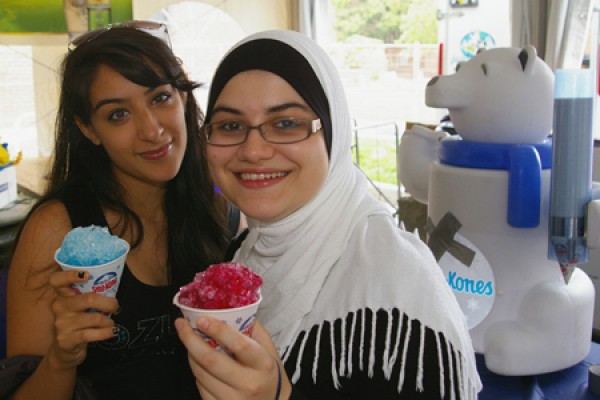
It’s nice to come to campus and feel wanted, says Lana El-Osta: “It really builds University of Windsor pride.”

The first-year biochemistry student joined her childhood friend Nikita Gandhi in trying to take advantage of all that is offered during Windsor Welcome Week. Tuesday, they enjoyed free snow cones outside the CAW Student Centre, courtesy of the International Student Society.

“There’s so much free stuff to do,” Gandhi says. “It gives you a good sense of how friendly the university is.”

The treats were distributed from the large tent serving as headquarters in the newly renovated Student Centre Courtyard between Dillon and Memorial halls. Tuesday’s programming also included the Tough Lancer competition and a hayride tour of the campus neighbourhood.

Today’s Windsor Welcome Week events are a little more academic, starting with Program Orientation, mandatory for first-year students in all courses of study. Welcoming Celebration begins at 3 p.m. in the St. Denis Centre for members of the Class of 2016. One lucky winner will receive a semester’s free tuition from the Alumni Association.

A reception for mature students to discuss balancing the demands of school, family and work is scheduled for Alumni Hall’s McPherson Lounge at 5 p.m.

The Coming Home Music Festival will rock Windsor’s riverfront, with a slate of acts headlined by Swedish DJ Avicii.

Other events this week include:

  • Thursday, September 6. First day of classes and the Adrenaline Rush inflatable carnival.
  • Friday, September 7. See the city with the Taste of Sandwich food tour and an evening cruise along the Windsor-Detroit riverfront.
  • Saturday, September 8. Shinerama Shine Day will put UWindsor students on the street, working their shoe-shining skills to benefit cystic fibrosis charities.

 Visit www.windsorwelcomeweek.ca for a full list of events, locations and times.
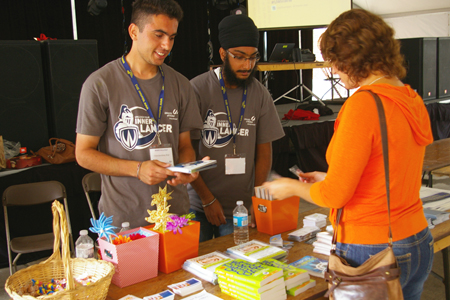
Volunteers Chandandeep Brar and Navjot Singh provide directions and free gear to Teresa Schincariol.
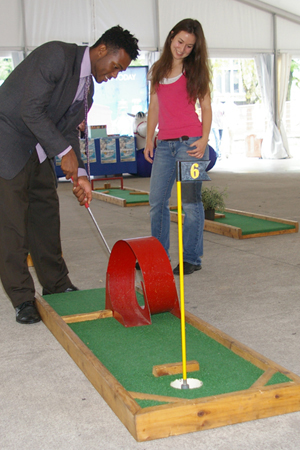
Hanan Ricketts muffs a putt First-year English major Hanan Ricketts muffs a putt during a game of mini-golf with friend Kasey Wiebe.

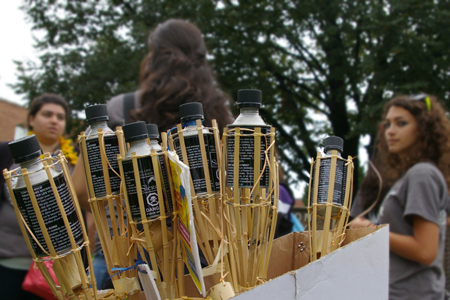
box full of tiki torches

Tiki torches await use by organizers of the River’s Edge beach party, outside Assumption University.
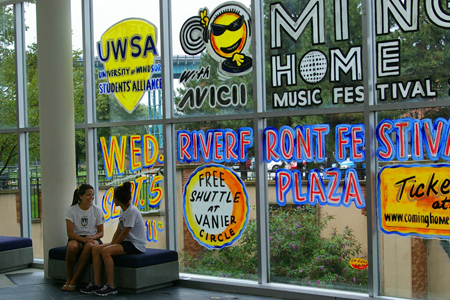
Window paint advertising concert

A large ad in the CAW Commons to promote the Coming Home Music Festival dwarfs Lancer soccer players Mia Cuffaro and Jaclyn Faraci.

Specialized maps to assist visually impaired in navigating campus

New maps will help people with visual disabilities to make their way through the campus, says Anne Mullen of the office of human rights, equity and accessibility.

The maps are available in large print format and in Braille—which employs raised print for interpretation by touch.

“It boils down to independence,” says Mullen, manager of accessibility and human rights. “Everyone should have the opportunity to navigate the campus on their own.”

The maps take the form of several pages coil bound on heavy stock, representing sections of the campus and an extensive index. They are available from Student Disability Services or through Mullen’s office.

“Our accessibility committee had identified the need,” she says. “We’re just glad to be able to provide this service.”

She says her office will consider improvements to the maps for future iterations. To procure either a large-print or Braille map of the campus, contact Mullen at 519-253-3000, ext. 2046.

Virtual ecosystem sheds new light on how species develop

Were Charles Darwin alive today, he’d probably be very interested in working with Robin Gras.

Without such modern technology as high performance computing, Darwin developed his theory of natural selection, an explanation of how all species of life on Earth have descended from common ancestors.

What science still can’t explain, however, is the actual process of speciation, or exactly how various species emerge from single gene pools. A Canada Research Chair in Heuristics for Bioinformatics and a computer science professor, Dr. Gras has developed a virtual world that attempts to shed light on that process. It’s a world he hopes will be embraced by biologists, geneticists and ecologists looking to answer the questions that remain largely unanswered since Darwin published On the Origin of Species in 1859.

“The big question is How do species emerge?” says Gras. “How is it that we have different species? What are the mechanisms that make that happen?”

Gras and his team have developed a virtual world, a complex ecosystem that runs on a high performance computing network called Sharcnet. It’s made up of virtual organisms, all programmed with genetic information and the ability to flee, fight, migrate, hunt, feed and reproduce, and it runs 24 hours a day.  Gras can check in periodically to see if new species have emerged, or if others have gone extinct.

In one of his latest experiments – the details of which were published in the academic journal Proceedings of the Royal Society B: Biological Sciences – Gras introduced obstacles in anywhere from one to 10 per cent of the one million “cells” in the virtual world. In the real world, those obstacles might be forests, rivers, or mountain ranges – anything that might reduce the mixing of certain individuals within a particular population.

Over about 80,000 hours of computing time, he repeated the experiment 60 times, introducing obstacles and monitoring how various clusters of organisms evolved over about 2,000 to 3,000 generations. The results proved that introducing obstacles actually increased speciation, with about 10 million new species being introduced, and more than 20 billion individuals born since the program began.

“The consequences were very clear,” said Gras, a native of France who came to Windsor several years ago from the Swiss Institute of Bioinformatics in Geneva, Switzerland. “We observed much more speciation by introducing these obstacles, even though they don’t completely isolate sub-populations from one another.”

Part of the explanation for increased speciation, Gras says, may have to do with reduced transferring of genetic material among populations, or “gene flow,” created by those obstacles. Reduced gene flow, he says, leads to more speciation.

“Increased gene flow leads to more mixing among the populations, while decreased gene flow actually leads to more differentiation among them,” he explained.

Gras, who would normally publish in computer science journals, hopes having his findings appear in a biology journal will introduce his to work to a more diverse group of scientists interested in experimenting in his virtual world with organisms specifically programmed to replicate the characteristics of those they study.

He has already partnered such UWindsor campus collaborators as Melania Cristescu, a professor in the Great Lakes Institute for Environmental Research who studies the ecology and evolution of aquatic invasive species and co-authored his latest paper, and Stephanie Doucet, a Biological Sciences professor who studies the ecology of various bird species.

“We’ve been recognized as being able to provide real insights for biologists,” he said. “And I have almost as many biology students in my group now as I do computer science students.”

Paid student positions now available for the Annual Giving phone campaign

The University Advancement Office is seeking a dynamic team of students to work as canvassers for its 2012 phone campaign, which begins this year on September 30 and will continue until November 29.

“Successful applicants will be enthusiastic, motivated, looking for a challenge, possess a good grasp of the English language and a clear speaking voice,” says Mona Dosen, development officer, annual giving. “They must have confidence to communicate with UWindsor alumni by telephone to encourage their financial support of the university and to update their address, e-mail and employment information for their alumni record.”

Student canvassers will make calls Mondays through Thursdays from 6 to 9 p.m. and Sundays from 4:30 to 8:30 p.m. Training will be provided and scheduling is designed to meet individual timetables. Interested students may schedule an interview by phoning Dosen at 519-253-3000, ext. 4279. The deadline to apply is Thursday, September 20.

American Windsorites to gather for Obama convention speech

It is important to stay on top of political developments in his home country, says Dan Edelstein, even when it’s right next door.

Edelstein, academic director of the Windsor Research Data Centre in the Leddy Library, is a US citizen living in Windsor. He will join fellow members of Democrats Abroad on Thursday, September 6, to watch president Barack Obama’s speech accepting the Democratic nomination.

“I still vote and participate,” Edelstein says. “We care about how things are going—it’s our home country and we have family and connections there. Plus, there is always the chance we will go back.”

The evening is open to all interested—Americans and their non-American friends and relatives—and begins at 7:30 p.m. at the Beer Market, 119 Chatham Street West. Organizers will have a computer on hand to register eligible voters online.

DailyNews to incorporate facilities notices

Facility Services has a new way to notify the campus about interruptions in service to campus buildings.

DailyNews will publish its announcements automatically alongside its news columns.

“This new system will allow facilities staff to issue updates by the minute,” says editor Kevin Johnson. “The department is responsible for the content of its messages and can change any notice to reflect the most current information.”

The facilities announcements are available for syndication across all UWindsor Web sites using the Drupal content management system.