As the transition from CLEW to Blackboard Learn is close, CTL is offering a number of online, classroom, and individual training sessions on an ongoing basis so instructors can make a seamless transition.As the transition from CLEW to Blackboard Learn is close, CTL is offering a number of online, classroom, and individual training sessions on an ongoing basis so instructors can make a seamless transition.

Instructors encouraged to get early start on CLEW to Blackboard transition

The countdown is on for UWindsor instructors to transition from CLEW, the institution’s current learning management system, to Blackboard Learn, a system that will enhance the University’s capacity to offer engaging, high-quality online and blended teaching and learning.

The first wave of the changeover will happen on Tuesday, September 8, for the faculties of Law, Human Kinetics, Education, Nursing, and the Odette School of Business. Remaining faculties will make the change by the end of December.

“We are asking instructors to plan well ahead of the deadline so they are familiar with the new tools and are comfortable using them in their classrooms,” says Erika Kustra, Director of Teaching and Learning Development in the Centre for Teaching and Learning (CTL).

Dr. Kustra says the new system is among the most popular learning systems in the world and brings state-of-the-art technology to teaching. Such functions as Retention Centre; plagiarism detection tools; lesson building options; enhanced assessment and interactivity, will eventually only be available through Blackboard Learn, though CLEW content will be maintained until September 2017 to allow for appeals, sabbaticals, and similar circumstances.

Kustra says CTL is offering a number of online, classroom, and individual training sessions on an ongoing basis so instructors can make a seamless transition.

Tim Brunet, Pathways Specialist and Coordinator for the Liberal Arts and Professional Studies program, is pleased with the move to Blackboard Learn and the support he received from CTL. He recommends professors allow themselves between six and 10 hours of instruction time, as well as a minimum of two weeks to engage with Blackboard’s many tools.

“Upgrading to Blackboard is important and brings the University of Windsor in full stride with the most advanced online teaching system in the world,” Brunet says.

Kustra says Blackboard has customizable options to support varied teaching styles and enables instructors to connect and engage with students through wikis, blogs, rich video, audio, text chatting, and discussion board options using desktops, laptops, tablets, and smart phones. As well, she says that Blackboard offers more options for providing student feedback and easier, integrated grading, with group friendly features for interactive learning.

“Our goal in CTL is to help our instructors feel supported during this time of transition. We are encouraging everyone to choose a Blackboard Learning training method that works best for them – whether it’s online, classroom, or face-to-face – and get an early start.”

For details on various workshops visit:

https://ctl2.uwindsor.ca/workshops/80/

https://ctl2.uwindsor.ca/workshops/86/

Blackboard Learn

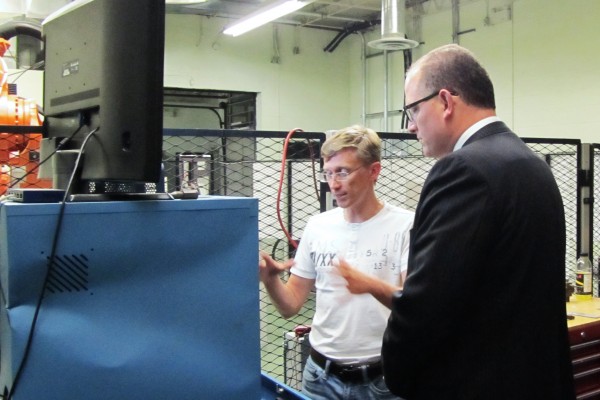
Windsor mayor Drew Dilkens (r.) listened to Dr. Andriy Chertov (l.) presentation on the “In-Line Spot Weld Quality Analysis” project, during his recent visit to UWindsor’s  Institute for Diagnostic Imaging Research.Windsor mayor Drew Dilkens (r.) listened to Dr. Andriy Chertov (l.) presentation on the “In-Line Spot Weld Quality Analysis” project, during his recent visit to UWindsor’s Institute for Diagnostic Imaging Research.

Mayor tours UWindsor’s Institute for Diagnostic Imaging Research

Windsor mayor Drew Dilkens paid a visit recently to UWindsor’s  Institute for Diagnostic Imaging Research to get a close-up look at a number of research projects currently under development with local community partners.

Dilkens was accompanied by IDIR Director General, Dr. Roman Maev, and Vice-President, Research and Innovation, Dr. K.W. Michael Siu, as he toured the facilities and received briefings on such projects as Improving Pathological Evaluation of Breast Cancer Using Ultra-High-Frequency Acoustic Microscopy; Ultrasonic Transcranial Imaging Systems; and Brain Phantom Start Up, Correction of Sleep Architecture by Electrostimulation; and Biometric Fingerprint Project.

“During my tour, it was great to see so many recent University of Windsor graduates finding work in their respective fields, right here in Windsor,” says Dilkens.

“Dr. Maev and his team are working on many innovative technologies with exciting applications in the fields of biomedicine, biometrics and automotive manufacturing. This really reinforced what I’ve known all along, that Windsor is home to a wealth of expertise that industries desire.”

The Mayor says he hoped that IDIR expertise would continue to attract new and innovative companies to locate their operations in Windsor.

Established in 2008, the Institute for Diagnostic Imaging Research (IDIR) at the University of Windsor is a multi-disciplinary, collaborative research and innovation centre whose primary focus is on the development of innovative diagnostic imaging technologies and products. The Institute has been consistently recognized as a world leader in the development of technology that is saving time, money and lives.

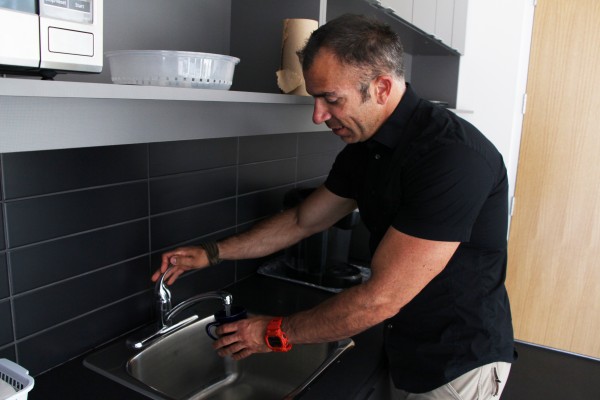
Civil and environmental engineering professor Rupp Carriveau's security study will review worst case scenarios that could possibly lead to Essex County temporarily losing access to safe drinking waterCivil and environmental engineering professor Rupp Carriveau's security study will review worst case scenarios that could possibly lead to Essex County temporarily losing access to safe drinking water.

Researchers collaborate with industry on water security plan

UWindsor researchers are reviewing worst case scenarios that could possibly lead to Essex County temporarily losing access to safe drinking water. Rupp Carriveau and David Ting are accessing possible threats and scrutinizing available back-up options for water security planning.

Dr. Carriveau, a civil and environmental engineering professor, and his collaborator Dr. Ting, a mechanical engineering professor, are working with engineering consultants Crozier Baird and Union Water Supply System – Essex County’s largest water supplier.

“During a potential water emergency, the smart sensory network being installed throughout Essex County will provide strategic information to aid in contingency operations,” says Carriveau. “This will include real time status of valve positions, network pressure, flows, and tank levels.”

For one weekend last summer, Toledo, Ohio citizens relied on bottled water after toxins tainted their public water supply. Toledo is just 100 kilometers south of Windsor. A large blue green algae bloom, or cyanobacteria, released microcystins that are dangerous if ingested and can irritate the liver, skin, eyes and throat.

“We take for granted that clean water will always be available because we live near the bountiful Great Lakes,” says Carriveau. “But after the blue green algae blooms tainted Toledo’s water last summer, we got a wakeup call to the possibility that this could happen to us.”

Toxins are not the only threat to water supply, says Carriveau. Processing plants could be shut down because of mechanical failure, cyber security or terrorism. That is why after identifying potential risks, and probabilities of those risks, Carriveau’s team wants to break down the utility’s reserve capabilities.

“If the water supply is compromised, regardless of the scenario, the question becomes what happens next, how quickly, and for how long can you supply water?” says Carriveau. “I don’t believe this can be done responsibly in a reactive way, which is why you have to research what is possible and understand what is available.”

Carriveau will measure how much tap water is currently stored in water tanks across the county, including in public water towers as well as on-site containers on greenhouse farms.

 “Once storage is exhausted, greenhouse growers would be exposed to many millions in crop damages. It’s not like a field crop that can survive a week or longer thanks to genetics, like root structure.”

Beyond back-up storage, Carriveau says it is important to understand how other regions could help in a water emergency.

“We will map out interconnects and determine true mechanical capacities, because even though we are connected to the grid, the infrastructure could get overwhelmed or there could be a water pressure issue,” says Carriveau. “We’ll locate the intakes, identify physical infrastructure and do a dynamic assessment of our neighbours’ abilities to help us.”

The security study is part of Carriveau’s ongoing Essex Region Smart Water Project (ERSWP), a water monitoring project aimed at more efficiently supplying Essex County’s greenhouse growers with water.

“Union water agrees this is important and needs to be done,” says Carriveau. “With industry, utilities and academic researchers working in collaboration, we can make more detailed and innovative plans than we could working in isolation.”

This will be the first study for UWindsor’s newly formed, Centre for Energy and Water Advancement.

“I’m excited because I think this is UWindsor’s chance to take a formative role in a crucial issue, which is contingency planning for safe water supply.”

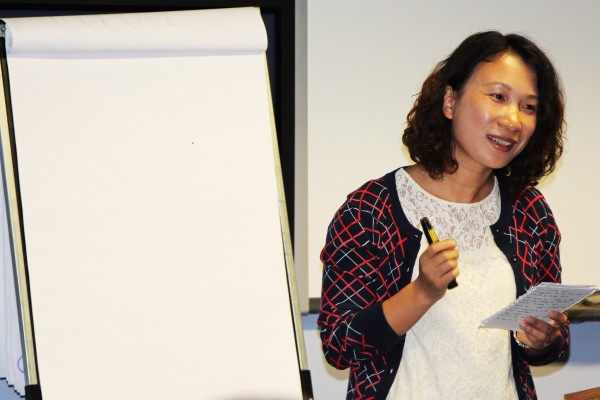
Aeronautic engineering instructor Lu Hongan from the Shanghai University of Engineering Science, gave a capstone presentation concluding her participation at the Centre for Teaching and Learning’s International Faculty Development Program. Aeronautic engineering instructor Lu Hongan from the Shanghai University of Engineering Science, gave a capstone presentation concluding her participation at the Centre for Teaching and Learning’s International Faculty Development Program.

Chinese instructors look to UWindsor for Canadian teaching strategies

After devoting at least six hours a day to workshops and lectures on Canadian teaching and learning strategies recently, Chinese aeronautic engineering instructor Lu Hongan gave a short presentation on her current teaching profile, and the future teacher she hopes to become.

Hongan was one of a 14 full-time faculty members from the Shanghai University of Engineering Science who completed the Centre for Teaching and Learning’s International Faculty Development Program -  a three-week, intensive introduction to innovative practices in higher education teaching and learning. The program was co-managed by Diana Kao, Associate Vice-Provost, International  Cooperation.

Hongan says though being in an English speaking country for the first time was difficult, she thinks it was helpful for her as a teacher.

“Our trainers demonstrated lots of examples that were useful. They taught us how to use research as a teaching method and how to present our complex topics in a simple way.”

English teacher Gao Yanning said the program has helped her re-discover herself as a teacher, learn about teaching methodologies within Canadian culture, as well as to learn from other participants who come from a variety of disciplines.

“Trainers here use a lot of body language, and that is different from what Chinese teachers do,” says Gao. “I think it would help me to use a bit of body language. It will help my students remember the information.”

Alan Wright, Acting Dean of the Faculty of Education and Academic Development and

Vice-Provost, Teaching and Learning, says CTL has hosted more than 90 Chinese faculty members over the past three years, with two Beijing University graduates from last year’s program now on campus as visiting fellows.

“The Chinese interest in sending their teachers to Canada illustrates their eagerness to learn from other cultures.”

He says that the whole program speaks to the wonderful development of the CTL and UWindsor names on an international basis.

“We are now leaders in the realm of international faculty development.”

CTL

English teacher Gao Yanning (l.), along with 13 full-time faculty members from the Shanghai University of Engineering Science, presented their capstone presentations as part of the Centre for Teaching and Learning’s International Faculty Development Program 

During the fourth annual popsicle stick bridge building contest, third year Civil engineering student Laura Daniel made sure her team’s structure is placed correctly in a specially-built machine that measures the force applied as the structures are crusheDuring the fourth annual popsicle stick bridge building contest, third year Civil engineering student Laura Daniel made sure her team’s structure is placed correctly in a specially-built machine that measures the force applied as the structures are crushed.

Bridge-building competition provides students with real-world experience

Building structures of popsicle sticks and glue may seem like child’s play, but it took the bright minds of third-year civil engineering students to make them strong enough to stand up to extreme load testing at the fourth annual popsicle stick bridge building contest on Tuesday.

Students in Amr ElRagaby’s Finite Elements for Analysis and Design class vied for top marks in a contest that rewards creative and innovation designs that bear the most load relative to their own, alongside the most accurate predictions of their strength and performance.

Teams were tasked with designing and constructing a truss bridge of at least 10 cm wide and 75 cm long which was exposed to a concentrated load until it failed by breaking or bending.

“Failure is the ultimate goal, because only then can we know the ultimate limits of their strengths and flexibility,” says Dr. ElRagaby. “Once the students have built their bridge, they analyze it using specialized software tools and make some predictions about how they will perform. Then we verify it under our experimental conditions.”

Structures are placed in a specially-built machine that measures the force applied as the structures are crushed. ElRagaby says that once students have a chance to apply theories they have learned in the classroom to a real-world outcome, they learn something they will never forget.

 “We did learn a lot a school, and we were able to apply that in our bridge,” says student Ali Taeb. “For example, based on our knowledge, we knew exactly where it might fail, and that helped us improve our structure.”

The best performing bridge— a triangular structure by Jordan Gangier, Chris Mullin, Griffin Cecilaws, Ali Taeb and Lucy Asemota, held more than 12.5 kg, with just 2.2 mm of deflection and weighing just 500 grams.

The best analysis presented was by Jonathan Baiano, Eric Walo, Joshua King, Joseph Fregin and Kory Snelgrove. And the most creative and innovative design was won by Zachary Bastien, Tara Benard-Rae, Zachary McPhee and Curtis Simpson.

The best performing bridge and most accurate analysis will receive $400 each, while winners of the most creative and innovative design will receive $500. Sponsors included Stantec Engineering, Canadian Deck and Joist Corporation, the Falkner family, and the Department of Civil and Environmental Engineering.

Watch the story on CBC news 

Third year civil engineering students Jordan Gangier, Griffin Cecilaws, Chris Mullin and Ali Taeb display their model bridge, a winner of the best performing bridge


Third year civil engineering students (from left to right) Jordan Gangier, Chris Mullin, Griffin Cecilaws and Ali Taeb display their model bridge, a winner of the best performing bridge.

Alumna Jenny Perla Leon is the first Canadian to be accepted into a highly-competitive MAIB/IBM International Business graduate program.Alumna Jenny Perla Leon is the first Canadian to be accepted into a highly-competitive International Business graduate program.

Grad first Canadian to win place in coveted business program

A recent UWindsor graduate is the first Canadian to be accepted into a unique international business and development master's program.

Jenny Perla Leon (BA’15) is one of only 15 students from around the globe to win a place in the Masters of International Business Development & International Business Management program. The program will give her an opportunity to earn two degrees over a 15-month period.

The tri-country program is in its second year and gives students a chance to study at the University of Milano Bicocca in Milan, Italy; Alliance University in Bangalore, India; and Centennial College in Toronto. The combined international business management education also gives student exposure to the cultural and socio-economic environment of each country and city.

Perla Leon, a Modern Languages and Second Language Education student who has also worked as an admissions assistant at Centennial College, says she has always been passionate about business and hopes to start her own business upon completion of her studies. She expects the program to give her the experience and knowledge to help her succeed and believes it will help broaden her mind when it comes to business.

“I am fascinated by international business, how it works and how you manage it,” she says, “While working in the international department I learned a lot about international students, how to recruit them and assist them.”  

Finding Audrey by Sophie Kinsella is the Campus Bookstore's Book of the Week. Finding Audrey by Sophie Kinsella is the Campus Bookstore's Book of the Week.

A “young adult” novel selected as the book of the week

The Campus Bookstore has selected is Finding Audrey by Sophie Kinsella, as its Book of the Week.

This is a new “young adult” novel by the author of the very popular Confessions of a Shopaholic series.

The book’s list price is $22.00; the Campus Bookstore will sell it for $13.17 until August 16 9.

Marketing coordinator Martin Deck reminds patrons that the store will match the price of all books with those offered by amazon.ca and chapters.indigo.ca. Read more on the Campus Bookstore website 

Sock monkeys offered for True Savings Thursday

The Campus Bookstore will offer 20 percent off all sock monkeys and sock monkey-based stuffed toys and slippers, both Lancer-branded and non-branded Thursday, August 13.

The store is open daily until 5 p.m. and is located on the lower level of the CAW Student Centre.

Sock monkey