Fred SasakamooseNHLer Fred Sasakamoose is among the Aboriginal athletes whose Wikipedia entries have been identified as needing updates.

“Editathon” to enhance awareness of elite Aboriginal athletes

UWindsor faculty and students will join conferees of the North American Society for the Sociology of Sport in an effort November 1 to enhance Wikipedia’s entries on elite Aboriginal athletes.

Kinesiology professor Victoria Paraschak is organizing an “editathon” as a service activity prior the society’s conference. The event responds to a call to action from the Truth and Reconciliation Commission:

We call upon all levels of government, in collaboration with Aboriginal peoples, sports halls of fame, and other relevant organizations, to provide public education that tells the national story of Aboriginal athletes in history.

The Department of Kinesiology and the Leddy Library are co-sponsoring the event, which aims to reach at least 151 entries in three Wikipedia categories:

No experience with Wikipedia is necessary, although Dr. Paraschak asks that volunteers make a minimum commitment of an hour.

“Librarians will be available for assistance in locating references that can be used to write and substantiate the entries,” she says. “And individuals who are familiar with writing Wikipedia entries will be on hand to provide guidance.”

The Wikipedia Editathon on Elite Aboriginal Athletes in Canada will run 9 a.m. to 4 p.m. Wednesday in room 248, Human Kinetics Building. Signing up for the event will include the process of creating a Wikipedia editor account: register online here.

UWindsor biochemistry graduate student Cody Caba and professor Bulent Mutus display the crystal structure of protein disulfide isomerase. Mutus received an NSERC Discovery Grant to examine cell proteins and structures and how they contribute to diseases.UWindsor biochemistry graduate student Cody Caba and professor Bulent Mutus display the crystal structure of protein disulfide isomerase. Mutus received an NSERC Discovery Grant to examine cell proteins and structures and how they contribute to diseases.

Biochemist to study how proteins contribute to neurodegenerative diseases

Bulent Mutus is a micro mechanic.

But instead of fixing cars with wrenches and grease, the biochemist rolls up his sleeves and chops up and rebuilds proteins using microscopes and Petri dishes.

“If this enzyme were a car we would know where the engine is, but now we are looking at turning that engine off so the pathology will go away,” the UWindsor professor said.

Dr. Mutus recently received a $200,000 Discovery Grant over five years from the Natural Sciences and Engineering Research Council of Canada (NSERC) to examine cell proteins and structures and how they contribute to diseases like cystic fibrosis and Alzheimer’s.

The human body is made up of about 10 trillion cells that intricately interact with one another to ensure the body functions properly. When cell-to-cell and internal cell signaling is disturbed, the body cannot function properly, and acute diseases and physiological or neurological disorders occur.

“It’s similar to a teeter-totter, wherein a normal situation everything is balanced,” Mutus explained.

Every cell contains strings of amino acid molecules that fold onto themselves, forming structures called proteins.

“If there’s something that messes up the balance within the cell, then the proteins don’t fold properly, and you get something called unfolded protein response,” he said.

Diseases reactive to the unfolded protein response include Alzheimer’s, Parkinson’s and Huntington’s — as well as many others.

Proteins are encoded from DNA instructions and form in ways that allow them to combine with other substrates to perform work. When proteins do work, they are called enzymes and help the body to function properly.
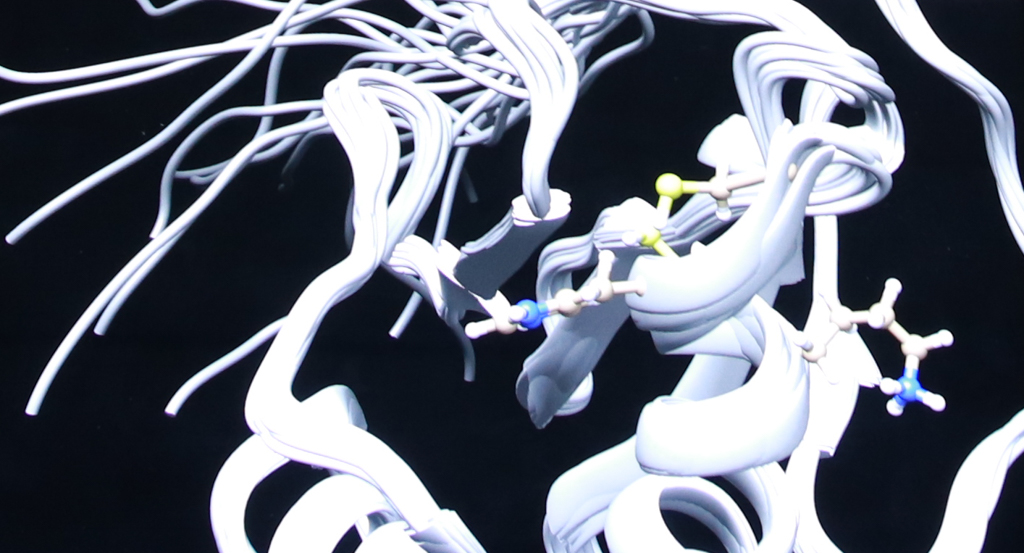
The crystal structure of protein disulfide isomerase is pictured in this computer visualization.

The crystal structure of protein disulfide isomerase is pictured in this computer visualization. 

Mutus’ NSERC research focuses on a sequence of amino acids containing sulfur, called cysteine amino acids, and the role they play in the regulation of enzymes. In the sequence, called the CXXC motif, two amino acids represented by the letter C for cysteine, are separated by any other two of the 23 amino acids, which are represented by X. These cysteine amino acids have a sulfur group that often binds to itself to create a stronger bond or fold within the protein structure.

Mutus said the sequence affects structure which in turn affects the function, and so improper sequences or structures can cause harmful pathologies in the body.

“Structure is related to function, and so if you build a building and you don’t have any doors it’s not going to be very functional,” the researcher said. “The same goes with a protein, and if a sequence works well in one particular protein, then it’s copied and repeatedly used somewhere else.”

By studying this CXXC protein sequence and its function in various cellular pathways, researchers can develop therapies to treat diseases caused by improper function.

Mutus’ lab has created probes that will bind to CXXC enzymes within the cells which can be followed to see their functions in internal cellular pathways.

He said an example of this is found in patients with cystic fibrosis. Within these patients, an enzyme called S-Nitrosoglutathione Reductase (GSNOR) is unable to form at appropriate levels in the lungs and can’t function in ion transport.

“If that ion transport protein can’t mature and enter into the cell membrane where it belongs, then fluid essentially starts to accumulate in the lungs and leads to infections,” Mutus said. “So if an enzyme contains this CXXC motif, and we think we can tweak onto something that’s a very small run of four or five amino acids, where we can play with one of the amino acids and really regulate the enzyme, like turning a car engine on and off to control negative pathologies in the body.”

Mutus’ research will eventually have implications in drug design as a means of controlling these important enzymes involved in pathologies and diseases that may affect all of us.

Monica Sanborn in still from On GirlsMonica Sanborn plays pregnant teenager Melissa Anderson in “On Girls,” showing October 30 at the Windsor International Film Festival.

Professor’s short film featured on festival playbill

A work by UWindsor professor Kim Nelson is on the opening program of the Windsor International Film Festival.

An associate professor in the School of Creative Arts, Nelson wrote and directed On Girls, a 15-minute film that will screen as part of WIFF Local Shorts collection at 8:05 p.m. Monday, October 30, in the Capitol Theatre. This will mark its Canadian premiere after showings in New York and Florida.

On Girls is about unplanned teen pregnancy and one young woman who has to face this situation alone,” Nelson says. “My hope is that the film sparks debate on many levels, from its characters and themes, to its mise-en-scène and structure.”

The cast and crew are largely UWindsor students and recent grads who filmed on campus and at Windsor Regional Hospital. School of Creative Arts professor Brent Lee composed the score.

Admission to the screening is $14; $9 for students. Learn more on the festival website.

Update notes uptick in student enrolment

An increase in first-year undergraduate enrolment reverses a multi-year trend, UWindsor president Alan Wildeman announced in a message to the campus community Wednesday.

“The net result is that there are in excess of 400 more full-time students on campus this year,” he notes.

His Update #34 praises the efforts of faculty and staff to raise awareness of what the University has to offer students, and also provides information on the status of new faculty positions, current construction projects, employee retirements, and the Strategic Mandate Agreement.

Read it now on the presidential communications webpage.

Guitarist Tariq HarbGuitarist Tariq Harb presents a recital on Friday, October 27, and a masterclass for music students the following day.

Quiz contest a chance to win tickets to Friday guitar recital

The School of Creative Arts is offering DailyNews readers a chance to win two free tickets to a recital by Canada’s next superstar of classical guitar, Tariq Harb, on Friday, October 27.

The show is set for 7:30 p.m. at the Capitol Theatre, 121 University Avenue West. Admission is $20, with a student rate of $5. More details are available on the concert webpage.

To enter the contest, just send your answers to the following three trivia questions. The winner will be selected at random from all correct responses received by 4 p.m. Thursday, October 26.

  1. Dr. Harb teaches guitar performance at which Canadian university?
    a) Concordia
    b) McGill
    c) Toronto
    d) Western
     
  2. Although he now calls Canada home, Harb was born in which country?
    a) Egypt
    b) Jordan
    c) Iraq
    d) Lebanon
     
  3. Friday’s program will feature Harb’s adaptation of a violin concerto by which composer?
    a) Ludwig van Beethoven
    b) Johannes Brahms
    c) Wolfgang Mozart
    d) Antonio Vivaldi

Contest is open to all readers of the DailyNews. Send an e-mail with your responses to uofwnews@uwindsor.ca. One entry per contestant, please.

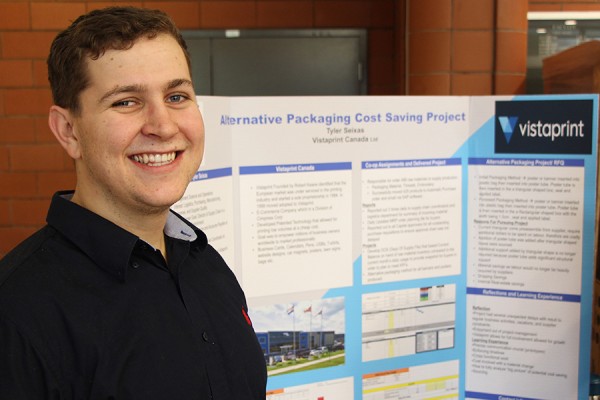
Tyler SeixasBusiness major Tyler Seixas has taken on a full-time position with Vistaprint in addition to his full-time studies after a co-op work term with the printing company.

Presentations reflect on co-op placement experiences

Co-op has given Tyler Seixas a taste of many facets of business, but his last placement promises to leave a lingering impression.

The fourth-year business student parlayed his term as a buyer with Vistaprint into a full-time position as logistics supervisor at the company’s Tecumseh plant.

“Co-op taught me as much about what I didn’t want to pursue as a career as what I do want to do,” Seixas said Wednesday during a discussion of his experiences with co-operative education. He was one of six students presenting posters about their work terms in the lobby of the Odette Building. Seven classmates will present today — Thursday, October 26 — from 10 to 11 a.m.

Kyle Seguin, who worked in human resources for food producer Highbury Canco, called his time there “an amazing experience.”

He was put in charge of recruiting, hiring, and training general and seasonal labourers for the Leamington-based facility, which produces condiments, soups, sauces, and juices. The greatest challenge, though, was having to dismiss employees.

“You really have to watch what you say,” Seguin said. “You have to legally compliant and protect the company as well as help the person adjust to being fired.”

Romina Oulevey, co-ordinator of co-op programs for business, kinesiology, and science, said the presentations help the students process what they have learned.

“It’s important for them to reflect after the work term, to find out what their work preferences are,” she said. “It also helps to show employers and our faculty what our students are capable of.”

Watch a video from Tuesday’s event on the UWindsor Facebook page.

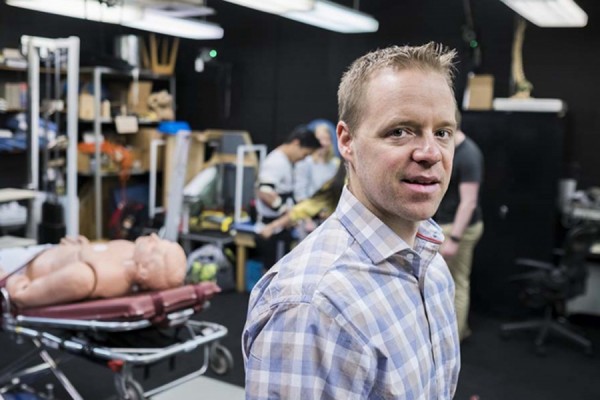
Steven FischerKinesiology professor Steven Fischer of the University of Waterloo will speak to his work preventing musculoskeletal disorders in paramedics Friday.

Lecture offers look at ways to prevent paramedic hazards

A professor from the University of Waterloo will discuss his work to promote workplace safety for paramedics, in a free public lecture Friday on the UWindsor campus.

Paramedics are exposed to hazards of musculoskeletal disorder while performing their normal job duties, says kinesiology professor Steven Fischer.

A certified ergonomist and director of research in the Occupational Biomechanics and Ergonomics Lab, he will deliver “Protecting Those that Protect Us: MSD Prevention in the Paramedic Sector” at noon October 27 in room 144, Human Kinetics Building.

Dr. Fischer’s research aims to optimize function and performance in the workplace and spans four themes: identifying determinants of movement behaviour in the workplace; advancing movement assessment in a workplace context; applying digital human models to predict movement behaviour in the workplace; and informing the design of better, safer products.

His address is part of the Faculty of Human Kinetics Distinguished Speakers Series.