Emilia Iacobelli, Radha Patel, and Deirdre Charron stuff totebags with snacks and information for visitors who will come to the University of Windsor by bus Saturday for its open house.
The University of Windsor will welcome thousands of prospective students and members of their families to Spring Open House on Saturday, March 3.
Check-in counters in the Welcome Centre and CAW Student Centre will direct guests to an information fair, more than 50 presentations on academic programs, and tours of campus, residence, athletics, and academic facilities.
“We’re really excited to be able to showcase some of our beautiful new spaces,” says organizer Zora Savic of the student recruitment office. “I think our guests will be impressed by the facilities dedicated to these specialized programs.”
She will be able to measure whether visitors enjoy their time here, with a survey asking them to describe their experiences. All respondents will be entered into a draw to win a pair of Snapchat Spectacles, which allow the wearer to record short videos of what they’re seeing.
Sessions will also provide information on career planning, financial aid, the Outstanding Scholars program, and application processes for medical and law schools. Activities will run 10 a.m. to 4 p.m. Find more information, including the full program of events, on the open house website.
One guest at Saturday’s open house will win a pair of Snapchat Spectacles.
A recital Friday in the SoCA Armouries will feature duets for violin and piano.
Violinist Michael Adamson and pianist Philip Adamson will share a stage for their recital “Music for a Winter’s Evening,” Friday, March 2, in the SoCA Armouries Performance Hall.
The two musicians are brothers — Philip Adamson teaches classical piano in the UWindsor School of Creative Arts while Michael Adamson pursued solo, chamber, and orchestral performance parallel to his business career. Find more detailed profiles along with the complete program on the event webpage.
The venue is located at 37 University Avenue East. Friday’s concert begins at 7:30 p.m. Admission is $20 with a student rate of $5. Purchase them online or at the door.
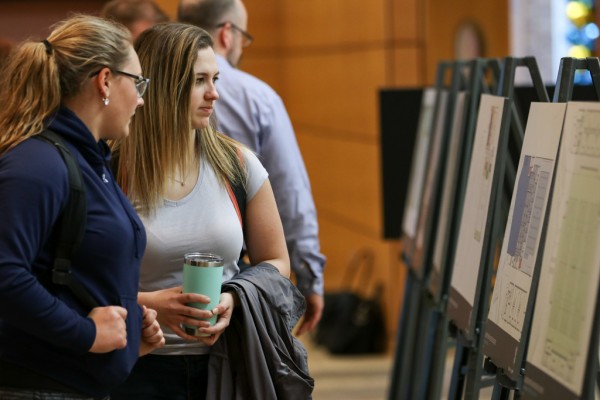
UWindsor students Monica Sokolowski and Stephanie Milling examine the architectural renderings for the Lancer Sport and Recreation Centre during the open house on Wednesday, Feb. 28, 2018.
The future Lancer Sport and Recreation Centre will provide a cutting-edge facility that brings together University of Windsor students, academics, and the community.
"The Lancer Sport and Recreation Centre (LSRC) will completely transform the student experience at the University of Windsor," said Michael Khan, dean of the Faculty of Human Kinetics. "The facility will allow the Lancer family to be immersed in community groups, students will have more opportunities to be physically active and our researchers will be able to gain experiential learning thanks to the new LSRC."
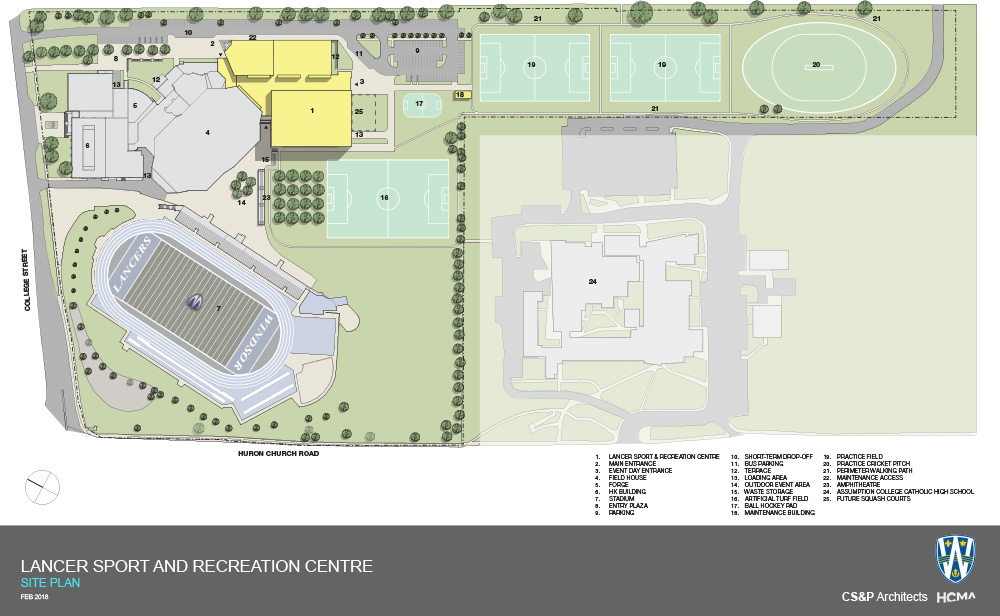
The $73-million facility will be added to the south face of the St. Denis Athletics and Recreation Centre and will feature a new eight-lane 25 metre pool, a gymnasium with seating for more than 2,500 people, multipurpose areas and social spaces, a fitness centre, new outdoor soccer fields, cricket pitch, perimeter walking path, and artificial turf field.
Representatives from CS&P Architects and Colliers Project Leaders, as well as University staff involved in the project, hosted an open house on Wednesday to discuss the new facility.
"We've created this nucleus that ties existing spaces like the fieldhouse into a social hub where there will be food kiosks and a place for students to hang out and study," said Craig Goodman, a principal architect with CS&P. "From the lounge, you'll have visibility into all the new facilities like the fitness spaces, multipurpose rooms, gymnasium, and the new aquatic centre."
Goodman said student input has been a vital component of selecting the LSRC's features.
"We've been having meetings with students since last summer and the main emphasis was creating an agile multipurpose space that can accommodate many kinds of uses," Goodman said. "The five multipurpose rooms can be used for martial arts, yoga, dance, Crossfit and indoor cycling."
CS&P principal architect Craig Goodman describes the features of the Lancer Sport and Recreation Centre during an open house on Feb. 28, 2018.
Biological sciences undergraduate student Stephanie Milling said she's most excited for the extra space to accommodate both the varsity and intramural sports leagues.
"Right now, it's difficult to have everyone in that space, especially when there are sporting events going on," Milling said.
"This is a nice design, it's open and it looks like it will be accessible for everyone."
Goodman said the exterior features of the new facility will also provide more opportunities for recreation.
"The artificial turf field will have lighting which will allow it to be used in extended hours and season," he said. "There will be new practice fields for soccer, a cricket pitch, outdoor ball hockey, basketball courts, and an amphitheatre."
The Site Plan for the Lancer Sport and Recreation Centre.
While construction is not likely to start until the end of this year, Goodman said preliminary work on the site will start as early as next month.
UWindsor students will contribute to the facility's capital cost as a result of the referendums held by the University of Windsor Students' Alliance (UWSA), the Graduate Student Society, and the Organization of Part-time University Students.
Goodman said the facility is expected to take about two and a half years and should be completed by Fall of 2021.
"The LSRC will put Windsor on the map," said UWSA president Jeremiah Bowers. "This will create a bridge between our students, employees and our Lancers to the different community groups that come in and use this space."
For more information about the Lancer Sport and Recreation Centre, visit www.uwindsor.ca/LSRC.
The University of Windsor Board of Governors announced today that the search for the seventh president and vice-chancellor will not conclude by June 30, 2018, when current president Alan Wildeman is set to conclude his term. The search committee had identified a highly preferred candidate from a broad and diverse pool of applicants, who, for personal reasons unrelated to the University of Windsor, declined the offer.
In reaching this conclusion, the board recognized that it is not realistic to identify a new preferred candidate in the short time frame remaining between now and June. The board also recognizes that this is a very positive time for the University of Windsor. Even though there are a number of presidential searches happening provincially and nationally, the opportunity at Windsor is highly attractive, and the board has advised the search committee to renew its efforts in the coming academic year, and is grateful to the committee’s members for their continuing dedication to the task. The search committee remains committed to identifying the candidate who best fits the position profile and mandate that were developed through wide community consultation.
The board will be making a statement in the coming weeks about an interim strategy until a new president and vice-chancellor is identified.
Windsor Mayor Drew Dilkens presents University of Windsor President Alan Wildeman with a heritage plaque for the rehabilitation of the former Windsor Star.
The storied past of the former Windsor Star building will be accessible to future generations thanks to the University of Windsor.
City of Windsor mayor Drew Dilkens presented UWindsor president Alan Wildeman with a plaque that recognizes the heritage value of the Beaux-Arts style building at 167 Ferry Street.
"There's a lot of history at that intersection and over the years I've learned stories of how it was in some ways the Internet for Windsor," Dr. Wildeman said. "Hundreds of people would come to this spot to hear about important matters like election results and significant world events.
"It's fortunate that the University has been able to preserve the historic look, so it can be there for the future and the community to see."
The University of Windsor was presented with a heritage plaque for its School of Social Work and Centre for Executive and Professional Education.
The limestone building was constructed in 1927 by local architect Albert H. McPhail and housed the Windsor Star newspaper offices until 2011.
The University of Windsor purchased the property at Pitt and Ferry Streets and in 2015 opened its School of Social Work and Centre for Executive and Professional Education in a new building that retains the historic facade of the Star building.
"We've been able to preserve a unique streetscape," Wildeman said.
"I think it will stand as a lasting and significant architectural feature of downtown Windsor. And most importantly, of course, we have been able to create a beautiful new learning, research, and community outreach hub for our students and faculty and staff, and one that will help our University have a greater positive impact on society."
University and college students across Ontario are being invited this week to participate in an online survey to gather information on their experiences, general attitudes, and beliefs related to personal safety and sexual violence.
The Student Voices on Sexual Assault survey is the first of its kind in Canada and builds on stand-alone sexual violence policies now in place at every university and college campus in Ontario.
“Research shows that sexual violence is persistently underreported and lacks consistent data-gathering mechanisms,” says Dusty Johnstone, UWindsor’s sexual misconduct response and prevention officer. “This survey is one component of a multi-faceted strategy to better understand and respond to sexual violence and harassment on campus.”
The survey is part of new overarching policies initiated by the Ministry of Advanced Education and Skills Development in 2016 which required all post-secondary institutions to implement sexual violence policies and report on their effectiveness.
“Sexual violence, as we understand it at the University of Windsor, is any act that targets a person’s sexuality, gender identity, or gender expression,” says Dr. Johnstone.
“These can be acts that are physical or psychological in nature and that are threatened or attempted without a person’s consent. This includes sexual assault, sexual harassment, stalking, indecent exposure, voyeurism, and sexual exploitation, and we encourage any student at any time to report these kinds of behaviours.”
Students eligible to participate in the survey will have received an email this week with a link to a landing page with more information about the survey, developed in consultation with an expert panel made up of representatives from student groups, colleges and universities, private career colleges, as well as researchers working on sexual violence prevention.
“The survey is entirely voluntary and students can complete as much or as little as they are comfortable with,” says Johnstone. “It takes about 15 to 20 minutes to complete, and the information gathered will provide valuable insight that will inform policy development on safety well into the future.”
Accounting student Sukaina Kazim discusses her co-op experience with the Canada Revenue Agency during a poster session Wednesday in the Odette Building.
With tax season approaching, it’s time to admit it: not everyone is a fan of the Canada Revenue Agency. Fourth-year accounting student Sukaina Kazim says a co-op work term with the government’s tax collectors changed her opinion.
“I was a little nervous going in, but I quickly learned that the CRA respects its employees,” she said at an event Wednesday showcasing the co-operative education experiences of business majors. “They believe a core role is educating the public and helping them understand the law.”
Kazim worked in the agency’s audit division, reviewing business sales tax returns. An international student born in the Democratic Republic of Congo, she said the experience helped her gain an appreciation for Canadian business practices.
“It was very interesting because I have never done anything with the Excise Tax Act,” she said. “I got to learn how important following legislation is in Canada.”
Kazim was one of five students presenting posters about their work terms in the lobby of the Odette Building. Another six classmates will present today — Thursday, March 1 — from 1:15 to 2:15 p.m.
Romina Oulevey, co-ordinator of co-op programs for business, kinesiology, and science, said that work placements help students prepare for professional life.
“It supplements their learning through hands-on experience,” Oulevey said. “Students have a chance to try out different industries and network with prospective employers.”
It worked out that way for Kazim, who believes her participation helped her land a full-time position with Union Gas, which she will begin after she graduates this spring.
“I had actual accounting experience I could draw on in my job interviews,” she said. “The three terms I worked in co-op helped me develop skills I otherwise wouldn’t have.”
Registration for the sixth annual Accessibility Awareness Day is open through Friday.
Registration will close Friday, March 2, for the sixth annual Accessibility Awareness Day, set for March 28 in the CAW Student Centre’s Alumni Auditorium with a theme of “Accessibility: More Than Meet the Eye.”
Sessions throughout the day will focus on increasing awareness of accessibility challenges and breaking down barriers within the campus and broader communities. Faculty, staff, and students will share their accessibility advocacy stories during breakout sessions.
The event is free to attend and everyone is welcome. Advance registration is required; find a link and more information on the event website.
Anna Medved, a 15-year-old Grade 10 student at Sandwich Secondary, takes part in the university’s first-ever coding workshop for girls.
Spots went quickly for the University of Windsor’s first-ever Go CODE Girl workshop for girls in Grades 7 to 11.
A packed room of 40 participants learned the basics of Python, a computer programming language, February 24 at a free workshop hosted by the university’s Faculty of Engineering and Faculty of Science.
“In Canada, we have a huge void and gap, not only in gender but also in skilled programmers,” says Ziad Kobti, director of UWindsor’s School of Computer Science. “We have a very small number of females who pursue careers in computer science and yet the employment after a four-year degree is nearly 100 per cent. Thanks to local donors, we’ve established a female entrance scholarship to encourage women to apply to this exciting field.”
Sponsored province-wide by the Ontario Network for Women in Engineering, Go CODE Girl aims to educate, inspire and equip girls with the digital skills, confidence and resources needed to pursue education in technology, computing and engineering.
Most of the girls who registered had previously participated in science, technology, engineering, and math (STEM) related outreach events hosted by UWindsor. Anna Medved, a 15-year-old Grade 10 student at Sandwich Secondary, said her interest for science and engineering sparked at a young age thanks to her parents who both work in STEM-related fields.
“It’s been there all my life and I guess it’s normal for me to go that way,” she said at the event after learning to code for the first time. “Maybe girls who don’t have that background or role models in these fields don’t think of it as an option or find it interesting.”
Medved said she will most likely pursue an education in civil engineering because she’s interested in the composition of structures.
“Today, I learned how to do Python coding and turtle functions. I thought it was pretty cool to learn how the computers do stuff for you and if I do go into engineering, I may have to use programming when working with blueprints or when I have to show how different parts work together,” she said.
Jennifer Johrendt, the engineering faculty’s assistant dean of student affairs and associate professor in the mechanical, automotive and materials engineering department, said at previous events, some female students said they feel more comfortable trying things for the first time when they’re around female peers.
“We also have some pretty experienced programmers here today, so it’s a great way for the girls to educate each other and try things for the first time in a comfortable environment,” Johrendt said.
Kobti said programming requires you to learn and record step-by-step how to use computer logic to solve problems.
“Hopefully, the girls unraveled the mystery of how to solve a problem by telling the computer how the solution works so the computer can carry out the solution. That’s what we call coding.”
Budget 2018 marks the biggest investment in science and university research in Canadian history, Universities Canada said Wednesday. With a focus on investing in people and ideas for a stronger, more prosperous Canada, the budget will increase diversity in science and help develop Canada’s next generation of research leaders.
In each of its budgets, Universities Canada - the voice of Canada’s universities at home and abroad, advancing higher education, research and innovation for the benefit of all Canadians - said the government has demonstrated commitments to science, research and students, and has recognized the central role of universities in shaping Canada’s future. Reflecting the core recommendations of the 2017 Federal Science Review Panel, which called for significant investments in research, Budget 2018 provides $925 million in new funding for investigator-led research through Canada’s three federal research councils over the next five years.
University of Windsor President Alan Wildeman added that "the 2018 Federal Budget provides significant new funding for basic and collaborative research across all disciplines, for research addressing important national issues, and for enhancing diversity within the research community. I want to thank the University of Windsor research community for being a part of the national effort to advocate for the importance of research in education and to the future of our country.”
Budget 2018 provides an increase of $354.7 million each for the Natural Sciences and Engineering Research Council and the Canadian Institutes of Health Research over the next five years, and $215.5 million for the Social Sciences and Humanities Research Council. An additional $231.3 over five years is targeted for the Research Support Fund – a critical program that assists universities with the institutional costs of research, such as facility costs and technology transfer supports
Budget 2018 will also establish a tri-council fund to support research that is international, interdisciplinary, fast-breaking and higher-risk, with $275 million over five years to be administered by SSHRC.
As well, granting councils will be required to increase tri-council collaboration, support for interdisciplinary research and diversity among funding recipients – including women, early-career researchers and other underrepresented groups. This aligns well with university leaders’ adoption of seven principles to advance equity, diversity and inclusion, along with a five-year action plan, in October 2017.
Budget 2018 invests $763 million for cutting-edge research infrastructure through the Canada Foundation for Innovation over the next five years, reaching a stable base of ongoing funding at $462 million per year by 2023-24.
The Fundamental Science Review Panel, a group of nine eminent Canadians chaired by David Naylor, president emeritus of the University of Toronto, laid out a blueprint for the future of Canada’s research ecosystem in April 2017.
“This budget makes important advances on the roadmap developed by the Naylor report,” says Paul Davidson, president of Universities Canada. “It’s a major investment in research that impacts Canadians’ everyday lives, from shortening commute times to lifesaving medical treatments and environmental protection.”
Canada’s universities also welcome Budget 2018’s $540 million investment in the National Research Council and a major renewal of federal laboratories.
Ann Pegoraro, director of the Institute for Sport Marketing at Laurentian University and a professor in its School of Human Kinetics, will speak on campus Friday.
A lunchtime lecture Friday in the Human Kinetics Building will consider working with big and small data for inquiry into issues surrounding sport.
Laurentian University human kinetics professor Ann Pegoraro, director of the Institute for Sport Marketing, will present “Social Media in Sport Research” at noon March 2 in room 144, Human Kinetics Building.
Dr. Pegoraro has focused her research on the intersection of digital media and sport. Her recent work has focused on the intersection of sport and social issues, including athlete activism in the digital age.
This event, part of the Faculty of Human Kinetics Distinguished Speakers’ Series, is free and open to the public.

 Emilia Iacobelli, Radha Patel, and Deirdre Charron stuff totebags with snacks and information for visitors who will come to the University of Windsor by bus Saturday for its open house.