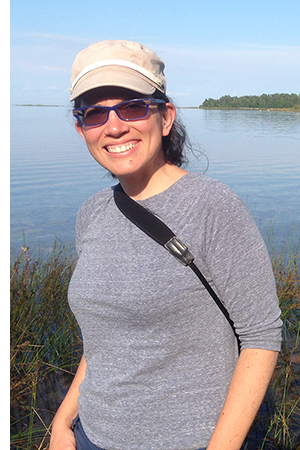
Catherine Febria trains Bkejwanong youth Kaitlyn Issac and Taylor MyersIn this 2019 photo, UWindsor researcher Catherine Febria trains Bkejwanong youth Kaitlyn Issac and Taylor Myers to conduct ecological studies on Walpole Island.

Ecological studies of Walpole Island receive funding support

With the help of UWindsor researcher Catherine Febria, the Walpole Island Land Trust has been awarded money to train students to conduct ecological studies during the ongoing pandemic.

The $95,300 grant comes from the Ontario Trillium Foundation’s Resilient Communities Fund. The fund is designed to help the non-profit sector cope with the effects of COVID-19.

The land trust — a registered charity founded by Clint Jacobs, an adjunct Indigenous scholar in UWindsor’s Faculty of Science — will use the grant to fund research like the monitoring of bird, frog, and freshwater mussel populations; taking inventory of plant species in the prairie grassland; and clearing invasive phragmites from wetlands, streams, and riverbanks.

It will set up outdoor classrooms and outfit students with protective personal equipment. It will also buy equipment it needs to create digital content to move programs online.

“We are grateful for this opportunity from the Ontario Trillium Foundation,” said Montana Riley (BSc 2017), eco-education co-ordinator at Nin.Da.Waab.Jig, the Walpole Island Heritage Centre.

“With this support, our community will rebuild and recover from the impacts of COVID-19 by co-ordinating, implementing, and amplifying efforts to deliver programs for youth, Elders, and Knowledge Keepers to steward our land and water."

Dr. Febria’s Healthy Headwaters Lab will process samples collected by the Bkejwanong Eco-keepers, the Walpole Island First Nation students conducting the surveys. With Jacobs, Febria leads field courses on Walpole Island and helped students apply for the Trillium grant, training that will help them and the territory apply for other grants in the future.

Her lab employs Indigenous scientists and includes an Indigenous Knowledge Circle run by Candy Donaldson.

“We meet regularly to ensure the community’s priorities are incorporated in everything we do,” Donaldson said. “We look for ways to bridge science and Indigenous knowledge in a good way.”

Febria said she was heartened to learn the grant application was successful.

“During the pandemic, nature has been a such a source of wellness for everyone,” Febria said. “This grant acknowledges that and will help keep youth engaged.”

Destiny Soney, a fourth-year Indigenous student studying environmental engineering who works in Febria’s lab, said working on the grant application was a valuable experience.

“It’s a good feeling to know this is something we can accomplish and perhaps keep getting funding for into the future,” she said. “It’s a real hope that we can inspire our students to pursue careers in the environmental sector or otherwise embrace stewardship and conservation.”

—Sarah Sacheli
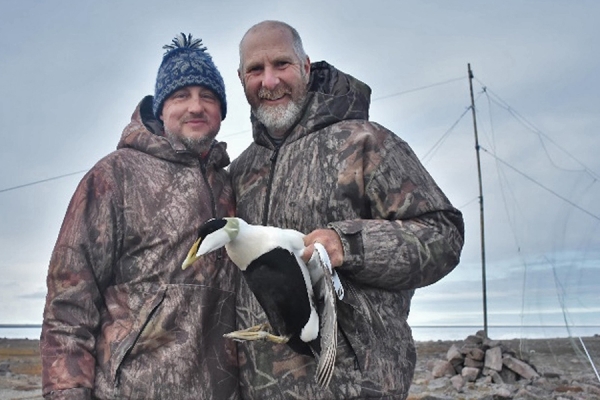
Oliver Love, Grant Gilchrist holding a seabirdUWindsor professor Oliver Love and Grant Gilchrist of Environment and Climate Change Canada are part of a team studying Arctic species of concern.

Arctic researchers helping to unlock the impacts of climate change

The way forward in tackling the diversity of issues facing wildlife in the Canadian Arctic, say University of Windsor researchers Christina Semeniuk and Oliver Love, is in strong collaboration, integration of both scientific and Indigenous approaches, and seeking community-based solutions.

Researchers from the Department of Integrative Biology and the Great Lakes Institute for Environmental Research (GLIER), the two are part of a team examining whether species of such as polar bears, seabirds, and shorebirds have the capacity to respond to rapid change in a historically stable Arctic.

The project has received a third-year renewal of a $360,000 research award for collaboration with Environment and Climate Change Canada to explore how the behavioural and physiological responses of wildlife determine whether they succeed or fail.

“Essentially, we can tackle three key questions with this type of multi-disciplinary teamwork approach,” says Dr. Love, Canada Research Chair in Integrative Ecology. “How do organisms respond to climate change? Which individual, population or species responses translate into success? Can we then predict who will be the winners and losers as the Arctic continues to change?”

Christina SemeniukAccording to Dr. Semeniuk, a predictive ecologist, the range of inputs is what really sets this work apart from past projects.
“We can use a diversity of data collected over decades to build predictive models that forecast how and why individuals, populations, and species will be affected by current and projected climate change,” she says.

The team also includes research scientists from Environment and Climate Change Canada:

  • Grant Gilchrist, an authority on Arctic seabirds;
  • Dominique Henri, a social scientist interested in Indigenous knowledge systems and northern sustainability;
  • Paul Smith; a specialist in Arctic shorebirds; and
  • Evan Richardson, an expert in polar bears.

Climate change is a complex and multifaceted challenge which requires diverse and comprehensive data and inputs to inform and enable the scientific community to come up with solutions that mitigate its impact, says K.W. Michael Siu, UWindsor vice-president, research and innovation.

“This requires extensive collaboration and teamwork, and I thank ECCC in its generous funding to Drs. Semeniuk and Love in their work,” Dr. Siu says.

Dean of science Chris Houser says building strong and sustainable partnerships with government and Indigenous communities is critical to address climate change impacts in the Arctic and throughout Canada.

“This study is an exciting and important opportunity to apply leading-edge science at the University of Windsor to wildlife management and support community-based solutions,” he says.

Semeniuk and Love hope the ongoing success of this collaboration demonstrates the importance of generating formal, long-term funding partnerships between academia, government, and northern communities so that teams can work together to study emerging issues facing at-risk Arctic wildlife.

“Investment that supports integration of the complementary approaches of these three groups is key to assessing how Arctic wildlife and the communities that depend on them can continue into the future,” says Semeniuk.

Read the complete story on the Faculty of Science website.

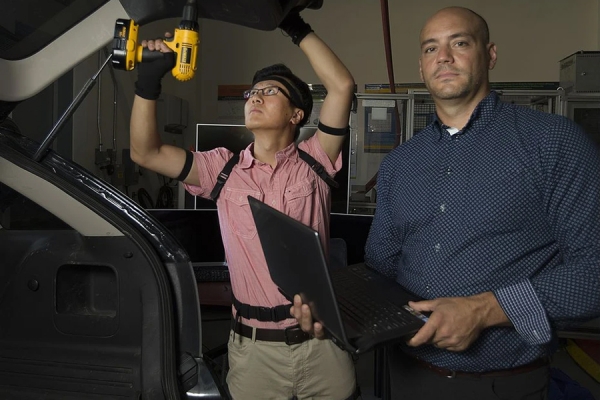
Xiaoxu Ji assembles a car, Joel Cort monitors his movementsKinesiology professor Joel Cort (right) is part of team of ergonomics researchers working to improve digital simulation tools to promote safety and efficiency in automotive assembly plants. Here, postdoctoral fellow Xiaoxu Ji straps on motion-capture sensors to record his movements.

Ergonomics project to speed simulations of auto plant operations

Ergonomics and human biomechanics researchers from the Faculty of Human Kinetics are poised to help improve workplace safety and efficiency, thanks to a new three-year Mitacs grant with additional industry funding from United States Council for Automotive Research members: Ford, General Motors, and Stellantis.

Professor Joel Cort and Masters of Kinesiology students Joe Kagumba and Jarrod Smith will be working to improve digital workstation simulation tools used in manufacturing settings. The project will focus on increasing the accuracy of digital representation of human motion and decreasing the time required to complete these simulations.

Collecting the motions of automotive assembly operators, or “industrial athletes,” as Dr. Cort calls them, will allow the researchers to develop a motion library that represents how the actual automotive assembly tasks are done. The library will also be used to develop prediction algorithms to speed up full workstation simulations in future.

These simulations advance the overarching goal of the Occupational Simulation and Ergonomics Laboratory to reduce the risk of work-related musculoskeletal disorders and improve the overall health and well-being of automotive assembly operators.

Cort noted that there are many factors in play that can contribute to these disorders, from repetitive motion to fatigue factors, over the course of a shift.

“By building a more complete library of motions for simulators, we are hoping not only to build more accurate simulations and functional workspaces, but also significantly reduce the time needed for engineers to accurately plan an assembly line,” he said.

Assembly plants can have more that 500 workstations, each representing a physical task which is repeated many times over the course of an hour. Simulations help engineers design each space to minimize risks of injury or fatigue and promote the best possible work environment. Workstations need to work for people of all sizes and abilities and take into consideration the real-world execution of tasks.

Kagumba, who will be helping with data collection and analysis for the project, became interested in the physical mechanics of movement through his passions for physics and sport.

“We want to investigate how a person’s height effects the variability of data between current digital modelling versus the reality of the plant floor,” he said. “By measuring these variances, we hope to improve the overall accuracy of current simulation technology.”

Mitacs Accelerate Grants support collaborative efforts between academic institutions and industry partners that can benefit from their expertise. Projects like this one provide real-world experience to such students as Smith, who found enthusiasm for the field of ergonomics during his undergraduate research experiences.

“Having worked as a TPT (temporary part-time) at Chrysler during the summers, I have seen first-hand how ergonomic factors can affect line workers,” he said.

Smith is grateful for the opportunity to get professional experience while helping to ensure a safe workplace for those on the line: “Our primary goal for this project is to help reduce injury in the workplace.”

Although ergonomics and human factors were not on the radar for Kagumba or Smith when they started their educational journeys, both have found it to be an engaging career path that has a lasting impact on quality of life.