
photos documenting construction progress in the Lancer CentreThe Lancer Centre is taking shape as its May 2022 opening date approaches.

Lancer Centre taking shape on south campus

The Lancer Centre is taking shape and excitement is building as the May 2022 opening date approaches. Faculty, staff, and students are anticipating the opportunities it will provide for campus life and Lancer spirit.

The new centre boasts an indoor elevated running track, triple gymnasium, expanded fitness centre, three additional multi-purpose rooms, and an eight-lane 25m accessible pool. These spaces will join existing facilities like the Dennis Fairall Fieldhouse, Forge Fitness Centre, and others to increase the University’s capacity for world-class sport and recreation activities.

Sandra Ondracka, co-ordinator of Campus Recreation, looks forward to the benefits the Lancer Centre will bring to programming and the student experience. In the past, a lack of space has limited the available programming, with varsity athletics and academic functions taking priority.

Ondracka notes that with the additional multipurpose rooms and triple gymnasium, many activities that were previously limited by lack of space can be expanded to provide further opportunities for student participation and health.

“Recreation is more than just sport and fitness. It includes several dimensions of wellness,” she says. “With our new building, we will be able to do so much more for our students, faculty, and staff.”

Accessibility and social spaces are among the priorities for the new building. Accessible entrances, changerooms, and a pool with wheelchair access are among the amenities that will create a more inclusive facility. These new features will open doors of opportunity for both campus and community and help strengthen partnerships both on and off campus.

The new social hub will bring spacious common areas and food service to the facility for the first time. These additions will provide an outlet for students from across campus to socialize and network, while providing additional amenities for varsity sports and campus events.

“The Lancer Centre will be a showcase of the Lancer spirit and will offer students more opportunity to become involved, helping to draw the north and south ends of campus together,” says Jasleen Dayal, president of the University of Windsor Students’ Alliance. “I am beyond excited about the potential of this new facility and I hope it will play a vital role in welcoming students back to campus.”

The partnership with the full-time undergraduate, graduate, and part-time student governments on the Lancer Centre project marks the largest financial student contribution to any university in Canada.

The centre is scheduled to open in May 2022. Information on the Lancer Centre, including construction photos and naming opportunities, can be found at www.uwindsor.ca/lancercentre.
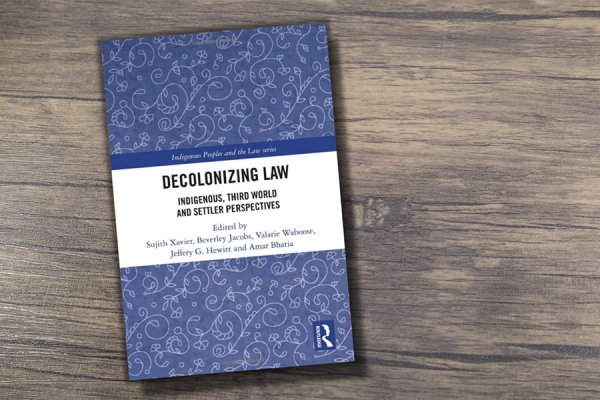
book cover of Decolonizing LawWindsor Law’s Sujith Xavier, Valarie Waboose, and Beverly Jacobs are among the editors of “Decolonizing Law: Indigenous, Third World and Settler Perspectives.”

Book examines legal decolonization

Law professors have published the first edition of a book centred around the decolonization of law from three unique perspectives. Published by Routledge, Decolonizing Law: Indigenous, Third World and Settler Perspectives studies the theory and practice of decolonizing law.

The book’s editors include Windsor Law professors Sujith Xavier, Valarie Waboose, acting dean Beverly Jacobs, and Osgoode Hall Law School professors Jeffery G. Hewitt and Amar Bhatia.

“Colonialism, imperialism, and settler colonialism continue to affect the lives of racialized communities and Indigenous Peoples around the world,” say the editors in their book description. “Law, in its many iterations, has played an active role in the dispossession and disenfranchisement of colonized peoples. Law and its various institutions are the means by which colonial, imperial, and settler colonial programs and policies continue to be reinforced and sustained.”

They suggest that law can also contribute to the dismantling of “colonial and imperial structures set up during the process of colonization.”

The book combines Indigenous, Third World, and settler perspectives to take up the effort of decolonizing law, both in practice and in theory. It does so as a means to distance, and to liberate the foundational theories of legal knowledge and academic engagement from the manifestations of colonialism, imperialism and settler colonialism.

Including contributions by scholars from the Global South and North, this book will be of interest to academics, students, and others interested in the legacy of colonial and settler law, and its transformation.

To purchase Decolonizing Law: Indigenous, Third World and Settler Perspectives, visit the publisher’s website.

keyboard buttons that read "Learn" and "Earn"Submit job proposals for the 2021-22 Ignite work study program through Wednesday, July 21.

Job proposals now open for Ignite work-study program

Job proposals for 2021-22 Ignite Work Study are being accepted through Qualtrics until Wednesday, July 21. Ignite is a co-curricular experiential learning program that funds part-time jobs at the University of Windsor. It is co-ordinated by Career Development & Experiential Learning in partnership with Student Awards and Financial Aid.

If approved for Ignite funding, supervisors will be reimbursed up to $2,000 for a two-term position or $1,000 for a one-term position. The program is open to all UWindsor students — some restrictions apply; view the Ignite website for details. Applicants whose positions receive funding will be notified by Aug. 27 and students can begin working as early as Sept. 7.

In 2020-21, 463 students were employed through the Ignite program in roles across more than 55 departments on campus. The Ignite Summer 2021 Pilot Program has added an additional 195 student hires so far, with almost two weeks to go until the July 9 hiring deadline.

“About half of the Summer Pilot Ignite students were hired into the same department or role they held as Ignite students in the fall or winter, whereas the other half accessed the program for the first time,” says Kerri Zold, manager of Career Development & Experiential Learning. “Although financial reasons and the opportunity to enhance their resume are the two most-often cited motivators for participating in Ignite, we also gathered from our feedback survey that 80 per cent of respondents feel that Ignite enhanced their academic learning in the classroom.

“We look forward to continuing to support such a wide variety of paid experiential learning opportunities right here on campus.”

Ignite is offering Employer Information Sessions July 7 and 15 and introducing drop-in sessions on July 9 and 16 from 11 a.m. to 1 p.m. Supervisors are welcome to attend any session, but there are no major changes or updates planned for this year’s program, so those who participated in the past may find the drop-in hours more beneficial, whereas those thinking about participating for the first time would get more out of an information session.

Direct questions to program co-ordinator Avy Maharaj any time at ignite@uwindsor.ca.

UWindsor flag at half-staffUWindsor flags will remain lowered for the next several weeks in recognition of the intergenerational effects of residential schools.

University issues statement regarding Marieval Indian Residential School

In honour of those who have lost their lives and those who have endured, witnessed, and felt the immense pain of the intergenerational effects of residential schools, UWindsor flags will remain lowered for the next several weeks, president Robert Gordon announced in a statement Friday.

“This week we learned about 751 unmarked graves of Indigenous children and adults found by the Cowessess First Nation at the site of the former Marieval Indian Residential School in Saskatchewan,” he wrote. “We recognize that trauma is compounded by these discoveries and that it not only reverberates throughout Indigenous communities across Canada but also impacts many of our colleagues and students on campus and in the surrounding community.”

He encouraged students needing support to contact the Student Counselling Centre at scc@uwindsor.ca to book an appointment, or access free confidential counselling by licensed counsellors via talk or text through the My Student Support program, 1-844-451-9700 or www.uwindsor.ca/MySSP.

Faculty and staff can access confidential support through the Employee and Family Assistance Program, which offers professional and confidential counselling and information services. The National Indian Residential School Crisis Line is also available at 1-866 925-4419.

Read the entire statement here.