vapor surrounding vape pen deviceResearch by professor Drew Marquardt aims to pinpoint which ingredients in vapes and e-cigarettes contribute to lung illness in users.

Researcher investigates safety of vaping ingredients

UWindsor professor Drew Marquardt says his research will help pinpoint which ingredients found in vapes and e-cigarettes are contributing to severe lung illness in users.

His project “Vaping-Associated Lung Injury: Insight into Mechanisms of Action” received $15,000 as part of the Breathing as One Young Investigators Research Award, a Canadian Lung Association program led by the Lung Health Foundation.

Drew Marquardt“Lung injury from vaping was established as an epidemic mere months before the COVID pandemic struck and since then has largely flown under the radar,” says Dr. Marquardt, assistant professor in the Department of Chemistry and Biochemistry, cross-appointed to the Department of Physics.

“Yet there’s been a surge in young people aged 18 to 30 who are vaping and a large number of them are getting sick, so we are interested in how ingredients like Vitamin E acetate interact with the lungs, contributing to this dangerous alveolar, or lung, injury.”

Marquardt (pictured at left) and his team are investigating how Vitamin E acetate and other ingredients induce e-cigarette or vaping use-associated lung injury (EVALI), by changing the way the lungs work on a mechanical and molecular level.

“Vitamin E acetate is likely not the sole culprit of the severe respiratory dysfunction seen in EVALI so we are also looking at propylene glycol, glycerin, and flavourings — ingredients touted to be safe when ingested but which produce potentially problematic by-products when heated to 190-230°C inside electronic vaping devices,” he says.

“By investigating at the molecular level, we are looking at the problem through a lens that few others would.”

The team will focus primarily on the pulmonary surfactant. The single lipid molecule thick layer is found on all on human lungs and allows them to expand and compress. However, any disruption can cause the aveoli to collapse.

By taking models and extracts of this layer and looking at how its physical properties, compressibility, and bending change, the researchers can look at how the basic structure changes.

The project is a collaboration with the Canadian Centre for Alternatives to Animal Methods (CCAAM), which will provide a 3D-printed model of human lung tissue for Marquardt to study, instead of needing patients or animals.

“CCAAM researchers can create what they dub an Alveoli-in-a-Dish: a novel, 3D-bioprinted human alveolar tissue model suitable for respiratory disease research designed to unravel molecular and cellular mechanisms underpinning lung disease, and acute inhalation toxicity testing – lung injury mediated by exposure to chemicals in consumer products,” says Marquardt.

“This allows us to assess human alveolar function and toxicity, and the 3D model replaces the need for animals in inhalation toxicity testing.”

—Sara Elliott

Marium Tolson-MurttyMarium Tolson-Murtty, anti-Black racism strategic planning officer and a UWindsor grad herself, is reaching out to Black alumni.

Perspectives of Black alumni sought for roundtable discussions

The Office of the Vice-President Equity, Diversity & Inclusion at the University of Windsor is reaching out to Black alumni in an effort to help the University establish — and in many cases rebuild — its relationships with them.

“As part of the University’s ongoing and rigorous strategic planning effort toward dismantling Anti-Black Racism, voices of alumni are essential,” says Marium Tolson-Murtty (BA 1996, B.Ed 2003, M.Ed 2008), anti-Black racism strategic planning officer.

“Since June 2020, the University has undertaken several initiatives, as part of a broader strategy, to address anti-Black racism.”

She says the University is extending an invitation to all Black alumni to participate in roundtable discussions to share stories and perspectives with each other. This initial meeting is intended as a first step in helping to inform and shape future, more extensive engagement initiatives.

“Not all of the experiences of our Black alumni have been negative. However, one negative experience is too many,” Tolson-Murtty says. “Good or bad, we need to acknowledge that there has been a disconnect once students leave campus, and the University of Windsor needs to remedy that.”

Alumna Yvette Blackburn (BA 1993, 2004, B.Ed 2005) says the consultation process is a step in the right direction in gathering Black student body voices of the past and galvanizing them into a collective.

“Bringing our experiences, insight, knowledge, and progressive mindsets, we collectively can impact and affect change that makes the future truly inclusive and allows our voices to be heard and taken seriously,” she says. “I encourage every Black alumnus to participate and add to the conversation. No matter how minuscule you deem your time on campus, you play an integral role.”

The consultation sessions will be conducted remotely via Microsoft Teams. Participants are requested to register by visiting uwindsor.ca/antiblackracism/blackalumni by Aug. 20. Read more.

young woman making presentationThe public is invited to online events Thursday, Aug. 19, marking the culmination of the 2021 RBC EPIC Founders Program.

Events to mark culmination of business accelerator program

Events on Thursday, Aug. 19, will mark the culmination of the 12-week RBC EPIC Founders Program startup accelerator, which provides training and mentorship to students and recent graduates who want to turn their ideas into businesses.

This year’s cohort features seven startups:

  • Entwine – Dharmik Paramkusham
  • Film Club – Harley Gills
  • Mantra Farms – Vikas Varma Datta
  • Snow Peak Cold Brew – Penny Cardelli and Leo Cardelli
  • Tenlo – Muhammad Sohail, Ali Naqvi, and Bial Sohail
  • Uni-Maps – Eric Lu, Edmund Lui, Jimmy Wang, and Michelle Muliana
  • Verellen Music Academy – Jacqueline Verellen

They will demonstrate their products or services during the public online Networking and Demo Day, from 11 to 11:45 a.m. Register to attend.

The founders will then pitch their business ideas to a panel of judges and a live audience for a chance to win a $3,500 cash prize during the Final Pitch Competition, from 4 to 6 p.m. Register to attend.

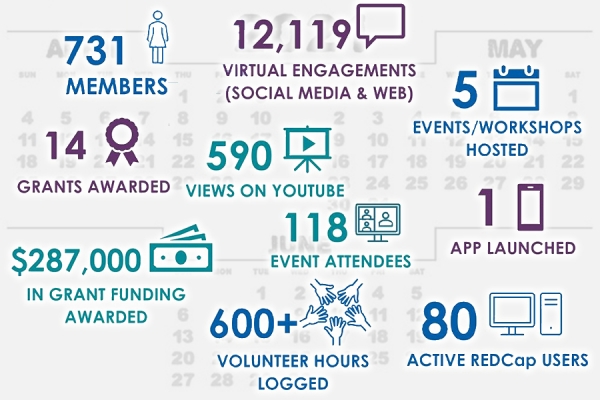
graphic listing achievements of WE-Spark in Q1 2021-22WE-Spark Health Institute has released its quarterly report detailing achievements along key metrics from May to July 2021.

Report details quarterly successes of WE-Spark Health Institute

WE-Spark Health Institute has released its quarterly report detailing achievements along key metrics from May to July 2021.

Highlights include:

  • increased membership by 54 new members for a total of 731;
  • awarded 14 grants totaling $287,000;
  • launched a network with 20 active volunteers logging 600+ hours;
  • expanded its health resource hub to include transgender and gender diverse, and mental health resources;
  • piloted an app for researchers to connect using a mobile device;
  • hosted five events, including Think Tanks and Knowledge Translation workshops; and
  • created a medical research associate position formalizing how Schulich School of Medicine and Dentistry – Windsor Campus medical students integrate with the local research community.

WE-Spark Health Institute is supported by the University of Windsor, Hôtel-Dieu Grace Healthcare, Windsor Regional Hospital, and St. Clair College. Read the report on the institute’s website.

prints of hands surrounding heartHuman Resources offers suggestions on how to support others going through challenging times.

Wellness tip offers ways to support others

Self-care is a vital part of a healthy lifestyle, but it’s not the only type of care a person needs, advises Human Resources in a message sent Monday to UWindsor faculty and staff.

Giving time and energy to others can be just as nourishing as taking care of ourselves. The Wellness Tip of the Week suggests ways to support others when they are going through challenging times:

  • Offer to help in practical ways. Make a meal and bring it to their home; pick up groceries or run other errands; take their dog for a walk.
  • Create a safe environment. Be present by answering their calls and texts; listen without offering advice or trying to fix things; keep things shared with you in confidence; be their friend and not their therapist.
  • Demonstrate that you care. Ask what you could do to help and then follow through; when together, focus on them and not your phone; be patient and avoid hurrying them through a conversation; offer to do something fun together like have coffee, see a movie, or go for a walk.

Read the entire Wellness Tip of the Week.