
finger holding micro sensorEngineering professor Jalal Ahamed holds a sensor on his fingertip with a magnified image in the background of a high-density sensor array similar to what will be imbedded in insoles to measure gait.

Walk this way: UWindsor researchers developing prototype of diagnostic insole

Insoles embedded with tiny sensors may soon diagnose problems with the way you walk.

A team of UWindsor researchers is taking the first steps toward bringing this invention to market. Armed with provisional patents and a difficult-to-obtain, research and development grant from the Natural Sciences and Engineering Research Council of Canada (NSERC), members hope to have a prototype ready for commercialization by this time next year.

“This is a unique project,” said Jalal Ahamed, a professor of mechanical, automotive, and materials engineering who brings his expertise in micro-scale sensors to the project. Other principal researchers are materials chemists Tricia Carmichael, who specializes in wearable electronics, and Simon Rondeau-Gagné, who has invented the flexible, self-healing polymer in which the sensors will be embedded.

“We are bringing together all these disciplines, which is what makes this project unique,” Dr. Ahamed said.

Assessing gait is something usually accomplished through an expensive, stationary device. Existing wearable insoles suffer from problems with flexibility, accuracy, and sensitivity.

Using an ultra-flexible, self-healing polymer will make the team’s insoles durable and allow the array of sensors to conform to the feet, offering three-dimensional mapping of gait. Ahamed said the insoles will also be Bluetooth capable, so they can send data wirelessly for interpretation or analysis.

The device will also be cheaper to manufacture than other sensing devices currently on the market, Dr. Rondeau-Gagné explained.

“These can be mass produced, requiring no specialized equipment or a special environment,” he said. “This is a versatile platform that can be applied to many other fields.”

The platform used for the sensor array can be adapted in the future for other wearables with health and fitness applications, said Dr. Carmichael.

NSERC has awarded the team a $125,000 grant through a funding program called I2I, short for Idea to Innovation. The objective of the national program is to accelerate the development of technology with potential for transfer to a new or established Canadian company. The grant requires applicants to conduct market analysis and gather letters of support from potential industry partners.

“The I2I program has a very rigorous set of criteria for success that evaluates technologies developed at university for transfer to Canadian industry”, said K.W. Michael Siu, UWindsor’s vice-president, research and innovation.

“On behalf of the University, I would like to thank NSERC for funding this highly innovative project and team. This I2I funding is a testament not only to the commercial potential of this initiative, but also to the outstanding strengths of the researchers involved.”

—Sarah Sacheli
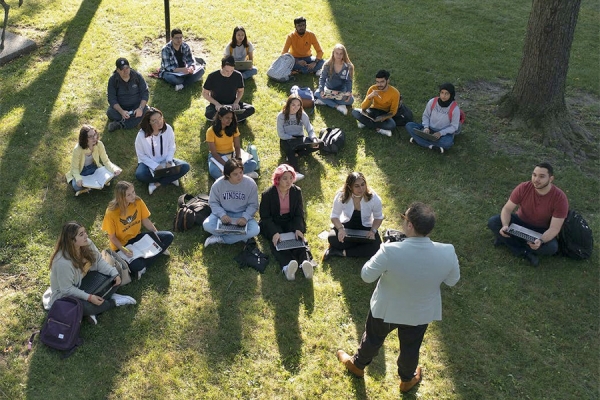
students sit in a circleA survey seeks feedback on a proposed approach to the University’s strategic planning process.

Feedback sought on proposed University strategic planning process

What can the University of Windsor do to enhance student success, engagement, and experience? What is our impact as an institution and how do we demonstrate that? What do we need to understand better so that our work and learning spaces and the relationships we build in them operate from a foundation of care, respect, and compassion?

These questions and more are some of the starting points outlined in a position paper proposing the University’s upcoming Strategic Planning process.

“We are aiming for an inclusive, transparent, and highly consultative process, and so we are asking the campus community to provide their feedback about how we are planning to proceed before we get started,” says UWindsor president Rob Gordon.

The draft position paper is accompanied by a slide-deck summary and a survey seeking feedback from the campus community. 

The position paper includes:

  • A summary of preliminary input about key values, contextual factors, and goals of the process;
  • A proposed set of guiding principles to shape the collective effort;
  • Information about the type of strategic plan proposed to collectively develop, and how it will be implemented;
  • Thoughts about engagement and consultation strategies;
  • Planned process stages and timelines.

The University has contracted with digital engagement platform Bang the Table, which offers a complete suite of listening, information, analysis, reporting and relationship management features to help people engage easily no matter where they are.

It has been used by more than 800 organizations around the world, empowering over 10 million people with online tools to participate and inform key decision making. The plan is to combine the use of these online tools with many other opportunities for real-time discussions and consultations. 

“Given the uncertainty about health guidelines that may be in place, we wanted to make sure that we could offer a range of ways to engage,” says Renée Trombley, executive director of Public Affairs and Communications. “Bang the Table has become a key tool that municipalities and public institutions across Canada have adopted to connect with their communities.”

Bang the Table ensures data confidentiality and storage within Canada and is GDPR compliant. Read more about its Privacy Policy and Data and Information Security.

The survey is open until Oct. 28 and will inform revisions to the plan, which will be released in its final form on Nov. 3. Find the draft process documents and the survey on the Engage UWindsor website, Aspire: Together for Tomorrow. Registration for the site is not required to view these documents and participate in the survey.

screen grab from a virtual labVirtual labs will give students hands-on opportunities to explore the bioinformatic-based analysis of structural biology.

Faculty member developing resource to provide hands-on experiences in bioinformatics

A seemingly endless stream of big data is pouring out of biological and life sciences research at a rate much faster than it can be analyzed. A UWindsor faculty member is developing a resource to help students take on bioinformatic careers in a field where demand for expertise outweighs the supply.

Zareen Amtul, who teaches core courses in the Department of Chemistry and Biochemistry’s Master of Medical Biotechnology (MMB) program, is developing a virtual laboratory module for research-driven bioinformatics exercise tutorials and tools. With graduate student and postgraduate partners, Dr. Amtul will share the module as an Open Educational Resource (OER) for others to use or adapt for their purposes.

The omnipresence of data is creating ample career opportunities in bioinformatics across multiple industries, she notes. Even academia is seeing an exponential uptick in bioinformatic career prospects, as the discipline itself is intensifying.

“MMB students don’t have a bridging opportunity available to narrow the gap between their biotechnological skillset and training for the inflated-in-demand bioinformatic data analysis work,” says Amtul.

She has secured an eCampus Ontario Virtual Learning Strategy (VLS) grant of $37,638 to create a set of bioinformatic activities to be incorporated into his capstone course on protein structure and function.

“These bioinformatic materials will be free and shared through the eCampusOntario Open Library,” says Mark Lubrick, a learning specialist in the Office of Open Learning who is working with Amtul.

“The rationale is to serve as a stimulus to students’ interest in science, technology, engineering and mathematics careers, to get them familiarized with scientific professions in data science and the academic training required to pursue them, and notably to increase their competencies to be able to take on the bioinformatic careers.”

Lubrick says open resources are likely to be better options than biochemistry textbooks that cannot keep pace with the rapidly exploding bioinformatics developments or data science.

“They will better prepare our students in undertaking bioinformatic scientific investigations or jobs and allow them to seize opportunities to become an effective part of the bioinformatic workforce,” he says.

More information about the VLS projects is available on the OOL website or by contacting openlearning@uwindsor.ca.

graphic indicating basketballLancer women’s basketball will host the Laurentian Voyageurs for exhibition games Friday and Saturday.

Soccer only conference action at home this weekend

A home-and-away series between Lancer soccer and the Laurier Golden Hawks represents the only varsity action at home this weekend that will count in conference standings.

Alumni Field will host a women’s contest at 5 p.m. and men at 7:15 p.m. on Friday, Oct. 22. These games will be webcast on OUA.tv. Both squads will then head to Waterloo to play Sunday, Oct. 24: women at 2 p.m. and men at 4:15 p.m.

Fans over 12 years of age must be fully vaccinated to attend Lancer home events. Find details of the COVID protocols on the ticket purchase page.

Football will travel to Waterloo to take on the Laurier Golden Hawks on Saturday, Oct. 23. Kick-off is at 2 p.m. Watch live on OUA.tv.

Women’s basketball will host the Laurentian Voyageurs for a pair of pre-season games in the Dennis Fairall Fieldhouse: at 6 p.m. Friday, Oct. 22, and 4 p.m. Saturday, Oct. 23.

Cross-country athletes will run in the Marauder Bay Open, Friday in Hamilton.

Women’s hockey will play a couple of pre-season exhibition games: Friday, Oct. 22, against the London Devilettes at the Capri Pizzeria Recreation Centre at 8:30 p.m. and Sunday, Oct. 24 against the Western Mustangs in London at 3 p.m.

Men’s hockey will play a pair of exhibitions against the Brock Badgers, 3 p.m. Saturday, Oct. 22, in Port Colbourne and 2 p.m. Sunday, Oct. 24 in St. Catharines.

Men’s volleyball in Toronto to play pre-season exhibitions against the Varsity Blues at 7 p.m. Friday, Oct. 22, and the Ryerson Rams at 3 p.m. Saturday, Oct. 23.

Nawal MustafaIn a recent article published in The Conversation, doctoral candidate Nawal Mustafa stresses the importance of culturally sound therapy for South Asian communities.

Doctoral candidate writes about mental health challenges in South Asian communities

A silent mental health crisis exacerbated by stigmatization exists in South Asian communities, writes UWindsor doctoral student Nawal Mustafa in a recent article published in The Conversation.

“Many studies have shown that South Asian immigrants in Canada, the United States, and the United Kingdom experience high rates of mental health disorders, sometimes higher than their peers,” Mustafa writes. Reasons may include intergenerational conflict or the stress of adapting to western society.

To address this, mental health professionals need to practise “culturally sound therapy,” Mustafa says.

“Mental health professionals must actively make an effort in understanding their client’s cultural background and belief system through continued education and consultation with colleagues from a similar cultural background.”

Mustafa is a PhD candidate in clinical neuropsychology whose research involves adapting cognitive assessment methods to people who speak Urdu or Hindi. She is also the Instagram phenom @Braincoach, passing on her science-based knowledge and helpful tips about how to improve mental health to her 648,000 followers.

Having moved to Canada from Pakistan when she was 12, Mustafa understands the cultural challenges faced by South Asian immigrants.

“Children of South Asian immigrants may face challenges associated with the pressure of straddling two different worlds,” she writes in her article. “While trying to fit into a western society that prides itself on individual expression, they may find themselves navigating a culture at home where personal boundaries are blurred, and self-identity is determined by the validation of their family and community.”

—Sarah Sacheli

man working on smart phoneIT Services provides helpful tips on keeping your mobile device secure.

Tips intended to protect your smart devices

Over 88 per cent of Canadians access the internet with a mobile device, according to Statista, a leading market and consumer data provider. With the ever-increasing dependence on portable devices to do tasks such as online banking or accessing work files, valuable information is being put at risk of cybersecurity threats.

“Smart cybersecurity practices are just as important for your phone and tablet as they are for your computer,” says Kevin Macnaughton, team leader security in Information Technology Services. “While it may only be for personal or recreational use, it should still be protected.”

IT Services’ list of top five ways to protect your mobile devices includes:

  1. Enable the security Personal Identification Number (PIN) to unlock your phone and keep it private.
  2. Set the device to auto-lock when inactive.
  3. Allow automatic updates for the operating system and apps.
  4. Only use the App Store and iTunes or Google Play for apps, games, and media.
  5. Use the University’s GlobalProtect VPN when accessing public or free Wi-Fi.

For more mobile device security best practices, see the webpage.

To highlight the global cybersecurity efforts, have a look at the European Cybersecurity Month campaign.

Led by IT Services, Cybersecurity Awareness Month efforts highlight cybersecurity issues relevant to the UWindsor community. More information can be found at uwindsor.ca/cybersecurity.

students looking at computer screenQuestions about transcripts and enrolment verification are among this week’s most-referenced Knowledge Base Articles.

Paperwork questions top-of-mind for students

Campus partners are working to maintain a robust set of Knowledge Base Articles (KBAs).

The team will continue to compile a weekly digest of the most-referenced KBAs to streamline student-focused questions to ask.UWindsor to support consistent communication with current and future students.

These are this week’s top-five referenced KBAs:

You can submit common questions or make suggestions to the KBA team at askkba@uwindsor.ca.