
students in the rain forestUWindsor students enjoy a study-abroad field course in Costa Rica in May 2022.

Study-abroad courses offer unique learning opportunities in Costa Rica and Iceland

After two years of delays and cancelled trips, students from the faculties of science and arts, humanities, and social science are once again able to study abroad in Costa Rica and Iceland this summer.

These for-credit experiences are supported through the Universities Canada Global Mobility funding for the Go Global STEPS and iWill Go Global programs, in addition to generous support from donors to the School of the Environment.

In the rainforests of Costa Rica, 35 students are conducting measurements of the water budget in a small, instrumented watershed within the Children’s Eternal Rainforest. The course, led by dean of science Chris Houser, gives students hands-on field-based learning. Participants are also supporting a nearby community through service work to maintain vital waterlines from source areas in the rainforest and provide field-based training to Costa Rican high school students on hydrological monitoring.

While in Costa Rica, the students will also visit a field site of Dan Mennill and Stéphanie Doucet from the Department of Integrative Biology. Working in Earth’s most imperiled ecosystem, the tropical dry forest, the students will contrast mature forests and those that are newly protected, studying the animals and plants in each.

“The opportunity to learn career-relevant field techniques and participate in cutting-edge research is transformative for the students participating on this trip,” says Dr. Houser.

In Iceland, Maria Cioppa and Ali Polat from the School of the Environment are introducing 11 students to the island’s geological wonders. This year they will visit the newest volcanic eruption site, Fagradalsfjall, in addition to assessing the impact of climate change on the country’s glaciers.

“Visiting Iceland allows us to introduce students to the tectonic processes that have resulted in the Earth as it is today — as well as the anthropogenic forces that are altering it,” Dr. Cioppa says.

The funding from Universities Canada will help support an increase in the number and diversity of study-abroad programs over the next four years.

“There was so much demand for study abroad this year that we decided to maximize enrolment in both trips and offer two separate trips to Costa Rica,” Houser says.

To support the expansion of international study opportunities for students, Houser has instituted a shadow program to train other faculty in running study-abroad trips. This year, Chantal Vallée is shadowing Houser in Costa Rica and meetings with the Federation de Baloncesto and other academic institutions in San Jose. He invites faculty interested in participating in the shadow program next year to contact him.

Follow the adventures of the Costa Rica and Iceland trips through the Twitter feeds of the Faculty of Science (@scienceuwindsor), the School of the Environment (@eeswindsor), and Houser (@houserchrisa1).

Tony VoHis Vietnamese heritage has assisted him in supporting UWindsor students, says Tony Vo, student experience co-ordinator in the Faculty of Arts, Humanities, and Social Sciences.

Student experience co-ordinator passes on lessons from Vietnamese culture

Asian Heritage Month is an opportunity to reflect on his own experiences, says Tony Vo, student experience co-ordinator in the Faculty of Arts, Humanities, and Social Sciences. He was born in Vietnam and came to Canada in 1999 at the age of three.

“Growing up, I’ve always had a connection with my Asian heritage and I’m proud of it because it has made me who I am today,” Vo says. “I thoroughly enjoy being with my family during Lunar New Year. It’s a time for celebrations, gatherings, and happiness, a day to celebrate the new year and to forget about the past.”

He fondly recalls eating che troi nuoc (sweet rice balls in sweet soup) and wishing his grandparents and relatives blessings to receive a red envelope filled with money.

“The Vietnamese culture, beliefs, and social values that I was taught while growing up have been engraved within me, especially understanding the great value of a university education,” says Vo. “I was extremely happy to see that these values are being highlighted through recent media, such as the films Shang-Chi and Turning Red.”

He says that his heritage has influenced his work in supporting students.

“My parents taught me the value of being an independent learner, but also to believe in myself and my abilities — that’s something that I’ve passed onto the students I’ve worked with,” Vo says.

This article is the first in a series featuring voices from members of the UWindsor community in celebration of Asian Heritage Month. The 2022 theme “Continuing a legacy of greatness” is a reminder for all Canadians to come together to combat anti-Asian racism and discrimination in all its forms.

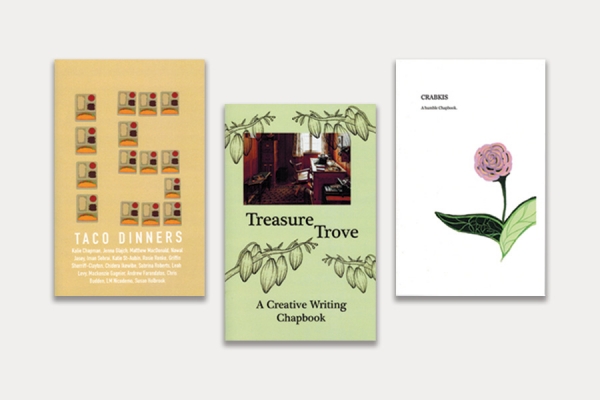
chapbook coversChapbooks collecting works by creative writing students mark the end of the school year.

Publications mark year of creative writing

Students of creative writing produced four chapbooks collecting samples of their work, culminating in a gala celebration April 27 featuring recordings of readings by the contributors.

The four main classes in the creative writing program are workshop-oriented and hands-on, explains professor Louis Cabri.

“Students develop peer-reviewing skills on each other’s work, verbally and in writing,” he says. “They undertake writing assignments — challenging, and also unusually fun ones included. Students read a lot, too, published work selected by instructors not for how well it sold or even for its literary or social standing so much as for how it exemplifies what writing can be and do.”

Students in his two-term course “Creative Writing I” produced the writing for an 81-page digital anthology, The Trip. It presents the results of group projects assigned to bring students together.

“The course was fully delivered online, but they got to experience each other working with words, through these collaborations,” says Dr. Cabri.

Read The Trip here.

Other classes published chapbooks in print:

  • Taco Dinners by “Creative Writing II,” instructor Susan Holbrook, with cover art by Chidera Ikewibe;
  • Treasure Trove by “Creative Writing III,” instructor Nicole Markotić, with cover design by Miranda Janisse; and
  • Crabkis by the two-term graduate creative writing class, instructor Dr. Holbrook, with cover design by Kyla Chandler.

These beautifully designed chapbooks are available through the Department of English and Creative Writing; email Elizaveta Gorshkova at Elizaveta.Gorshkova@uwindsor.ca.

The Gala Celebration of Creative Writing is available for viewing on YouTube. View it here:

book cover: “Every Cyclist’s Guide to Canadian Law.”Windsor Law professor Chris Waters has published a second edition of the book, “Every Cyclist’s Guide to Canadian Law.”

Prof’s book a guide to law on bicycling

More Canadians are riding bicycles than ever before, but misinformation about cycling and the law is common, says Chris Waters.

The law professor has published the second edition of the book,Every Cyclist’s Guide to Canadian Law. In it, he discusses the rules of the road, purchasing and using bikes, what to do in the case of a crash or a stolen bike, starting up a cycling club, racing a bike, and more.

Written for those with little or no legal background, the book is also an authoritative reference for lawyers, advocates, club directors, and coaches. The first edition was written by University of Ottawa law profs Craig Forcese and the late Nicole LaViolette.

Dr. Waters draws on anecdotes and examples from his own experience as a seasoned commuter and recreational cyclist to illustrate explanations free of jargon. He will donate all author royalties to the  Share the Road Cycling Coalition.

Alexandra Flynn of the University of British Columbia School of Law praises the book as “accessible and funny,” adding it “brings alive the legislation and legal cases that those on wheels engage with … making it an ideal resource for all.”

Learn more on the publisher’s website.

old-timey film cameraThe Rose City Film Award promises cash and in-kind prizes to help beginning filmmakers.

Competition offers prizes for emerging filmmakers

A student film competition will judge entries on their emotional appeal as well as technical merits.

The Rose City Film Award promises cash and in-kind prizes to help beginning filmmakers. The competition is open to students 18 years of age or older attending school in Windsor-Essex, Chatham Kent, Sarnia-Lambton, or London-Middlesex.

It is sponsored by Gear House Windsor and Canadian Arts Productions in partnership with the Windsor Endowment for the Arts.

The deadline to enter is Sunday, Aug. 28. Find more details on submissions, eligibility, prizes, and judging criteria on the contest website.