
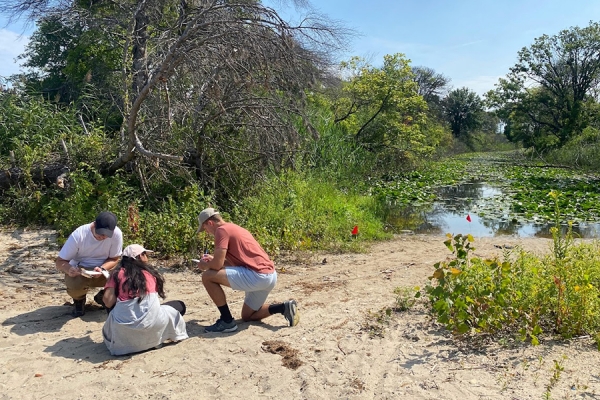
students crouch on sand by beachStudents Brian Kountourogiannis, Rucha Patel, and Ryan Gilham set up transects to collect samples on Peche Island.

Participatory science project to engage community in monitoring Great Lakes

A new project led by researchers at the University of Windsor will combine their data with that gathered by community members to protect the waters of the Great Lakes.

Led by the Real-time Aquatic Ecosystem Observation Network (RAEON), “Bridging Knowledge Gaps between Scientific Data and Citizen Science” will engage individuals and communities in collecting information to supplement research activities.

Starting in May, RAEON will lead bi-weekly community science events where volunteers will collect baseline water quality data and learn about the factors that influence the health and ecological integrity of their local watersheds.

The goal is to build knowledge that leads to actionable steps to protect Canadian resources while engaging people in stewardship of the Great Lakes, says Katelynn Johnson, project co-lead and research and operations director for RAEON and learning specialist in the UWindsor School of the Environment.

“The benefits of having individuals participate in the science is twofold: first, their input will help expand and supplement data collection,” she says. “But perhaps even more important, participants will learn more about the scientific process and the challenges facing the environment in which they live.”

Data collected by individuals will supplement traditional scientific methods to help inform decision-making processes, develop and refine management plans, and address research needs related to Great Lakes water quality and ecosystem health. This integrated approach ensures that decision-makers have access to comprehensive and diverse datasets, enabling them to formulate evidence-based policies and management strategies, Johnson says.

The data will contribute to research publications and conference presentations, adaptive and holistic management plans, and environmental policies, while developing a better informed and engaged society involved in the stewardship of their environment.

A group of people working on a table

AI-generated content may be incorrect.

Environmental studies undergraduates sort and classify specimens from the Detroit River.

The project team is collaborating with institutions across the Great Lakes region to extend its reach and facilitate participation from diverse communities. The team will engage municipal, provincial, and federal government scientists, managers and ministers, nonprofit agencies, and underrepresented groups, such as nontraditional fishers.

A key part of this effort will be led by the community science liaison, who will engage a variety of groups, including K-12 schools, universities, and colleges; water utility and wastewater industry personnel; professional associations; municipal, provincial and federal authorities; non-governmental organizations; recreational water users; and bi-national partners.

Besides Johnson, the project team leads include Aaron Fisk, co-lead, science director of RAEON, professor in the School of the Environment, and Tier 1 Canada Research Chair in Changing Great Lakes Ecosystems; and RAEON community science liaison Edward Millar.

The project will be funded by a $540,000 grant from the Canadian Water Agency in addition to $672,667 in-kind funding, for a total of $1,212,667.

smiling officials holding sparklersCelebrating their renewed partnership in the WE-Spark Health Institute are Michael Silvaggi of St. Clair College, Andrea Steen of Hôtel-Dieu Grace Healthcare, UWindsor president Rob Gordon, Kristin Kennedy of Erie Shores HealthCare, and Karen Riddell of Windsor Regional Hospital.

Partners renew commitment to health research in Windsor-Essex

Local health and academic leaders have pledged another five years to sparking innovation and advancing critical research.

Representatives of the University of Windsor, Erie Shores HealthCare, Hôtel-Dieu Grace Healthcare, St. Clair College, and Windsor Regional Hospital signed a five-year memorandum of understanding Monday at Ambassador Golf Club reaffirming their partnership in the WE-Spark Health Institute.

“This renewal underscores the power of partnership and our unwavering commitment to advancing health research that has meaningful impact,” said Dora Cavallo-Medved, interim director of WE-Spark Health Institute. “Together, we’re building a strong, collaborative research ecosystem that supports discovery, improves care and transforms lives in our region and beyond.”

Following the signing, the group posed for a photo holding sparklers, symbolizing their efforts to light the way toward a healthier Windsor-Essex and celebrating all that has been achieved and all that’s yet to come.

After more than a decade of planning, WE-Spark officially launched in March 2020 and has since made its mark on the local research landscape — accelerating projects, fostering collaboration, providing funding opportunities and helping build a critical mass of health researchers, among other achievements.

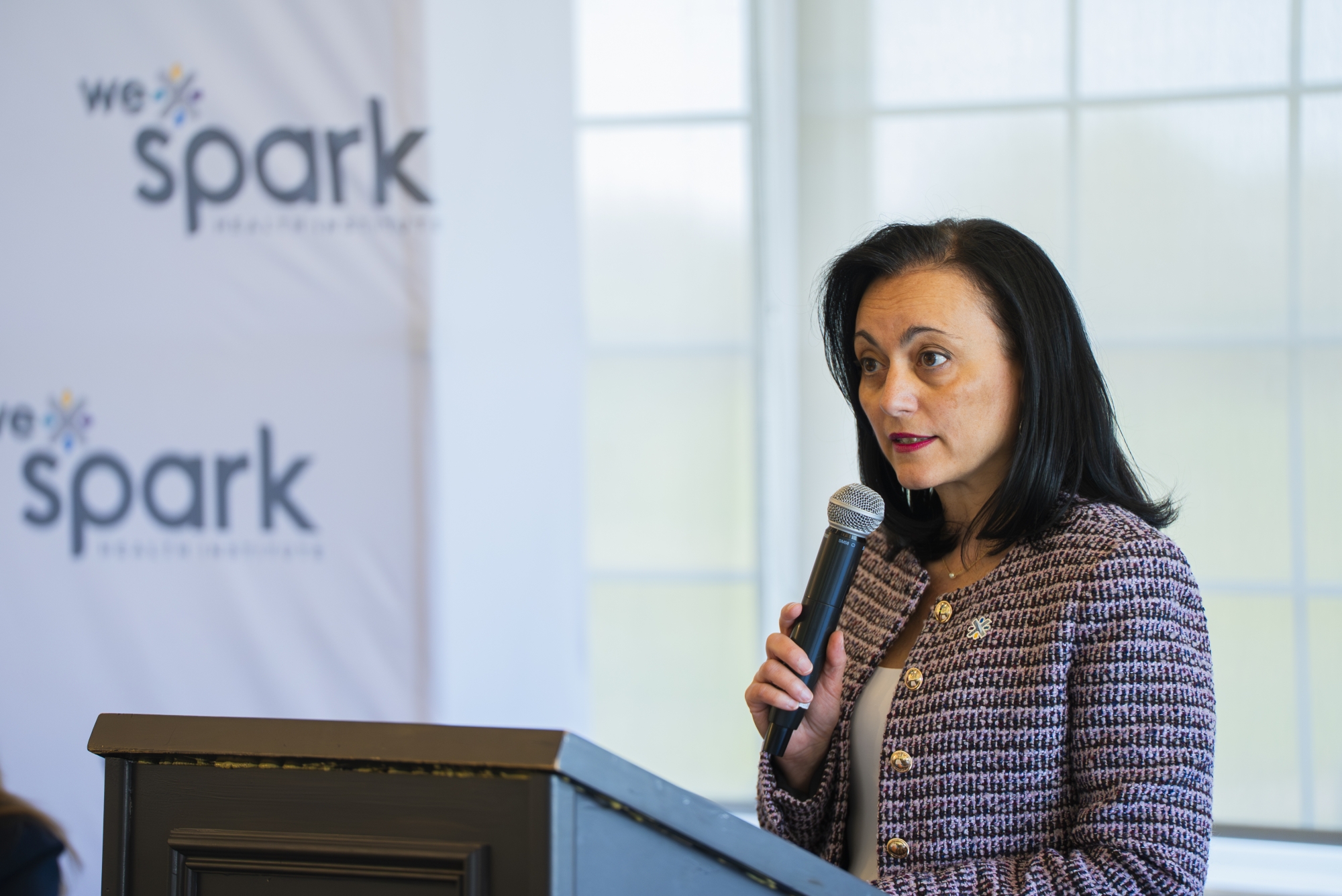
Dora Cavallo-MedvedDr. Dora Cavallo-Medved, interim director of WE-Spark Health Institute, speaks at a signing ceremony celebrating the renewal of a five-year partnership among Windsor-Essex health and academic institutions. (Photo by UWindsor)

Reflecting on the last five years, Dr. Cavallo-Medved said she’s proud of the work the group has done to come together with a shared vision for health research in the region.

“We’re already starting to see an increase in our capacity and strength to conduct health research. That includes local, provincial, national, and international funding coming to Windsor-Essex for all five partner institutions working together. We’re also building shared resources that we now, as a collective, have access to in support of the health research we’re doing,” she said.

Karen Riddell, acting president and CEO of Windsor Regional Hospital, said WE-Spark is working together to transform ideas into real-world solutions that directly benefit patient care.

“Through WE-Spark, our clinicians and researchers work side by side with partners from across the academic and health-care spectrum, sharing knowledge, resources and a common goal to improve health outcomes for our community,” she said.

“This important work strengthens our ability to attract top talent to our region, secure research funding and ultimately deliver higher quality, more personalized care to our community.”

Since launching, the institute has supported 1,685 active research collaborations and awarded 85 local seed and bridge grants totalling more than $1.4 million. It has also leveraged an additional $4.8 million in national and international funding and secured nearly $78 million in external research funding for the Windsor-Essex region.

WE-Spark has also made an impact through education and training, engaging more than 2,068 students in research, mentorship, and professional development opportunities.

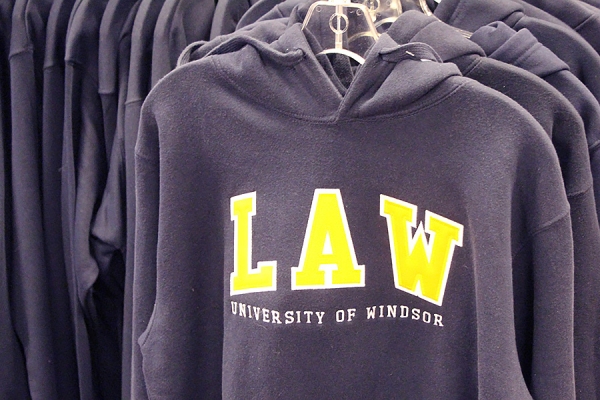
hooded sweatshirt embroidered LawLaw students can buy a discounted hoodie Thursday in the Campus Bookstore.

Thursday savings in store for law students

The Campus Bookstore is offering savings to students in the Faculty of Law on Thursday, May 1, as part of a series of discount days targeted to students in specific programs.

Hooded sweatshirts embroidered with “Law” are available for $55 — a savings on the regular price of $69.95. The sweatshirts are a 50-50 blend of cotton and polyester and boast a kangaroo pocket.

Law majors can further claim a 10 per cent discount on any gift in-store Thursday.

The program discounts continue:

  • May 6, Nursing
  • May 15, Biomed
  • May 21, Neuroscience
  • June 9, Social Work
  • June 20, Computer Science

See the selection in the store, located on the lower level of the CAW Student Centre.

sign reading closed for inventoryThe University Print Shop will close Wednesday, April 30, to conduct inventory.

Inventory to close Print Shop on April 30

The University Print Shop will be closed on Wednesday, April 30, to complete its annual end-of-fiscal-year inventory count. Regular operations will resume on Thursday, May 1.

Its staff appreciates the understanding and co-operation of patrons.

happy customers eating burgersCampus fans of smash burgers can satisfy their cravings at Whamburg all summer long.

Burger eatery remaining open through summer

Whamburg, the restaurant adjacent to the Education Building, will maintain daily operations through the summer, advises owner Adam El-Dika.

“We will continue to open seven days a week from 11 a.m. to 9 p.m.,” he says. “Our day-specific promos like Wham Wednesday and Fried Chix FryDay will be available all summer long.”

The eatery will commence a special summer promotion on May 1, serving $5.99 Whams and $1.99 milkshake upgrades for combos through August. In addition, the outlet will continue to stock Mare Nostrum grab ’n’ go items.

WE-Spark After Dark text on starry backgroundThe next WE-Spark After Dark session is May 1.

Gathering a chance to connect with expanding network of health researchers

WE-Spark Health Institute hosts WE-Spark After Dark, a monthly networking event designed to bring together individuals with a shared interest in health research.

An opportunity to connect with members of the research community through both informal conversation and structured networking, the event will take place Thursday, May 1, from 5 to 7 p.m. at the Bourbon Tap & Grill, 1199 Ottawa St.

Whether participants are actively involved in health research or simply curious to learn more, the event provides a welcoming environment to build meaningful connections. The first hour will focus on casual networking, giving attendees a chance to meet like-minded individuals in a relaxed setting.

This month’s event will also celebrate the launch of institute’s new strategic plan, highlighting the future of health research in the region and the continued growth of the WE-Spark community.

Registration is encouraged but not required. Guests are welcome — feel free to bring a friend or colleague. Click here to register.