
GLIER

MSc candidate Dennis Otieno contributes to water quality monitoring in the Detroit RiverMSc candidate Dennis Otieno contributes to water quality monitoring in the Detroit River.

MSc candidate helps monitor water quality in connecting channels of the Great Lakes Basin

Dennis Otieno, an MSc candidate from the Lake Victoria basin in Kenya, is gaining hands-on experience with the Laurentian Great Lakes by contributing to water quality monitoring in the Detroit River, a connecting channel of the Great Lakes.

The project is part of the Environment and Climate Change Canada (ECCC) connecting channels monitoring program. Sampling sites along the connecting channels of the Great Lakes have been established and are continually monitored to evaluate the year-round distribution of nutrients and suspended sediments transported between lakes.
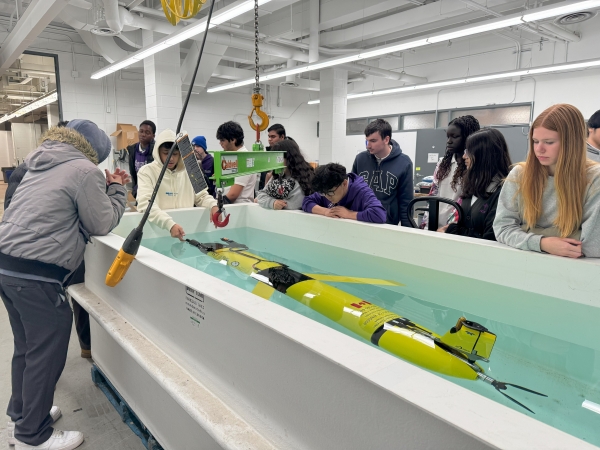
Assumption College Catholic High School students get close up look at RAEON gliderStudents from Assumption College Catholic High School visited RAEON, where they got a close-up look at the underwater gliders and lab.

Students dive into robotics and research at RAEON

A group of high school students took a deeper look at the mechanics of underwater gliders during a visit to RAEON (Real-Time Aquatic Ecosystem Observation Network) earlier this month, gaining hands-on experience with the high-tech devices used to monitor the Great Lakes ecosystems.

About 21 students from Assumption College Catholic High School’s Technological Design (Robotics) class, grades 10 to 12, visited RAEON to learn about what they do, how the autonomous gliders work, and the mechanics behind them.

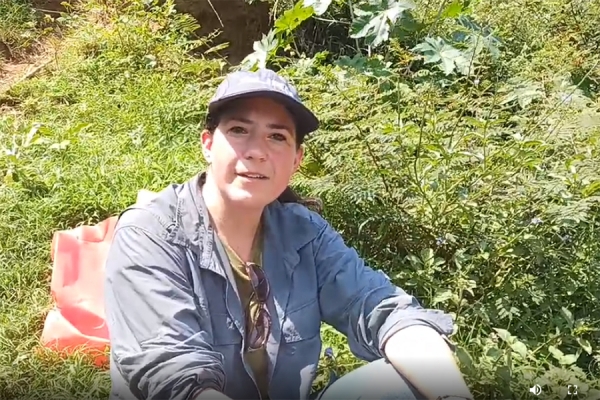
Photo of Doctoral Student Emily Varga taken in KenyaDoctoral student Emily Varga travelled to the east African country of Kenya to gain an understanding of its algal blooms.

Team comparing algal blooms in Africa and North America

Harmful algal blooms are not unique to Lake Erie. The global issue took a team of UWindsor researchers to Kenya to study its algal blooms, in hopes of shedding light on the problem in southern Ontario.

The collaborative effort paired researchers from Canada, the United States, the United Kingdom, and Kenya to collect data on Lake Victoria in hopes of better understanding the environmental drivers of harmful algal blooms. Algal blooms are collections of algae that have the potential to produce toxins that can contaminate drinking water and harm the ecosystem.