 A mother deer tends to her two fawns in Jill Urbanic's back yard.
Jun 17th, 2013
Engineering professor recently woke to find two baby deer had been born in her back yard.
A mother deer tends to her two fawns in Jill Urbanic's back yard.
The Great Lakes are under constant stress from pollution, habitat loss, climate change, invasive species and over-exploitation, but a group of University of Windsor researchers have received about $6.7 million in research dollars to find ways to improve and preserve their health.
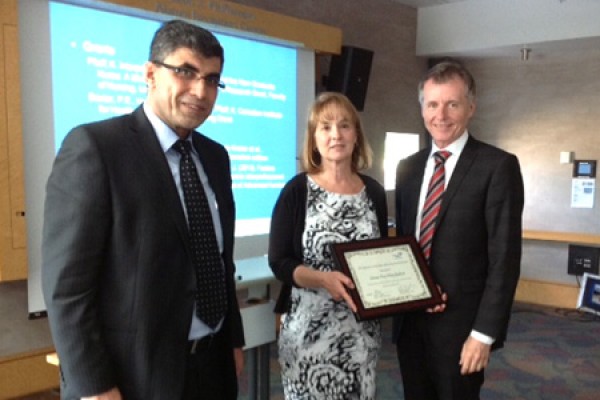
A nursing professor who focuses her attention on improving heart health was recently presented with “the jewel” of awards that recognize top researchers in her faculty.
Susan Fox-Wasylyshyn, the faculty’s acting associate dean was given the Faculty of Nursing 2013 Research Excellence Award at an event held May 16 in the McPherson Lounge at Alumni Hall.
Children who immigrate to Canada may lead dual lives in order to fit in with their peers while maintaining the cultural traditions of their families, according to a visiting psychology researcher who will deliver a lecture here next week.
“The research shows that it’s possible to have double identities, and in fact, those who do, usually have better psychological well-being,” said John Berry, professor emeritus at Queen’s University.
Hosting a national science fair next spring will provide a great opportunity to heighten the university’s profile while showcasing all the great things happening in this region, according to Edwin Tam.
“This is something that draws a lot of attention,” said Dr. Tam, an engineering professor who just returned from the University of Lethbridge, which recently hosted the Canada Wide Science Fair and had more than 400 students submit entries to the contest.
Outwardly, Mark Sewell doesn’t seem like the type of guy who could dream up an extremely unhinged, über-violent, misguided, psychotic crime fighter.
Tiny tropical fish much like minnows may hold the key to helping oncologists deliver more personalized and effective methods of treatments to their cancer patients.
That’s the aim of Indrajit Sinha, CEO of Biomedcore, a Tecumseh medical diagnostics company that worked with biology professor Lisa Porter on setting up an experimental system to grow cancer cells in zebrafish and see how they respond to a variety of drug therapies.
A little bit of rebelliousness can create positive change in the world, but misdirected, can lead to all kinds of negative consequences. Being a rebel with a cause is key, according to psychology professor Kathryn Lafreniere.
Claire Sanders was finishing an undergraduate degree at the University of Alberta when her fascination with birds began. Now she’s living her dream.
“I took an ornithology class in my final year and I’ve been hooked on birds ever since,” she said. “I start talking about birds and I can’t stop.”
A scientist born in Windsor but who now conducts his research at New York’s Columbia University will discuss how a natural product derived from plants like aloe vera may slow the progress of such neurodegenerative diseases as Parkinson’s and Alzheimer’s when he appears as a featured speaker at a conference here next week.