
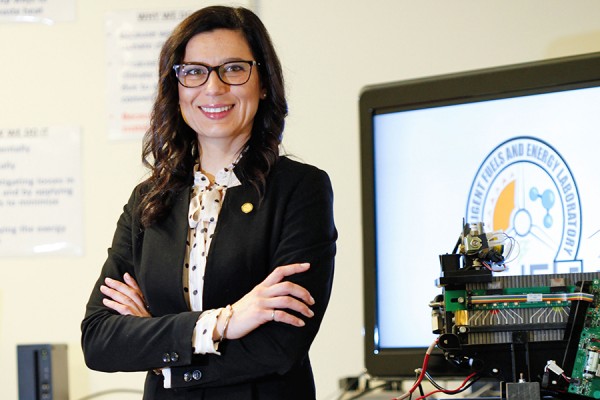
Ofelia JianuMechanical engineering professor Ofelia Jianu is leading a UWindsor team working to advance the use of hydrogen in sustainable energy systems.

Team working to ease transition to a hydrogen-based economy

UWindsor engineering professors are contributing to a national momentum that’s mapping out the future of hydrogen in Canada.

Hydrogen has the potential to become a major fuel of the future since it can be produced from clean sources such as water, says Ofelia Jianu, a mechanical engineering professor and director of the Intelligent Fuels and Energy Laboratory (I-FuELs).

Dr. Jianu is leading a UWindsor team developing new predictive models for hydrogen generation to advance its integration in sustainable energy systems.

“Hydrogen is an energy carrier that can be produced from local, zero-carbon sources and consumed by non-emitting devices such as fuel cells,” Jianu says. “Therefore, transitioning to a hydrogen-based economy would alleviate concerns related to climate, air quality, and energy security as well as create new economic opportunities for Canadians.”

The most common method of hydrogen production utilizes steam in a chemical process that converts methane to hydrogen and releases carbon dioxide into the atmosphere.

“In order to achieve a future hydrogen economy and zero emissions, more sustainable methods of hydrogen production are needed,” she adds.

The team aims to enhance clean methods of hydrogen production called thermochemical cycles, which undergo a series of chemical reactions in three different reactors at various temperatures to split water without releasing particulates or greenhouse gases into the atmosphere.

According to Jianu, past studies have examined momentum, heat transfer and mass transfer within the reactors where the reactions take place, but limited studies have examined the transport of materials from one reactor to the next to complete the cycle. This is paramount, she says, because it affects the overall performance and rate of hydrogen produced.

“Our team will focus on this area by examining multiphase flows and transport phenomena with a ShadowSizer system, which we acquired through project support,” Jianu says.

The ShadowSizer system is a state-of-the-art microscopic backlit camera that is used to freeze particle motion, which allows researchers to measure and examine particle size, velocity, and shape.

The $144,000 project is funded in part by the Canada Foundation for Innovation, Ontario Research Fund, and Dantec Dynamics and includes co-investigators Ram Balachandar and David Ting from the Faculty of Engineering.

The Government of Canada is striving to position the country as a global leader in hydrogen technologies. Its Hydrogen Strategy for Canada, released in December 2020, aims to cement hydrogen as a key part of the country’s path to net-zero carbon emissions by 2050.

The report quotes Seamus O’Regan, minister of natural resources, as saying: “As we rebuild our economy from the impacts of COVID-19 and fight the existential threat of climate change, the development of low-carbon hydrogen is a strategic priority for Canada,”

It follows the Ontario government’s establishment of a Hydrogen Strategy Working Group, which aims to support the province’s clean technology sector and environment plan.

—Kristie Pearce

arctic skylineUWindsor faculty and students document the desertion of an Arctic settlement in the experimental film short “Qausuittuq.”

Faculty and students produce film showcasing Arctic community

“The place where the sun doesn’t rise” is the subject of film professor Min Bae’s latest short experimental documentary shot in the Arctic circle community of Qausuittuq, a small settlement located in the Inuit hamlet of Resolute Bay, Nunavut.

The film Qausuittuq explores the parallels between humans’ and nature’s influences on the northern landscape, emphasizing the inevitable passage of time and the impact of climate fluctuation. The industrialization of this community disrupts the once peaceful and natural land that now contains abandoned machinery, melting polar ice caps floating on the crystal blue-violet sea, and white silent nights shattered only by the cries of foxes.

This film was directed, produced, and shot by Bae, associate professor of film production in the School of Creative Arts (SoCA). Two graduate students in the MFA in Film and Media Arts program, Gemma Cunial and Adam Dunn, also worked on the film. Cunial was the associate producer and Dunn the film’s editor.

The film asks viewers to “immerse yourself within an experience of isolation and loneliness from a place you’ve never been before. Wasted warehouses, empty oil tanks, broken industrial machinery, and forgotten sunsets: Qausuittuq showcases the desertion of a North Pole settlement.”

Bae says he wanted to express the North Pole’s uncanny coexistence of nature and humankind.

“I exhibit the evolution and digression of human creation, consumption, and inevitable abandonment of the ‘place with no dawn’,” he says.

Bae received the best international director award for Qausuittuq at the recent Oregon Documentary Film Festival.

Qausuittuq was an interesting challenge to assemble,” recalls Dunn. “Unlike most short films, Qausuittuq does not have a traditional narrative, and it took a few iterations to find the structure and flow of the short.“

The film’s ethereal soundtrack was composed and performed by Brent Lee, associate dean, research and graduate studies in the Faculty of Arts, Humanities and Social Science, and associate professor in SoCA.

“The soundtrack features many layers of electric guitar lines,” explains Dr. Lee. “I don’t know that I would have taken that approach except that I’ve been playing more guitar with headphones since the pandemic began and the instrument is easy to record at home.”

As associate producer on this film project, Cunial carried the promotional responsibilities.

“For this project, I developed skills in distribution. I created a press kit for the film, maintained social media pages, as well as submitted the film to festivals worldwide,” says Cunial. “The film has already been accepted into four festivals: Venice Shorts in California, Oregon Documentary Film Festival, Oregon Short Film Festival, and the Oxford Film Festival in Mississippi.”

As it garners nominations and distinctions, look for Qausuittuq at several Canadian and international festivals this year. Check out the trailer here: https://vimeo.com/439533684.

—Susan McKee

piles of papers to be gradedAn opt-in alternative grading system for Winter 2021 will support students facing academic challenges because of the coronavirus pandemic.

Alternative grading system to provide flexibility for students

An opt-in alternative grading system for the Winter 2021 semester will support students facing academic challenges because of the ongoing coronavirus pandemic, says provost Douglas Kneale.

The change will allow eligible students to choose from three options once their final grades have been posted:

  • to accept the final grade assigned by the course instructor;
  • to request a Pass/Non-Pass grade for one course, based on the minimum required passing grade in their program or course; or
  • to voluntarily withdraw from a course without academic penalty.

The revised Voluntary Withdrawal provision applies to all students except pre-service students in the Faculty of Education and students in the Faculty of Law’s JD and Dual JD programs.

The Pass/Non-Pass option applies to all students except pre-service students in the Faculty of Education.

“We strongly encourage students to strive for the best grade possible in all classes to support their future success and to think cautiously about using alternative grading before selecting this option,” says Dr. Kneale.

He encourages students considering any alternative grades to meet with an academic advisor to review the potential implications on future academic and professional pursuits, such as applying to law, medicine, graduate school, a professional licensing organization, and employment opportunities.

A memorandum providing more detail has been circulated to students and faculty. Find more information at ask.UWindsor.
Monica Forrester and Lazarus LetcherMonica Forrester and Lazarus Letcher will discuss Black Trans Liberation on Thursday, March 11.

Panel to discuss rights for transgender people

An online panel discussion will feature two advocates for transgender and Black people, Thursday, March 11, at 10 a.m.

Lazarus Letcher is a doctoral student in American studies, a solo musician and violist for the queer indie-folk band Eileen & the In-Betweens, and an addiction recovery coach for the BIPOC community.

Monica Forrester is a program and outreach co-ordinator for Maggie's Toronto Sex Workers Action Project. Since 1999, she has worked in various agencies to educate and make services accessible for trans folks.

Entitled “Black Trans Liberation,” the event is hosted by the Women's and Gender Studies program in partnership with Windsor Essex Transgender and Allied Support and the Office of Human Rights, Equity, and Accessibility.

It is free and open to the public; register at www.uwindsor.ca/wgst/blacktransliberation.

Igniting Discovery Grant logoWE-Spark Health Institute and its funding partners have awarded 15 research grants totalling $287,450 to tackle local health challenges.

UWindsor researchers among local health funding recipients

WE-Spark Health Institute and its funding partners have awarded 15 research grants totalling $287,450 to tackle local health challenges, including nine UWindsor projects.

Called “Igniting Discovery Grants,” the funding promotes the development of early-stage, innovative health research and education projects in Windsor-Essex, and can include studies related to emerging topics in health, addressing gaps in healthcare needs, igniting new ideas, generating and disseminating knowledge, and sparking collaborations.

A key goal of the grants is to encourage co-operation across WE-Spark’s four partner institutions — the University of Windsor, Hôtel-Dieu Grace Healthcare, Windsor Regional Hospital, and St. Clair College — along with community members, students, and volunteers.

“Grants are the fuel that allows researchers to put together a team, to move their idea forward and tackle the biggest health problems that impact society,” said biomedical sciences professor Lisa Porter, the institute’s executive director. “Our grants program depends on the generosity of our donors, individuals who give directly to WE-Spark and local organizations that make supporting research a part of their mandate. These funders recognize the importance of igniting new and promising research ideas right here in Windsor-Essex.”

The 15 projects will involve over 100 researchers and trainees and thousands of participants.

The Windsor Cancer Centre Foundation was the largest grant funder, supporting $130,000 in cancer research grants:

  • Designing probes for early identification of prostate cancer;
  • Investigating novel ways to protect against cancer; and
  • Working to develop better drugs for cancer treatment.

The remaining 11 grants were funded by WE-Spark Health Institute, the Windsor Cancer Research Group, and NYN Designs. Some of the projects include:

  • Looking to improve online tests to assess and monitor cognitive functioning;
  • Evaluating an online memory and brain health promotion intervention for older adults;
  • Understanding the needs of caregivers and creating programming to provide essential support;
  • Novel development of diagnostic imaging agents for use in future local PET scanning;
  • Making gains towards inclusive physical education programs in schools;
  • Bringing together national leaders to advance novel diagnostics and therapies for cancer patients (funder: Windsor Cancer Research Group).

Details of all projects can be found here: https://www.wesparkhealth.com/projects.

This is the second round of WE-Spark Health Institute Igniting Discovery research grants awarded since the creation of the institute a year ago. Its 2021 competition launched March 5.

banknotesUndergraduate scholarship and bursary applications are still available.

Student awards available with mid-March application deadline

Some undergraduate scholarship and bursary applications are still available for students to apply. The next application deadline is March 15, 2021.

To apply, log on to UWinsite Student > Student Homepage > Award Profile.

Student Awards and Financial Aid is also hosting online drop-in sessions this week for students who require assistance with completing their applications. Find a schedule on the awards office website.

Samra ZafarSamra Zafar is the keynote speaker for the March 12 webinar “Womxn Empowering Womxn: Empower Yourself and Others.”

Empowering women aim of Friday webinar

A webinar Friday will feature Samra Zafar, an advocate for gender equity, inclusion, and human rights and the author of the best-selling book A Good Wife: Escaping the Life I Never Chose, based on her journey of escaping an abusive child marriage to pursue an education.

The University of Windsor Students’ Alliance Womxn’s Centre and the Women of Windsor Mentorship Collaborative are co-hosting the event, “Womxn Empowering Womxn: Empower Yourself and Others,” on March 12 from 11 a.m. to 3:30 p.m.

In addition to Zafar, presenters include local women who will speak on topics as varied as “finding yourself” and body positivity.

Attendees will also have a chance to meet and network with members of the mentorship collaborative and learn about the opportunities it offers.

Attendance is open to the campus community; register here for the Zoom videoconference.

Phebe LamPhebe Lam has taken up a two-year appointment as acting associate vice-president, student experience.

Alumna to head student experience office

UWindsor alumna Phebe Lam (BSc 1995, BA 1997) began a two-year appointment as acting associate vice-president, student experience, on March 22. Dr. Lam earned master’s and doctoral degrees in psychology from Wayne State University and has been teaching at the University of Windsor since 2015.

In addition to teaching the “Mentorship and Learning” course, she has helped to expand the reach of mentorship programs across the Faculty of Arts, Humanities, and Social Sciences and developed new student advising and support programs, including online projects such as the Pathway to Academic and Student Success peer mentor program and the Reach Virtual Online Peer Mentor Support.

Lam has also served several roles in support of the Student Mental Health Strategy and as chair of the Senate Student Caucus.

Provost Douglas Kneale welcomed Lam to her new role.

“I sincerely appreciate her willingness to step in at a crucial time both on campus and around the globe. I know that she will enjoy the backing of colleagues all across campus, and together with her strong team she will work to support an awesome student experience at the University of Windsor,” he said in a message emailed to the campus community.

Tech Talk logoWatch Jonathan North introduce Lists basics in a Tech Talk video.

Video an intro to Microsoft Lists

Microsoft Lists is an app that helps you track information and organize work.

With Lists you can stay on top of what matters most to you and your team. Use it to track issues, assets, routines, contacts, inventory, and more using customizable views. Then leverage its smart rules and alerts to keep everyone in sync. With ready-made templates, you can quickly start lists online, on the mobile app, and directly from within Microsoft Teams.

Watch Information Technology Services team member Jonathan North as he introduces Lists basics — including creating lists and adding, editing, and removing items — in this 117-second Tech Talk video.

Tech Talk is a presentation of IT Services. More Tech Talks are available at www.uwindsor.ca/its/tech-talk.

alarm clockEstablish a healthy sleep routine, advises Human Resources.

Message provides tips to enhance quality of sleep

Sleep is as important for overall health as good nutrition and physical activity, says a message sent Monday to UWindsor faculty and staff by Human Resources.

The wellness tip notes that slip allows muscles and tissues to repair and heal and provides some examples of how to enhance the quality of sleep:

  • Go to bed at the same time every night and wake up at the same time each morning.
  • Practise the same rituals to help de-stress, such as reading, taking a bath, or listening to calming music.
  • Avoid exposure to blue light from electronic screens two to three hours before bedtime.
  • Keep your room dark, noise-free, and cool.
  • Avoid alcoholic and caffeinated beverages and fatty or spicy foods before bed.

For more tips on how to improve sleep hygiene, view the 3 Keys to a Healthier “U” information sheets and access the sleep hygiene checklist