
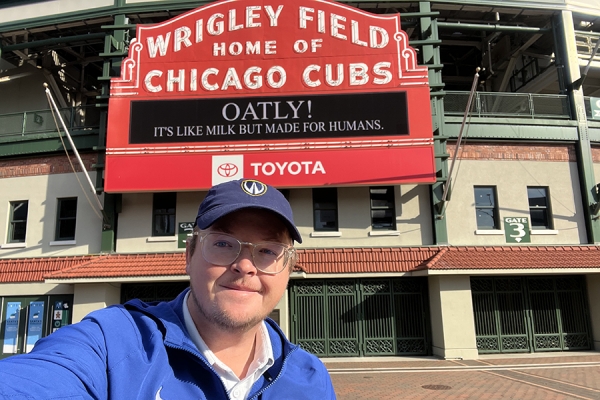
Mike Sonne outside Wrigley FieldMike Sonne’s expertise in biomechanics, paired with his love of baseball, has landed him a job as the Chicago Cubs’ new baseball scientist.

HK grad new baseball scientist for the Chicago Cubs

UWindsor alum Mike Sonne has always been a baseball guy.

He plays baseball. He coaches baseball. He’s a fan.

But recently, Dr. Sonne went from being just any baseball guy to being the baseball guy, snagging a job with the Chicago Cubs as the major league club’s new baseball scientist.

What’s a baseball scientist?

“Everyone asks that,” said Sonne.

Sonne uses his expertise in biomechanics to figure out how hard a player can work before performance diminishes or injury is inevitable.

“The idea is to optimize performance,” he explained. “I look at how safely we can get our players on the field performing at their maximum for as long as possible.”

Sonne is part of the Cubs’ research and development department. Without giving too much away, Sonne said the size and scope of the Cubs’ tech team rivals that of any start-up in Silicon Valley. The department collects data on every player in the franchise — from the Cubs’ starting pitcher to young hitters on the club’s farm teams. It collects data on players from rival teams, too.

Sonne takes all that data and runs it through a model he originally designed to predict muscle fatigue in automotive assembly-line workers.

“My job is to figure out how to translate this data into actionable items.” Using a pitcher as an example, Sonne said he can go to the coach and say, “Get this person on the mound more, or maybe they need to skip a start.”

Sonne says there’s no magic to what he does — you just need to know what to look for.

“When you have a good understanding of how muscles fatigue, you can see subtle changes in movement patterns,” he said.

Comparing what he sees to the data collected, he can predict when players need rest to get back at the top of their games.

Sonne, 39, said he never dreamed of becoming a baseball scientist.

“I don’t think my dreams were ever so audacious to think this was possible.”

He graduated from Belle River high school intent on studying music.

“My guidance counsellor told me if I took kinesiology, I could only be a gym teacher,” he said wryly.

After completing his bachelor’s degree in human kinetics, he worked for two years as an ergonomist in Ottawa and Michigan before returning to UWindsor for master’s studies. During grad school, he worked with kinesiology professor Dave Andrews researching the body movements of assembly-line workers in the automotive industry.

“I definitely loved the HK program there,” he said.

For his PhD, he attended McMaster University and conducted further research on autoworkers with former UWindsor professor Jim Potvin.

Throughout his time at UWindsor, Sonne was the trainer for the Lancers football team. A helmet the team gave him when he graduated remains on display in the bedroom of his Hamilton home.

As part of this UWindsor master’s education, Sonne did an internship with an ergonomics tech company. When the company later folded, Sonne started his own.

His company allowed clients to use cellphones to analyze joint angles to improve ergonomic design. After completing his doctoral degree, Sonne worked for the Occupation Health Clinics for Ontario Workers in Hamilton.

He started blogging about sports, applying his expertise on forces, posture, and repetition to what professional baseball players do. Among other topics, he wrote about how the introduction of a pitch clock would put major-league pitchers at higher risk of injury.

“I ended up getting a pretty significant social media presence,” he said.

Sports sites and publications such as Fangraphs and The Athletic approached him about becoming a freelance writer. That led to an article in Sports Illustrated.

Then came a call from Craig Breslow, assistant general manager of the Chicago Cubs and a former Major League Baseball pitcher himself.

Breslow brought Sonne in for a team education seminar. Afterwards the two men exchanged texts about a possible role with the club.

They inked a deal in October.

Sonne spends some time at Wrigley Field each month, but spends most of his time on the road, visiting farm teams in Iowa, Tennessee, and South Carolina.

Hamilton, where Sonne is a player-coach with the Steel City Inclusive Softball Association, will remain his home base.

His parents, Patsy and Brian, still live in Windsor, a place he called home from the time he was seven.

Like when he was a boy, he revels in the magnificence of the game.

“I’m always amazed when I watch a pitcher throw,” he said. “They are so outside normal human function…. It’s a beautiful celebration of what can go right with the human body.”

—Sarah Sacheli
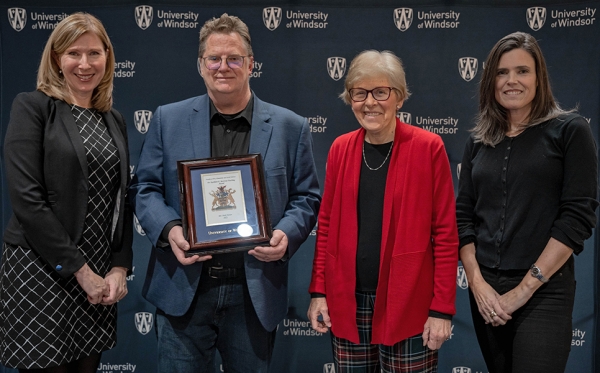
Nick Hector, Cheryl Collier, Kathleen McCrone,  Kim NelsonExtending congratulations to Nick Hector (second from left) on his Dr. Kathleen E. McCrone Teaching Award were dean Cheryl Collier, professor emeritus Kathleen McCrone, and SoCA colleague Kim Nelson. Photo by Crystal Bryan.

Reception recognizes accomplishment in arts, humanities, and social sciences

Faculty and staff in the Faculty of Arts, Humanities, and Social Sciences (FAHSS) gathered Dec. 7 in Alumni Auditorium to celebrate colleagues’ accomplishments in research, teaching, and creative activity during the past year, and to recognize in person those award recipients from 2020 and 2021 when events were held virtually.

This was the first in-person gathering since 2019 for the FAHSS Teaching and Staff Awards and Research, Scholarship & Creative Activity Excellence Recognition Event.

This year’s faculty and staff awards were presented to:

  • Natalie Delia Deckard, Faculty Meritorious Service Award
  • Lauren Waymouth, Staff Meritorious Service Award
  • Nick Hector, Dr. Kathleen E. McCrone Teaching Award

Charlene Senn was recognized for becoming a Fellow of the Royal Society of Canada in 2022, and Adrian Guta (2021) and Jennifer Willet (2020) were honoured for becoming members of the Royal Society of Canada.

Carol Davison, Randy Lippert, and Nicole Markotic were recognized as the Outstanding Research, Scholarship & Creative Activity Established Faculty Award Winners in 2021.

Eight faculty members were recognized for being awarded Tri-Council Grants in 2022, including:

Jijian Voronka, social work, SSHRC Insight Grant “Street Health and Social Services in the Age of COVID-19: Mapping the impact of the pandemic on street-involved services and supports in Windsor, Ontario.” This project seeks to investigate the effects of the COVID-19 pandemic on homeless and harm reduction services and supports for street-involved individuals, those that serve them, and the surrounding community of Windsor, Ontario.

Katherine Rudzinski, a post-doctoral fellow in social work, SSHRC Insight Development Grant “Gendering safe supply programs: Understanding women's experiences of victimization, criminalization, and resistance.” This study advances knowledge about the relationship between women, drugs, and society, and proposes novel solutions to the complex social problem of the overdose crisis that move beyond the “war on drugs.”

Felipe Duarte, social work, SSHRC Insight Development Grant “Localizing the Sustainable Development Goals in Windsor, Ontario.” This project seeks to understand the process of adapting the global UN Sustainable Development Goals to the city level, which represents the engagement process of planning and implementing the goals in all three dimensions of sustainability social, environmental, and economic — to the local level.

Kendall Soucie, psychology, SSHRC Insight Development Grant “Breaking the silence: Building an inclusive, resiliency-based framework to support women with Polycystic Ovary Syndrome across the lifespan.” The goal of this project is to center the lived experiences of women with Polycystic Ovary Syndrome from a lifespan developmental biopsychosocial framework.

Ashley Glassburn-Falzetti, women’s and gender studies in social work, SSHRC Insight Development Grant “Felt Indigenous Histories: Miami perspectives on the violence of settler historical narratives.” The goal of this project is to integrate Indigenous heritage values and felt experiences of historical narratives into the process of history making, beginning with narratives of the Miami Nation of Indiana, of which Dr. Glassburn-Falzetti is a member.

Charlene Senn, psychology, CIHR Project Grant “A Randomized Controlled Trial of the Efficacy of IDEA3 — an Evidence-Based Sexual Assault Resistance Intervention for Undergraduate Women Adapted for Internet Delivery.” The Enhanced Assess, Acknowledge, Act (EAAA) sexual assault prevention program developed by Dr. Senn is an intervention proven to significantly reduce sexual assaults in campus communities. The project asks if a synchronous online adaptation of this program would increase women’s ability to detect risk; use the most effective self-defence strategies; increase women’s confidence that they could defend themselves if confronted with a sexual assault situation; reduce rape myth beliefs that hamper risk detection; and reduce women’s self-blame if a rape occurs.

Adrian Guta, social work, CIHR Catalyst Grant “It takes a village: Developing community-based research capacity for safer opioid supply clients in Kitchener-Waterloo.” The goal of this community-based Research Catalyst Grant is to develop a program of community-based research attuned to the needs and realities of people living with and affected by HIV and/or Hepatitis C Virus and other sexually transmitted and blood-borne infections in Kitchener-Waterloo.

Dana Menard, psychology, CIHR Open Operating Grant “Laying the groundwork for improved psychological preparedness and adaptation of Canadian nurses working during healthcare crises: Simulated training to improve resiliency of nursing groups (STRONG).” The goal of this project is to create and pilot a training program that will prepare nursing students to work during this pandemic and other extreme healthcare crises. The program will consist of 10 training modules combining online content and in-person practice; topics may include trauma, burnout, moral distress, self-care, and resiliency, working with racialized patients during COVID, and stigma.

Karen PillonAssociate university librarian Karen Pillon has received the 2022 OHREA Employment Equity Award.

Librarian wins recognition for contributions to employment equity

Demonstrating a commitment to employment equity is something she tries to do every day, says associate university librarian Karen Pillon.

“Equity is not something we just do when we sit down at an employment equity table and we say now we’re going to use it,” she says. “It really has to be life-long.”

Pillon’s contributions to the advancement of employment equity earned her the Employment Equity Award from the Office of Human Rights, Equity, and Accessibility.

She has served as an equity assessor, a member of the Review Committee on Employment Equity, and chair of the Windsor University Faculty Association’s status of women committee, and professes a particular passion for ensuring a more representative staff and faculty complement at the University.

She has served as a member of the Review Committee on Employment Equity, and is past chair of the Windsor University Faculty Association’s status of women, diversity, and equity action committee. Pillon continues to contribute as an employment equity/procedures assessor, as a long-standing member of the Employment Equity Co-ordinating Committee, and by providing leadership in formalizing employment equity processes in hiring.

Watch a video on her award:

This is the second in a five-part series recognizing recipients of the 2022 OHREA awards.

notebookLet’s Talk Teaching Dossiers: a Community of Practice for graduate students will meet monthly next semester.

Dossiers on docket for grad student discussion

A series of monthly meetings during the winter 2023 semester will provide an opportunity for graduate students to discuss, review, and share knowledge about teaching dossiers.

The Community of Practice on Teaching Dossiers will also give participants optional self-paced modules and resources that can be utilized to start or refine an existing teaching dossier.

For more information and to register, visit: https://ctl2.uwindsor.ca/workshops/52/#wkshp-3500.