
Biochemistry professor Kenneth Ng is a member of a multidisciplinary group of UWindsor researchers partnering in an effort to enhance Canada’s preparedness for future pandemics.
Crews work to remediate contaminated sediment at the former UniRoyal site on the Detroit River. Photo courtesy Detroit Riverfront Conservancy.
Contaminated sediments limit the ecological recovery of the Detroit and Rouge River ecosystems, says a report released Tuesday by the State of the Strait Conference steering committee.
On the U.S. side of the Detroit River, up to 5.1 million cubic metres of contaminated sediments have been targeted for remediation by state and federal governments. No additional sediment remediation is required on the Canadian side.
Doctoral student Shayenna Nolan will discuss key findings in a study of the Grand Marais Drain on Tuesday, Nov. 22.
A presentation Tuesday, Nov. 22, will focus on understanding stream health in modern human-impacted landscapes.
Shayenna Nolan (BSc 2021), a PhD student in integrative biology and director of communications at the Healthy Headwaters Lab in the Great Lakes Institute for Environmental Research, will deliver “Streams of the Anthropocene” over Zoom starting at 7 p.m.
In his new book, “Great Lakes Champions,” John Hartig tells stories of 14 activists working to clean up polluted watersheds.
Laboratory technician Keta Patel welcomes registrants to the GEN-FISH annual general meeting.
The Genomic Network for Fish Identification, Stress, and Health held its annual general meeting on Nov. 3 and 4.
UWindsor student Elissa Weir will premiere two short films at the Windsor International Film Festival, including “Sapphic Dating for Rural Victorians.”
Catherine Febria with IPBES fellow Amani Al-Assaf at the organization’s 2018 plenary in Medellín, Colombia.
Catherine Febria has been appointed to the Intergovernmental science-policy Platform on Biodiversity and Ecosystem Services.
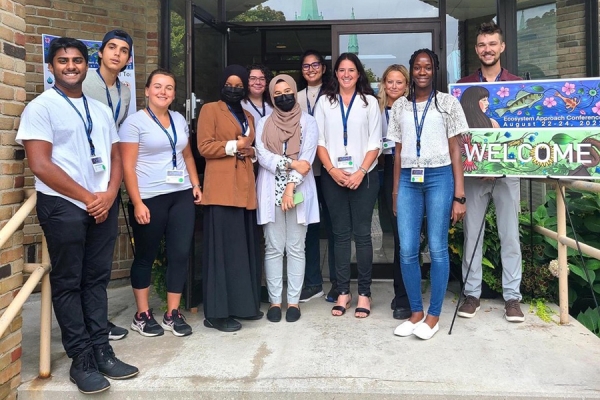
Student volunteers with the Ecosystem Approach Conference & Synthesis Workshop display a welcome poster with art by Mariah Alexander.
GLIER wrapped up a successful three days of knowledge sharing and networking at the inaugural Ecosystem Approach Conference & Synthesis Workshop.
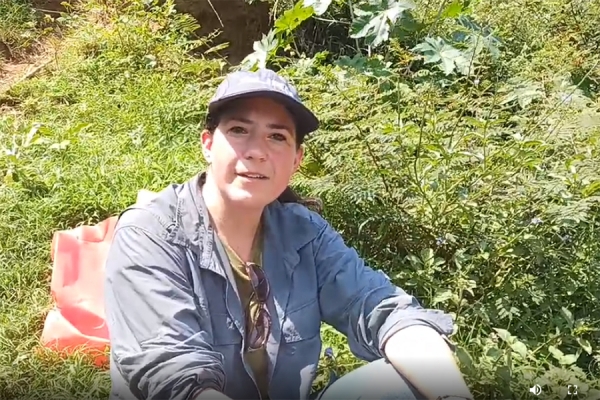
Doctoral student Emily Varga travelled to the east African country of Kenya to gain an understanding of its algal blooms.
Harmful algal blooms are not unique to Lake Erie. The global issue took a team of UWindsor researchers to Kenya to study its algal blooms, in hopes of shedding light on the problem in southern Ontario.
The collaborative effort paired researchers from Canada, the United States, the United Kingdom, and Kenya to collect data on Lake Victoria in hopes of better understanding the environmental drivers of harmful algal blooms. Algal blooms are collections of algae that have the potential to produce toxins that can contaminate drinking water and harm the ecosystem.
Hugh MacIsaac of the Great Lakes Institute for Environmental Research has been awarded $275,000 over five years under the Natural Sciences and Environmental Research Council of Canada’s Discovery grant program to assess interacting stressors in lakes.