
A new process to coat surfaces will help meet demands of manufacturers, says a doctoral student of mechanical, automotive and materials engineering whose work on the topic won first prize in a national poster competition.
Mo Karimi took top honours in the student competition at the Canadian Cold Spray Conference, last week in Boucherville, Quebec, for his poster Numerical Simulation of Gas Flow in Shockwave Induced Spray Process. The conference was hosted by the National Research Council's Industrial Materials Institute and attracted leaders in industry and research from 11 countries.
Karimi conducted computer simulations to analyze a new coating process that promises to offer a more efficient alternative to current cold spray technologies. Cold spray technology offers the possibility of portability—Karimi cites the example of an airplane part which needs to be re-coated.
"Potentially, that repair could be done on-site," he says. "That cannot be done with any other technology."
Cold spray processes work at temperatures well below the melting point of spray materials, enabling them to mitigate adverse effects on substrate materials—which could include oxidation, warping, and even melting—caused by the high temperatures required by traditional thermal spray coatings.
"The best word for them is that they're messy," says Karimi.
Using shockwaves during the application of the coatings reduces wastage, and the lower temperatures make the work more flexible.
"New lightweight alloys used widely in aerospace industry now can be very susceptible to corrosion," he says. "They need to be coated."
Besides aerospace, the Shockwave Induced Spray Process may find applications in everything from glass manufacturing to machining to medicine. The process is currently in commercial development by Centreline Windsor Ltd. Karimi worked for the company after completing his master's degree in 2005.
Upon his return for doctoral study, he received an Alexander Graham Bell Canada Graduate Scholarship (CGS D), which provides $35,000 annually and is offered only to the top-ranked applicants. His research is conducted under the co-supervision of UWindsor professor Gary Rankin and Bertrand Jodoin of the University of Ottawa—the inventor of the process.
"This is the first time I have undertaken co-advising with a faculty member from another university, and the long distance experience is working very well," says Dr. Rankin. "Mo is an excellent student."
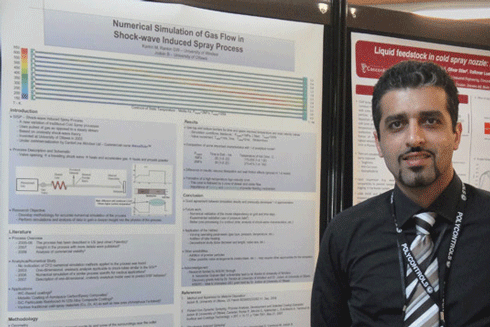
Doctoral student Mo Karimi poses next to his award-winning poster at the Canadian Cold Spray Conference in Boucherville, Quebec.
News story courtesy of UWin Daily News