

Having difficult conversations to address issues and resolve conflicts provides an opportunity for all parties to have a better understanding of each other's perspectives/interests and to identify opportunities for enhancing the working relationship. The following are some guidelines for resolving workplace conflict with a colleague:
It is important that prior to meeting your colleague that you take the time to reflect and prepare for the conversation. Consider the issue(s) from both your perspective and the other person's. Determine your and the other person’s interests (needs, fears, wants, and concerns about the issue). The following are some questions that can help you prepare for a productive conversation:
- Do I have all the information?
- What outcome do I hope to achieve from the discussion?
- What challenges do I expect to encounter?
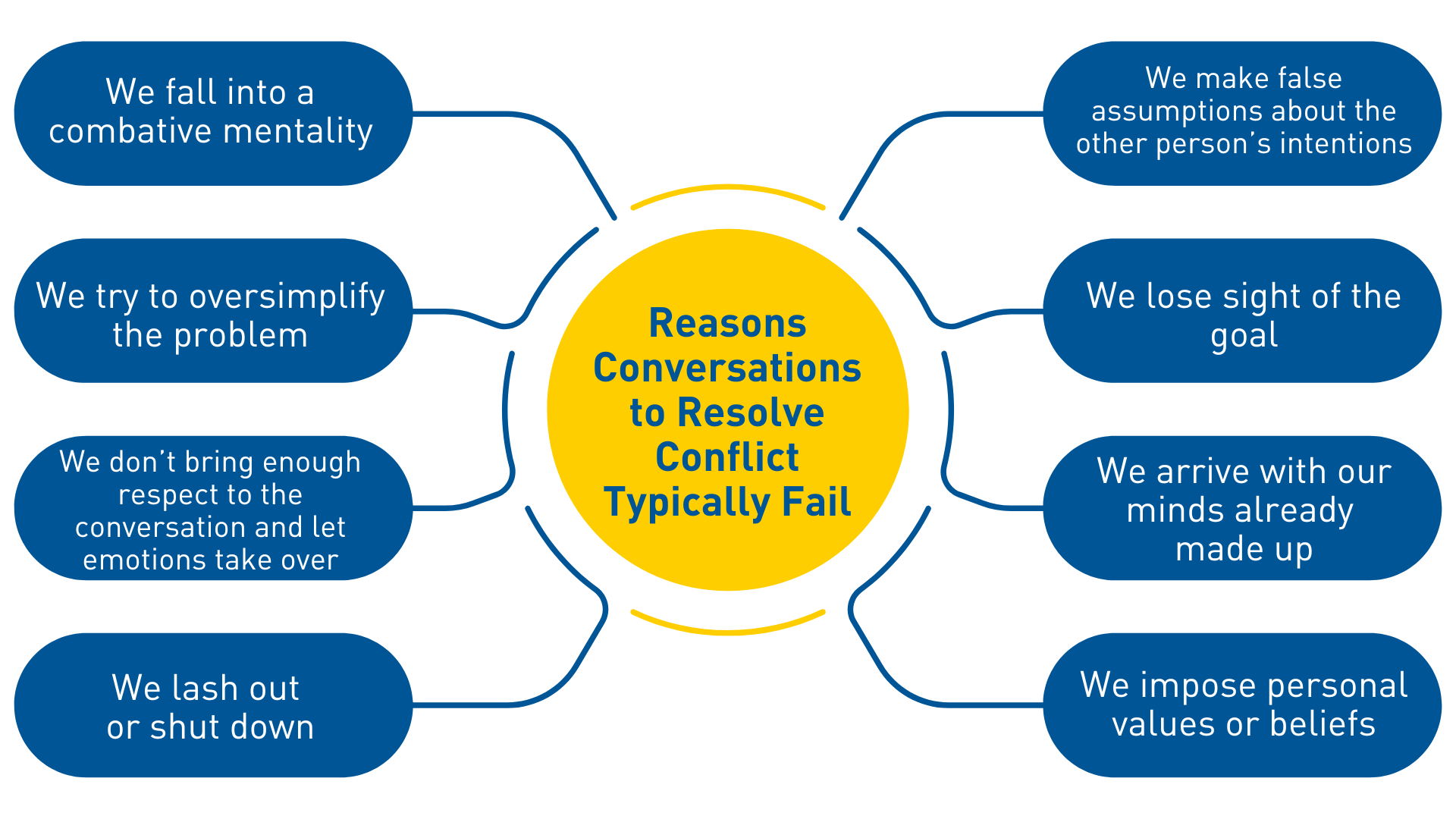
- What assumptions am I making about my colleague’s intentions/behaviours?
- How might my colleague interpret the situation?
- What are my needs and fears related to the situation? What do I think are the needs and fears of my colleague?
- Have I contributed to the situation? If yes, how?
- How does my attitude towards the conversation influence my perception of the situation?
- What options could we explore to solve the situation?
Keep the matter confidential. Consider how you would feel if you heard that someone was criticizing you behind your back. This typically results in more anger, which may lead to the conflict escalating.
If you need support/coaching to prepare for the conversation, approach a trusted colleague or your supervisor, emphasizing confidentiality.
Before engaging in the conversation, make sure that you are ready to hear the other person’s perspective. Hearing the other person’s perspective does not mean that you share or agree with their perspective. Resolving conflict is not about arguing about what happened, it is about understanding yours and the other person’s perspective and the needs and wants of each person in relation to the conflict.
Even though each situation is different, the following are some best practices for navigating the conversation:
- Describe the purpose of the conversation.
- Talk about the need to work together to determine how to resolve the issue.
- Focus on moving forward, not blame.
- Share your facts and tell your story (observations, impact, and assumptions)
- Invite the other person to share their perspective.
- Watch for body language and listen for unspoken energy.
- Focus on areas of common ground without losing sight of differences/opposing interests.
- Do not interrupt; listen actively.
- Respond, not defend.
- Do not take things personally – be prepared for an emotional reaction/push back.
- Summarize and paraphrase to ensure you “got it right.”
- Show that you have heard and understood their position. It does not mean that you agree with it.
- Acknowledge the other person’s feelings and perspectives.
- Brainstorm possible solutions: ask the other person what they think might work, find something in their idea that you like, and then build on it.
- Assess the options identified and reach agreement on the one that would work best (if no solutions identified, schedule a time to continue the conversation).
Sometimes it might take more than one meeting to develop a good working relationship and/or repair a relationship. Make a commitment to meet again to “check in.”
Thank your colleague for their co-operation.
Some reminders:
- If at any time during the discussion, your colleague starts yelling, name-calling, or threatening, politely stop the conversation and report this to your supervisor. Such behaviours cannot be tolerated in the workplace and could be a symptom of a conflict that has escalated and therefore requires a different intervention.
- For complex issues and/or out-of-control conflict, it is important to ask for assistance from your supervisor, Human Resources (staff), Academic Labour Relations (faculty) and/or the union/association. These situations may require other interventions such as mediation or a neutral third party to help restore the relationship.
While first attempts to resolve conflict may feel challenging and/or awkward, with practice you will gain confidence. Do not hesitate to reach out to a trusted colleague or supervisor to help you navigate the conversation.