

MFA Film Production
Our Master of Fine Arts (MFA) in Film Production is dedicated to the development of the candidate’s creative practice. Our graduate students engage in a practice-based research approach that informs the conceptualization, development, production, and post-production of an original short thesis film.
This full-time, two-year, hybrid thesis/course-based program begins with two terms of graduate-level coursework. During this period, candidates establish a research theme, a conceptual framework, and a creative methodology for their thesis project. Theoretical study is complemented by graduate-level studio courses in which candidates further investigate their research theme through screen tests, experiments, practical exercises, and a proof-of-concept film.
Candidates work independently under the close guidance of a Thesis Advisor. Building upon their coursework, they identify a research question concerning the art and craft of filmmaking that can be most effectively explored through the production of a film. They proceed to write, plan, shoot, and edit a short film that addresses this question. This creative work is accompanied by a substantial exegetical academic paper that justifies, contextualizes, and interprets the project. The program concludes with a public exhibition of the thesis film and an oral examination.
We are proud of the wide range of fiction, documentary, and experimental films produced by our MFA candidates. Their work reflects a rich spectrum of aesthetic interests, personal concerns, and technical means. Our students learn in a collegial and highly creative environment supported by faculty with diverse research interests and significant production experience. Faculty expertise spans fiction, experimental, and documentary filmmaking, from expository and cinéma-vérité traditions to poetic forms and expanded interactive documentary models. All are committed to helping you discover and refine your creative voice.
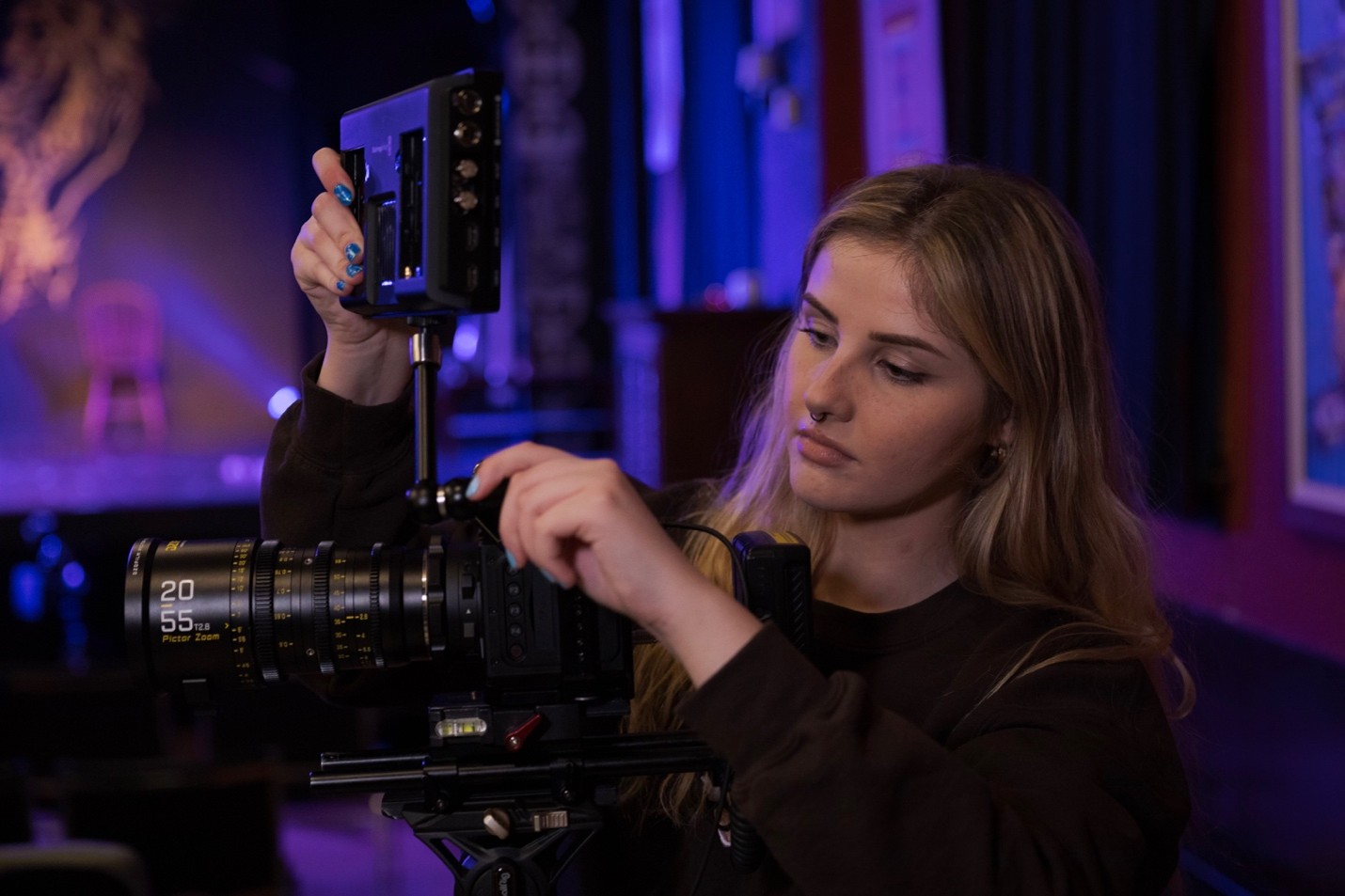
Program Curriculum
The MFA Film Production program is delivered in a hybrid course/thesis-based format. The first two terms consist of two courses each, along with individual study supervised by a Temporary Thesis Advisor (TA). The final three terms consist of individual study closely supervised by a Primary Thesis Advisor (PA). Candidates present their work in progress at the end of terms one, two, and four in formal critiques. A final oral examination, the ‘defence’, is given at the end of term five.
Term 1: Ideation
In the first semester of the program, students will begin by identifying a research theme for their project, developing practice-based research skills, and writing their project’s literature review in CMDC-8500 Pro-Seminar. This theoretical work is supported by practical filmmaking creative exercises in FILM-8100 Studio Production. In an individual study supervised by their TA in FILM-8010 Project Development I, students begin to conceive a film (approx. 10 to 15 minutes in duration) whose production will answer the practice-based research question at the core of their creative project. Candidates will submit a preliminary annotated table of contents that indicates the structure and substance of the support document. The term will conclude with a formal critique, during which students will present their research and creative work in progress to peers and graduate faculty.
Term 2: Pre-Production
In their second term, candidates will build on the work completed in term one. Students will prepare genre-appropriate writing components of their work (e.g. screenplay, documentary development, storyboarding, etc.) in FILM-8000 Graduate Research Seminar. In FILM-8105 Studio Post-Production, students engage with key concepts in film post-production through editing the proof of concept for their research project produced in FILM-8100. In FILM-8020 Project Development II, students undertake the pre-production phase of their thesis project in this individual study supervised by their Temporary Thesis Advisor. The end of term two marks the end of the course-based component of the program. At this point, the candidate will begin to work with their Primary Advisor.
Term 3: Production
Upon approval of their script (or treatment) and pre-production plan, students complete the production phase of their thesis film and continue the research and writing of their project’s support document under the close supervision of their Primary Advisor. Academic research in this term focuses on drafting a methodology, including the identification and justification of the research method, the production of a creative process journal, and a reflexive analysis of your production process in light of the research question. The candidate will formally present their work to their PA at the end of the term. Candidates are also encouraged to screen dailies with peers and faculty during the production process and elicit feedback.
Term 4: Post Production
In term four, students begin the post-production phase of their thesis film and continue the research and writing of their project’s support document. Students will submit their work for approval to their Primary Advisor at the formal stages of assembly, rough cut, and fine cut. In a final end-of-term review, students will present their work to peers and faculty. At this stage, the student must be able to reflect on their research design, its theoretical basis, its methodology, and their in-progress creative artefact, as well as provide preliminary findings of the project.
Term 5: Presentation
In this final term, candidates will complete the post-production of their thesis film and the writing of the project’s exegetical support document. After the conclusion of this rigorous process, candidates will prepare for the oral examination or ‘defence’. At the end of the term, the candidate will present their work in a public forum to the examination committee, student peers, faculty, and the public.
Applications for September 2027 intake are open as of September 15, 2026.
To begin an application for admission to a University of Windsor graduate program visit Signon (uwindsor.ca). Please use the MS Edge browser.
Calum Hotchkiss, MFA, Film & Media Arts 2021, is one of five university students across Canada awarded the Canadian Cinema Editors’ Student Award of Merit for his thesis film Continuum.