
Introduction
The Industrial Research Chair in Tribology of Lightweight Materials focuses on the understanding of how friction and wear occur at the microscopic level on lightweight materials, such as aluminums or magnesium, and composite materials made of these alloys. This research will contribute to new technologies to help industrial designers select materials and design systems or components that are resistant to wear, yet easy to machine. This is vital to metal processing and manufacturing industries, including automotive manufacturers. Research programs will be conducted in the new Tribology of Materials Research Centre under the direction of Chair Holder, Dr. A. T. Alpas, professor of Materials Science and Engineering. Research is done in partnership with General Motors' Surface Engineering and Tribology Research Group.
Why Research Tribology
Cleaner, more fuel efficient engines
The development of lightweight internal combustion engines using materials such as aluminum composites, or alloys, represents one of the most significant technological developments in automotive technology in the last decade. These engines reduce vehicle weight, which in turn reduces fuel consumption and emissions. However, further development of lightweight engines is impeded because they have poor wear resistance. While major automotive manufacturers, aluminum companies, and coating suppliers are investigating ways to reduce excessive wear on engines, current solutions are not necessarily based on scientific understanding of the factors that make materials wear-resistant. Research programs conducted by the Research Chair address these fundamental issues by studying wear problems that are common and significant to industry.
More efficient and environmentally friendly machining processes
Research will help to improve manufacturing methods of wear resistant lightweight materials and their composites, especially dry machining, which is more environmentally friendly than machining practices that use large amounts of lubricants.
Objectives of Research Chair
- To establish a world-class Tribology of Materials Research Centre to conduct research on lightweight materials such as aluminum or magnesium alloys as well as research on micro structural aspects of friction, wear, and machining processes.
- To use a "systems engineering approach" in tribology research that will result in new wear resistant materials, improved coatings, and new design methods to improve performance of engineering components subjected to friction and wear.
- To develop collaborative research programs with other universities, government research labs, and manufacturers who make or use lightweight materials and will transfer resulting new technologies to automotive and metal cutting industries.
- To strengthen existing research capabilities at University of Windsor and become a resource for engineers and technologists in auto and manufacturing industries.
Objectives of Research Program
- To develop new methods to measure rates of wear, coefficients of friction, and surface temperatures by using tests that imitate industrial settings. These tests will contribute to standardizing wear testing procedures.
- To develop new methods to measure wear on a microscopic level and to establish relationships between mechanical, physical, and chemical properties of materials and their wear resistances.
- To develop wear maps that categorize how wear will occur when materials are under different operating conditions. These maps will assist industrial designers in selecting appropriate operating conditions to minimize wear of materials.
- To develop models that predict how wear will occur in different industrial settings. These models will assist in designing and selecting materials for systems that are subject to wear and friction.
- To study the parameters that affect the quality of wear resistant materials, especially the factors that affect how these materials can be machined.
- To develop new tool coating materials for dry machining of aluminum and other alloys.
Current Research Programs
The following is a list of the current research programs conducted by the chair.
Wear Research Programs
- New techniques and extended capabilities
- In-situ wear measurements
- Oxide state measurements
- High temperature tribology
- Wear tests and surface characterization
- Subsurface stresses and strains
- Tribo-chemistry
- Microstructural changes
- Wear mechanisms maps
- PTWA, HVOF coatings on Al
- Al-Si alloys
- Laser treated surfaces
- Graphitic MMC's
- Nano-structured materials
- Lubricated wear
- Engine tests
- Correlations between laboratory tests and field tests
- Modeling of tribological processes
- Design criteria based on wear mechanism information
- Failure prediction in coatings
- Finite element modeling of surface contacts
Machining Research Program
- Cutting mechanisms in metals and composites
- Plastic flow during metal cutting
- Microstructural changes during cutting
- Chip formation mechanisms
- Dry machining of lightweight alloys
- Coatings for cutting tools
- Relationships between wear maps and heat dissipation mechanisms in cutting tools
- Predictive models to design wear resistant tool materials
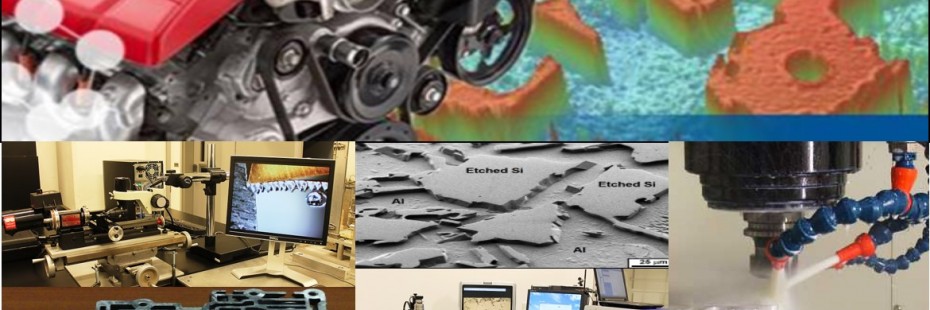
Lightweight Materials for Automotive Products and Manufacturing Processes
The Research Centre
The Tribology of Materials Research Centre (TMRC) is a state-of-the-art tribological testing and characterization facility located in the Ed Lumley Centre for Engineering Innovation (CEI).
The TMRC conducts fundamental and applied research on friction, wear and lubrication of advanced engineering materials, composites and surface coatings. Research programs focus on understanding and improving the friction and wear behaviour of lightweight materials, like aluminum, magnesium and their composites and developing novel coatings to protect them against wear.
The TMRC’s research programs are aimed at improving the performance of materials, manufacturing processes, and clean energy conversion systems through the application of modern surface engineering methods. The TMRC draws its strength from the synergy arising from a complementary nature of faculty members with wide variety of expertise focusing on tribology research. The primary collaborators of TMRC include Canada based companies, universities and government research laboratories. Users vary from collaborating scientists in automotive and aerospace sectors, aluminum manufacturers and application engineers interested in developing advanced coatings, to university researchers involved in fundamental studies in tribology. Each year, TMRC provides training for over sixty undergraduate and postgraduate students in engineering and science programs.
Research Highlights
The TMRC researchers, Dr. Alpas and his team, study the physicochemical mechanisms that occur on the surface of aluminum during contact with moving dynamic hard surface, such as a piston ring or a cutting tool. The analysis of these mechanisms includes advanced material characterization techniques on samples excised from the first few hundred nanometers below the surface. The results helped to optimize the microstructure of aluminum-silicon alloys, which contributed to the development of a new generation of linerless aluminum-silicon alloy internal combustion engines.
Improving automotive manufacturing processes is one of the primary focuses of the TMRC. Researchers here have devised a simple and cost-effective technology that has allowed for environmentally sustainable machining of powertrain components and other aluminum and magnesium castings. They have shown that by protecting tool surfaces with diamond-like carbon coatings, it is feasible to use only a few millilitres of metal cutting fluid, thereby vastly reducing the large amounts of coolant used in traditional flooded machining and resulting in longer cutting and forming tool life. Advancement of surface engineering based solutions to the tribological problems associated with forming of automotive materials is another goal of the research.
The research program also includes understanding the microstructural aspects of graphite and Sn-C based electrode damage mechanisms that are essential to control capacity loss and enhance energy efficiency of Li-ion batteries. 'In-situ' microscopy and focussed ion-beam microscopy based TEM techniques were developed to examine the electrode/eletrolyte interfaces and the crack morphoogies. New surface treatments and composite electrodes were developed to control capacity loss and enhance energy efficiency of lithium-ion batteries
Overall, the research programs generate the fundamental scientific and engineering knowledge needed to produce energy efficient automotive components and manufacturing technologies as well as train the necessary highly-qualified personnel and in this way they enhance the ability of Canada to compete in the global market place with new products and services.