
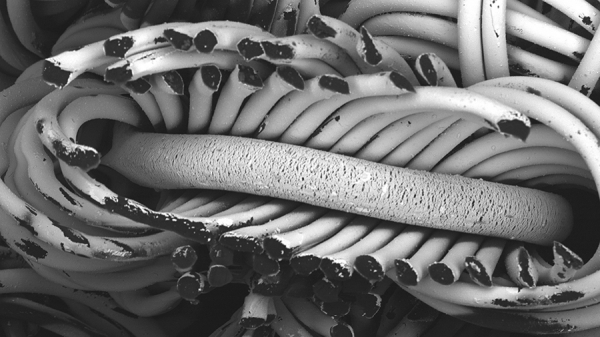
 This image by Gloria D’Amaral, a PhD candidate and graduate research assistant to chemistry professor Tricia Carmichael, is a finalist in the national Science Exposed contest. It shows a cross-section of spandex and nylon fibres in pantyhose, suitable as a foundation for development of wearable electronic materials.
Sheer fabric offers an excellent foundation for the creation of stretchable electrodes, unlocking possibilities for advanced wearable technologies, says Gloria D’Amaral.
A PhD candidate and graduate research assistant to chemistry professor Tricia Carmichael, D’Amaral had her photo of a cross-section of pantyhose composed of spandex and nylon fibres selected as a finalist in the Natural Sciences and Engineering Research Council of Canada’s (NSERC) Science Exposed contest.
The contest showcases images of scientific research in all fields of study. D’Amaral’s entry is one of 20 competing for one of three jury prizes as well as the People’s Choice Award selected by public vote.
D’Amaral employed a scanning electron microscope to capture a close-up photo of the fabric, entitled Sheer Anatomy.
“The fibres are so tightly intertwined that separating them is incredibly challenging,” she says. “When coated with metal, this fabric can function as an electrode in a light-emitting device. This innovative application has exciting potential for use in smart clothing, health-care monitoring, and emergency safety gear.”
Vote towards the People’s Choice Award from among the finalists through Sept. 21.