
A civil engineer will return to Windsor in mid-December with a wealth of new expertise that will ultimately help Canadian resource managers better cope with potential water shortages caused by climate change.
Civil and Environmental Engineering
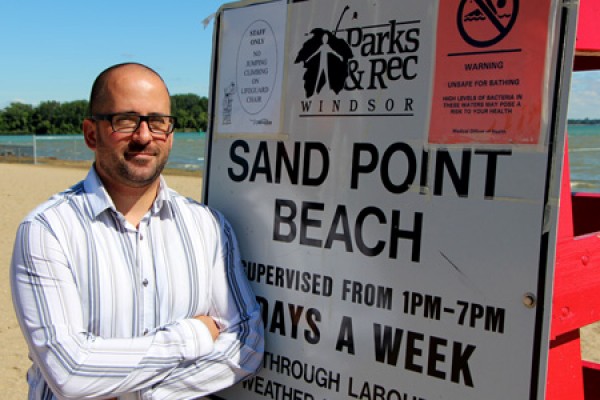 Kerry McPhedran stands beside a warning sign posted on a lifeguard stand at Sandpoint Beach. The post-doctoral fellow believes predictive modelling may be a better way to determine whether beaches should be closed to swimmers.
Aug 6th, 2013
Post-doctoral fellow Kerry McPhedran believes predictive modelling may be a better way to determine if beaches ought to be closed to bathers.
 Students display their model bridge, winner for most creative design: Mariam Hamadani, Khaled Alhakim, Felipe Paramo and Darius Ghib.
Aug 6th, 2013
Third-year civil engineering students learned a lot in a competition to design and build a model bridge—and watch it destroyed to test its strength.
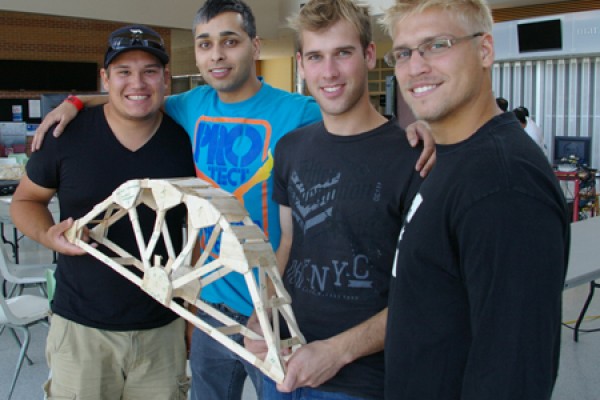 The winners of last year’s popsicle sticks bridge competition—Josh Mailloux, Ismaeel Babur, Eric Sylvestre and Evan Reidel—show off their arched design, which held more than 4800 newtons (almost 1,100 pounds) while weighing just over 1100 grams.
Jul 29th, 2013
The public is invited to watch engineering students test the strength of their model bridges on Wednesday.
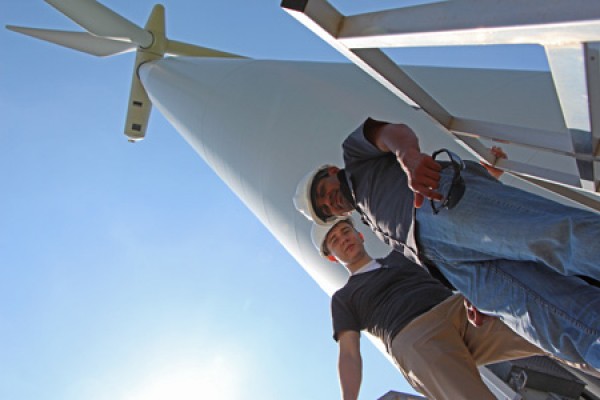 Jamie Smith, left, and Fezan Iqbal stand at the base of one of the wind turbine towers they work on.
Jul 29th, 2013
The 88 turbines at Kruger Energy’s wind farms on Lake Erie’s north shore are generating a lot more than just a steady supply of renewable energy.
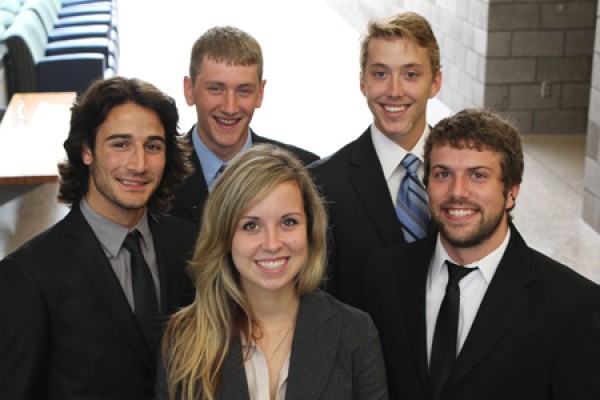 Students Anthony Travaglini, Ryan Frouws, Jillian Hicks, David Brown and Josh Power celebrate the completion of their capstone project on solid waste management in the small Nunavut community of Arviat.
Jul 22nd, 2013
Fourth-year students of civil and environmental engineering presented the final reports on their capstone projects Friday.
Jul 22nd, 2013
Producing fuels from under-utilized biomass instead of fossil based feedstock is an effective means of alleviating concerns about climate change and energy security, according to an engineering professor who will present his research at a conference in India this week.
“These are the major factors driving our search for cheap renewable energy sources,” said Jerald Lalman, a professor in the department of Civil and Environmental Engineering.
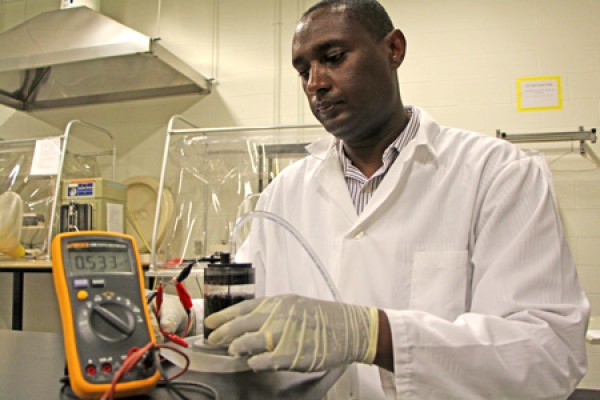 Wudneh Shewa measures the electrical current being produced by a microbial fuel cell in his lab in the Ed Lumley Centre for Engineering Innovation.
Jun 20th, 2013
Manufacturers in the pulp and paper industry may one day convert a toxic by-product from their processes into electricity, thanks to the work of an engineering graduate student.
An award-winning researcher from California and long-time collaborator with the Los Alamos National Laboratory will speak here tomorrow about his efforts to help create the equivalent of “hurricane charts” that help predict when structures might fail.
A video podcast of a lecture featuring engineering professor Rupp Carriveau and his predictions for what life will be like in Ontario in 2030 is now available on line.
Dr. Carriveau, whose expertise is in renewable sources of energy, is the university’s representative in a campaign called Research Matters. Organized by the Council of Ontario Universities, its aim is to increase public awareness about the importance of university level research.