
Jun 9th, 2014
A Café Scientifique on June 16 will address issues of cardiovascular health.
A Café Scientifique on June 16 will address issues of cardiovascular health.
 Biochemistry PhD student Pam Ovadje and third-year undergrad Daniel Tarade recently presented their research at the Natural Health Products Research Society annual conference in British Columbia and came home with top honours in the oral and poster presentation competitions.
Assisted suicide is topic guaranteed to court all kinds of controversy.
However one place where you’ll get general consensus on the matter is among the students working in the biochemistry lab of Siyaram Pandey, where rather than people, they help cancer cells commit suicide.
“One of the hallmarks of cancer cells is that they forget how to die,” says third-year undergrad Daniel Tarade. “We’re forcing their hand, and causing them to commit suicide.”
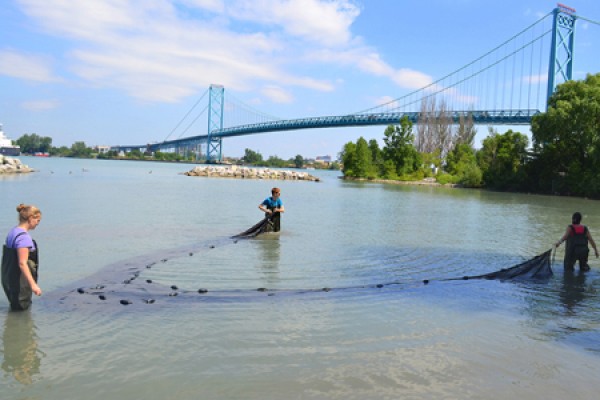 Students gather samples from the Detroit River along the shore west of the Ambassador Bridge.
A public lecture Wednesday will discuss the cleanliness of the Detroit River.
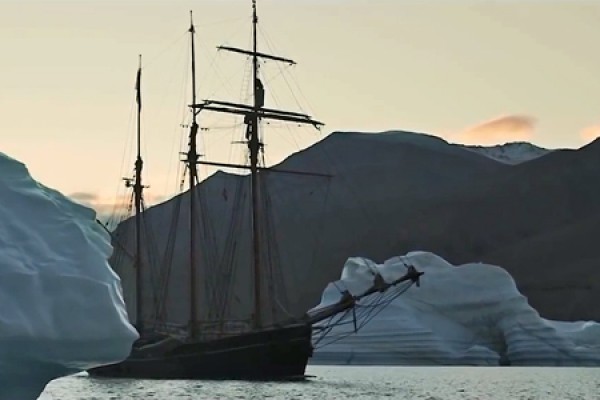 Curiosity, great pathos and a liberating splash of humour come together in “Expedition to the End of the World.” The documentary will be screened Thursday.
The Windsor International Film Festival and Science Rendezvous are teaming up for a screening of two documentaries Thursday at the Capitol Theatre.
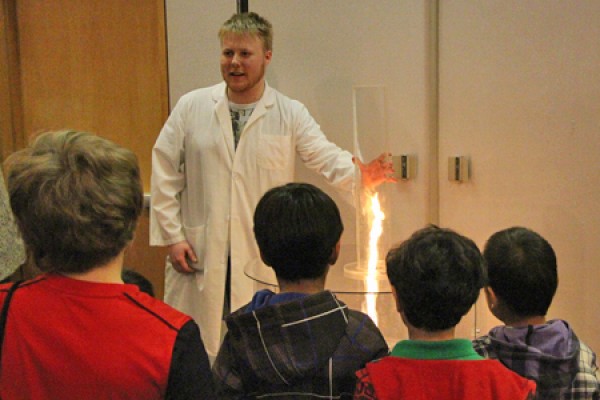 Youngsters crowd close to view the principle of angular momentum illustrated by a fire tornado during last year’s Science Rendezvous demonstrations.
The free public festival Science Rendezvous will open doors to discovery, Saturday, May 10, on the UWindsor campus.
 Physics student Melissa Mathers says that it’s important to foster a new generation interested in science.
The Let’s Talk Science Challenge will bring grade 6, 7 and 8 students to campus for team competition Friday.
 Gordon Drake is part of a team of physicists who determined the exact critical charge for two-electron atoms that form elements like helium.
Going back to the days of Sir Isaac Newton, there have always been certain problems of physics and mathematics that seem all-but unsolvable.
Many of those persist today, and the list is a lengthy one. What is dark matter made of? What causes a supernova to explode? Is there a grand unification theory, or a ‘theory of everything,’ which explains all fundamental physical constants?
 Grad student Heather Christiansen holds up part of a jaw bone from a great white shark.
It would appear, at least for now, that the great white shark population in the northwest Pacific Ocean has remained fairly stable over the last 60 years. Heather Christiansen would like to keep it that way.
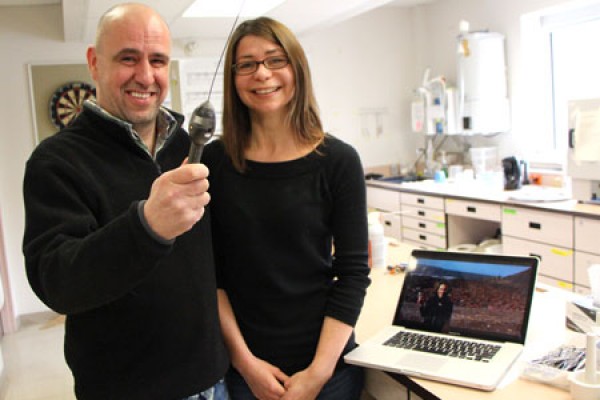 Nigel Hussey, shown here with his wife Anna, holds up a satellite tag like the one he attached to a Greenland shark in the Canadian Arctic. The device detached and floated all the way to Wales, where it was found by Mari Williams.
Call it a high-tech message in a bottle.
A satellite tagging device used to record migratory data that was attached to a Greenland shark in the Canadian Arctic in 2012 was recently found washed up on a beach in southwest Wales—just a short distance away from the spot where the wife of the researcher who planted it used to spend her summers.
 Roman Maev and Dmitry Gavrilov pose with their thermographic analysis equipment at the Institute for Diagnostic Imaging Research.
Walk in to the Louvre, take a flash photo of the Mona Lisa and chances are you’ll be promptly escorted out by some rather unhappy security guards. Besides obvious copyright and security concerns, museum curators take a dim view of light from flashbulbs hitting the priceless art works for which they’re responsible.