
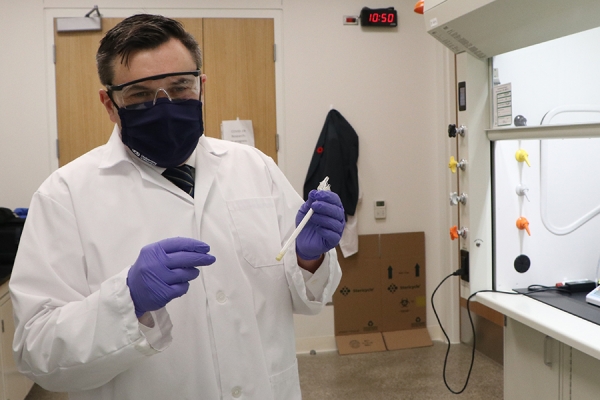
 Mike McKay, executive director of UWindsor’s Great Lakes Institute for Environmental Research, has received another $540,000 in funding for his research program that uses samples from wastewater treatment plants as an early warning system for COVID-19 outbreaks. The funding is part of a $12 million investment by the province to support and expand the network of researchers analyzing wastewater across Ontario.
Researchers at the University of Windsor using sewage as an early warning system for COVID-19 outbreaks are receiving $540,000 in funding as part of a new provincial wastewater surveillance system co-ordinated by the Ministry of the Environment, Conservation, and Parks.
Mike McKay, executive director of UWindsor’s Great Lakes Institute for Environmental Research, is leading a team that has been collecting and testing weekly samples of wastewater from Windsor, Leamington, Amherstburg, Lakeshore, London, Sault Ste. Marie, North Bay, and Thunder Bay. Dr. McKay’s project, launched early in the pandemic, was among the first in the province and is now part of a network of Ontario labs monitoring sewage for SARS-CoV-2.
The Ontario government has announced it is investing more than $12 million to support and expand the network. The province is partnering with 13 academic and research institutions across Ontario to enhance the ability of local public health units to identify, monitor, and manage potential COVID-19 outbreaks.
“Monitoring wastewater for COVID-19 gives us a close-to-real-time way to track the spread of the virus — even before people begin showing symptoms,” said environment minister Jeff Yurek. “Together with clinical and public health data, wastewater monitoring can help local public health units identify potential COVID-19 outbreaks and enable more timely decisions about how and where to mobilize resources in response.”
The new provincial funding builds on research already underway, expanding to some First Nation communities, long-term care homes, retirement residences, shelters, and correctional facilities.
Studies have shown that a significant proportion of people with active COVID-19 infections shed the virus in their stool before symptoms start. Since many people infected with virus are asymptomatic or experience mild symptoms and never seek medical care or are tested, detecting the virus’s genetic material in wastewater is a good indicator of the true infection rate in the community, McKay explained.
McKay’s group is collecting samples from sewers on UWindsor’s campus to monitor the health of students living in residence. It is part of a broader campus screening initiative that will include a COVID-19 dashboard to inform the campus community of testing results.
McKay is co-ordinating the project with Mitacs-funded post-doctoral fellow Qiudi Geng and research associate Ryland Corchis-Scott. Engineering professors Rajesh Seth and Nihar Biswas are overseeing the sampling of local sewers and biochemist Yufeng Tong and molecular biologist Lisa Porter are overseeing campus screening initiatives.
The team recently began collaborating with UWindsor biochemist Kenneth Ng who is studying SARS-CoV-2 variants.
“The team recognizes the power of tapping into the wastewater stream as a tool for discovery of SARS-CoV-2 variants,” McKay said. “In fact, we are already testing for the B.1.1.7 variant of concern in our wastewater samples from Windsor-Essex and samples are sent weekly to the Public Health Agency of Canada’s National Microbiology Lab for sequencing analysis.”
Wastewater testing has been used by scientists and public health officials around the globe as a non-invasive way to monitor how diseases are spread within communities. McKay, who normally studies algal blooms, said scientists have pivoted during the pandemic to study the virus and control its spread.
“Little did I know a year ago the potential wealth of information contained in our wastewater stream. From tracking pharmaceuticals and illicit drugs to human pathogens, wastewater truly is a community swab, and wastewater-based epidemiology will become an important tool for public health beyond the current pandemic,” McKay said.
“From a personal perspective, the collaborations both within the University and across the country that have evolved over the past year have been a silver lining of the pandemic. Due to the urgent need for information to flow to public health, this has been one of the most collaborative environments I have encountered during my career.”
Called the Ontario Wastewater Surveillance Initiative, the provincial network will involve the Ontario Clean Water Agency which will provide technical expertise and equipment to ensure increased testing in sampling locations.
“Since the onset of the COVID-19 pandemic a year ago, our government has been committed to using every resource at our disposal to keep Ontarians safe,” said Christine Elliott, deputy premier and minister of health.
“This initiative enhances Ontario's pandemic response by providing valuable data that will help to track and monitor COVID-19 and act as another tool to help stop the spread of this deadly virus in our communities.”
—Sarah Sacheli