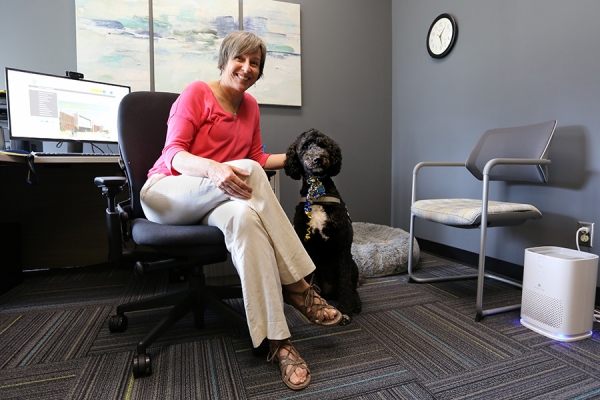
Therapist Giselle St. Louis and therapy dog WinnieHaving a ruff day? Therapist Giselle St. Louis and therapy dog Winnie are here to help.

Canine comfort part of caring for engineering students

Clinical therapist Giselle St. Louis has a new partner in Windsor Engineering’s wellness office, helping engineering students with mental health and wellness — Winnie the therapy dog.

A labradoodle, cross-bred between a Labrador retriever and a poodle, Winnie comes by her good looks naturally, but had earned her therapy credentials the old-fashioned way, completing a rigorous six-month training program at Mindfulness Therapy Dogs in Pinckney, Michigan.

Research has shown that petting a dog lowers the stress hormone cortisol while the interaction between a dog and a human increases levels of oxytocin, the feel-good hormone.

“Academics, relationship conflict, and in some cases social and cultural change, are factors in the amount of stress a student may encounter during the school year,” says St. Louis. “The ability to cope and manage stress and anxiety are critical in the student’s academic success. Winnie’s presence supports the nervous system, allowing it to relax, which makes therapy more effective.”

Meet-and-greet “Wednesdays with Winnie” sessions start July 27 and will run 3:30 to 4:30 p.m. in the student support services room 1160, Centre for Engineering Innovation.

To schedule a session with Winnie and St. Louis, or to learn more about the faculty’s counselling services, visit https://www.uwindsor.ca/engineering/counselling.

And by the way, doggie treats are not necessary. Winnie is well cared for.

—Gam Macasaet

Allesandro Rotondi strumming guitarAllesandro Rotondi will perform as part of the President’s Concert Series at noon Wednesday, July 20.

Open-air concert to feature alumnus singer-songwriter

The President’s Concert Series continues Wednesday, July 20, with a noontime performance by singer-songwriter Allesandro Rotondi (BMus 2020, B.Ed 2022).

Sponsored by the Office of the President, the series is intended to bring together the campus community in an informal setting. Attendees will enjoy free gelato as well as music by UWindsor alumni.

Bring a lawn chair or blanket at noon to the grassy area between Assumption Hall and Assumption Church — in the event of inclement weather, the concert will relocate to the student centre Commons.

Rotondi is a multi-instrumentalist specializing in the genres of pop, rock, and jazz, whether on guitar, piano, bass, percussion, or ukulele. He has released the solo album Around You and two additional albums with the pop-rock quartet Midnight Metro. Learn more at linktr.ee/allesanbro.

beach flying warning flagsThe Coastal Research Group’s studies on awareness of rip tides is especially timely given the recent spate of drownings on the Great Lakes. Photo by Michael Spadoni/Pexels

Coastal researcher says drownings demonstrate need for beach safety awareness

A spate of recent drownings in the Great Lakes and elsewhere in Canada has put the spotlight on beach safety, says University of Windsor researcher Chris Houser.

Dr. Houser, dean of the Faculty of Science, heads the Coastal Research Group. Its members study the physical and social dimensions of the drowning hazard posed by rip currents in field sites along the Great Lakes, in the Maritimes, and in Costa Rica.

Beachgoers often aren’t aware that rip currents exist in the Great Lakes, Houser says. His team’s research has shown that even when warning signs are posted, beachgoers often fail to notice them, or misinterpret the signs.

“Beach safety cannot be achieved through passive means,” Houser said. “It requires accurate and dynamic warnings as well as an investment in lifesaving technology and lifeguards.”

To date in 2022, there have been 47 confirmed drownings and 12 rescues on the Great Lakes, according to statistics compiled by the Great Lakes Surf Rescue Project. According to the water-safety advocacy group that trains lifeguards and first responders on open-water rescues, there have been 1,093 confirmed drownings in the Great Lakes since 2010.

On June 29, a Burlington man drowned in Lake Huron. On June 27, a 38-year-old man drowned in Lake Michigan while trying to rescue a teen in distress at Indiana Dunes National Park. On June 20, a migrant farm worker from Guatemala drowned in Lake Erie near Leamington while swimming in the water with friends. These drownings are among 13 on the Great Lakes last month alone.

In a recent article in The Conversation, Houser and Alex Smith, a post-doctoral fellow in the Coastal Research Group, predict a higher number of drownings this summer as people travel more to catch up on lost experiences during the pandemic.

“This so-called ‘revenge travel’ has the potential to raise the number of drownings, as more people choose to enter the water, even when the conditions aren’t ideal,” they write.

—Sarah Sacheli

students being oriented academicallySubmit plans for academic orientation programming so they can be assigned a space and included in promotional materials for new students.

Organizing committee issues call for academic program orientation plans

Organizers of UWindsor Welcome Week invite faculty members to submit their plans for academic orientation programming so they can be assigned an appropriate space and included in promotional materials for new students.

The orientation sessions are held on Wednesday, Sept. 7 and should finish by 2 p.m. to allow attendees to participate in the Welcoming Celebration.

The Student Success and Leadership Centre has already reserved campus spaces that departments traditionally book for their sessions, and will assign them on completion of the online proposal form. Register an academic program orientation here no later than July 13.

Find more information on the centre’s website.

child making artIn an article in The Conversation, education lecturer Kimberly Hillier offers tips on how to combat learning loss in children over the summer break. Photo by Cottonbro/Pexels.

Combating ‘summer slide’ may be as simple as reading licence plates, lecturer writes

Kimberly Hillier

Everyday activities that promote early literacy skills can help combat learning loss over the summer break, writes Faculty of Education lecturer Kimberly Hillier in an article published in The Conversation.

“For researchers of children’s literacy, year-end reflections may prompt discussions of the summer slide — children’s loss of knowledge over summer break, particularly in literacy and numeracy — and what can be done to mitigate this learning loss,” Dr. Hillier writes.

Her article offers practical suggestions — tips that won’t feel like schoolwork. Hillier suggests giving children space and opportunities to practise independence, encouraging them to move their bodies, visiting a library, offering multi-sensory experiences, and reading letters and text found in their everyday environment.

Read the full article on supporting children’s early literacy skills here.

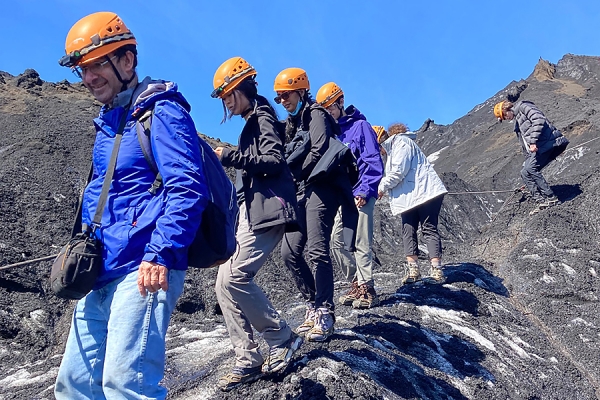
UWindsor students on a study-abroad field course in Iceland.UWindsor students on a study-abroad field course in Iceland in May 2022, led by School of Environment professors Maria Cioppa and Ali Polat.

Newsletter provides update on Faculty of Science

From the return of studying abroad field courses to Costa Rica and Iceland, to a strong showing of new research projects, the students, faculty, and staff in the Faculty of Science are enjoying a return to in-person activities.

Check out the Summer 2022 edition of Science Matters, the faculty’s newsletter that highlights science achievements — from people to research.