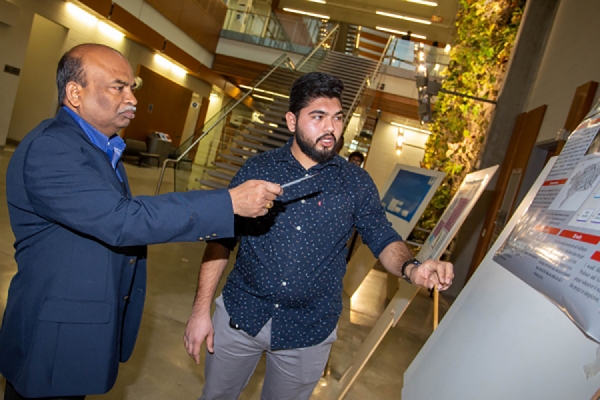
Civil engineering professor Tirupati Bolisetti and Kwaku Gyau Gyamfi discuss the student’s project on resilience of water supplies in Arctic communities on World Water Day.
The next time you look at the Great Lakes or wonder about Arctic communities, you will think about them a little differently because of the research of engineering students Vrashesh Vipul Karkar and Kwaku Gyau Gyamfi.
Karkar examined the water in Great Lakes Basin watersheds to assess the amount of microplastics that are present in the water. His research focuses on the quantities of microplastics humans are releasing into rivers and the Great Lakes, developing cutting edge modelling tools to quantify the microplastics being released.
What if a material that could protect structures from earthquake damage was widely available all over the world? Niel Van Engelen is exploring the use of scrap tires as a type of shock absorber between buildings and their foundations.
A professor in the Department of Civil and Environmental Engineering, Dr. Van Engelen is an expert in structural control and earthquake engineering. The project team includes doctoral student Norouz Jahan and master’s student Tanveer Shaik.
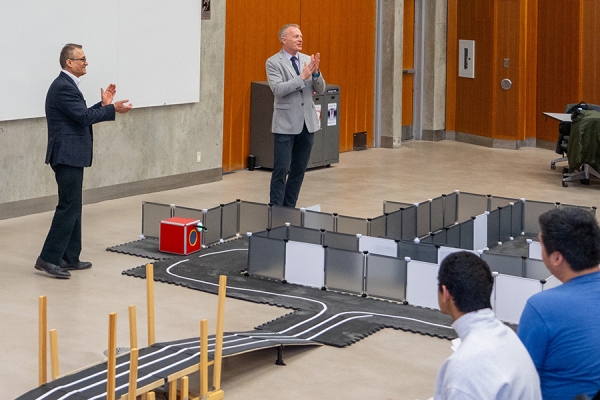
Professor Rashid Rashidzadeh and dean Bill Van Heyst congratulate engineering students on their work programming model trains to navigate an obstacle course.
A competition challenging first-year engineering students to design and program an autonomous model locomotive gave them the chance to apply theoretical knowledge to real-world applications, says professor Rashid Rashidzadeh.
His course in Cornerstone Design is mandatory for first-year students and culminated in more than 70 teams competing for cash prizes April 1 and 2.
The class is highly praised by students for its hands-on approach, says Dr. Rashidzadeh.
“Students thoroughly enjoy the practical aspect of the course, allowing them to put their academic understanding into action.”
Tensions ran high as teams tested their design and programming skills by putting their railcars through a course with such obstacles as a functional drawbridge and customs communication booth.
Distracted driving is a worldwide problem, says professor Chris Lee, and preventing it is of global importance for improved road safety.
“There has been a startling rise in the number of fatal and seriously injured collisions linked to the widespread use of electronic gadgets in automobiles,” he says.
Dr. Lee, a professor in the Department of Civil and Environmental Engineering, and Master’s student Larissa Dushime are collaborating with civil engineering professor Nicola Baldo at the University of Udine to compare driver behaviours in Canada and Italy.
If we want to mitigate the effects of climate change on waterways, we’ll need to change our own ways, says Tirupati Bolisetti.
A professor in the Department of Civil and Environmental Engineering, he integrates socio-economic factors into water management models and adaptation strategies from the Great Lakes to the Arctic. Challenges addressed in his research range from urban flooding to quality and quantity of drinking water supply.
It takes a lot of juice to run a greenhouse, and a UWindsor researcher is leading a project exploring how to provide it.
Rupp Carriveau, a professor in the Department of Civil and Environmental Engineering, and a team that includes partners from the agricultural and energy industries, have secured funds to investigate the use of hydrogen generated by wind power to supply power to both the electrical grid and the greenhouse sector.
World Water Day is more than simply a commemoration, says civil and environmental engineering professor Tirupati Bolisetti: it’s a call to action, an opportunity to make a genuine impact in conservation and sustainability.
He is calling on students in any discipline to participate in a display of research posters on March 22. This year’s theme, “Water Peace,” highlights collaborative efforts to achieve harmony and sustainability in water management.
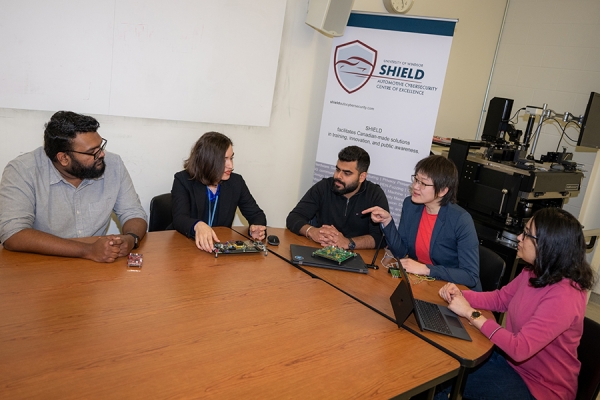
Representatives of the SHIELD Automotive Cybersecurity Centre of Excellence and Block Harbor Cybersecurity discuss their collaboration on addressing vehicle defences against cyberattack.
Partnering with specialists Block Harbor Cybersecurity will help UWindsor students develop skills in high demand, says engineering professor Mitra Mirhassani, co-director of the SHIELD Automotive Cybersecurity Centre of Excellence.
Headquartered in Troy, Michigan, the company develops tests to determine whether vehicles are meeting standards against cyber threats. It will provide cases to SHIELD for training in assessing the robustness of vehicle security measures.
The partnership provides a valuable link between academe and industry, Dr. Mirhassani says.
“SHIELD was established with the goal of training experts in this exciting field,” she says. “Automotive cybersecurity requires a hands-on approach.”
The next wave of the internet will completely change how people connect, communicate, and play by submerging them in a virtual world, says professor Ning Zhang.
But in “A Survey on Metaverse: Fundamentals, Security, and Privacy,” an article co-authored with colleagues from Xi’an Jiaotong University and the University of Waterloo, he warns that this immersive arena is still developing to its full potential, so making forecasts is difficult.
A professor in the UWindsor Department of Electrical and Computer Engineering, Dr. Zhang points to the significant investment of major corporations like Apple and Meta in technologies like virtual reality.

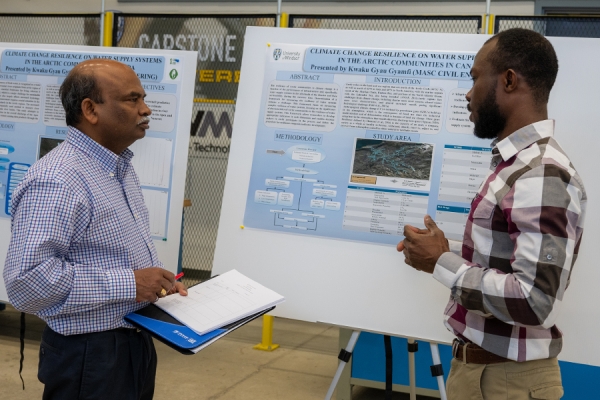 Civil engineering professor Tirupati Bolisetti and Kwaku Gyau Gyamfi discuss the student’s project on resilience of water supplies in Arctic communities on World Water Day.