
There are numerous institutional costs incurred to conduct research at a university ('indirect costs of research'). Such costs include maintenance of the buildings where research is conducted, the electricity used to power the specialized equipment, or the staff that provide support for research funding applications/agreements,oversight and compliance. The Government of Canada’s Research Support Fund (RSF) assists Canadian postsecondary institutions and their affiliated research hospitals and institutes with the expenses associated with managing the research funded by the three federal research granting agencies:
- The Canadian Institutes of Health Research (CIHR);
- The Natural Sciences and Engineering Research Council (NSERC); and
- The Social Sciences and Humanities Research Council (SSHRC).
Every year, the federal government invests in research excellence in the areas of health sciences, engineering, natural sciences, social sciences and humanities through its three granting agencies. The Research Support Fund reinforces this research investment by helping institutions ensure that their federally funded research projects are conducted in world-class facilities with the best equipment and administrative support available.
The program (formerly known as the Indirect Costs Program) was introduced in 2003 as part of the federal government’s strategy to make Canada one of the world’s top countries in research and development. It currently has a budget of over $500 million and serves more than 150 postsecondary institutions across the country.
The five main expenditure areas of the Research Support Fund are: Facilities; Resources; Management and Administration; Regulatory Requirements and Intellectual Property.
- Research facilities;
- Research resources;
- Management and administration of an institution's research enterprise;
- Regulatory requirements and accreditation; and
- Intellectual property and Knowledge mobilization.
Examples of costs supported by the program are:
- Institutional support for the completion of grant and award applications/research proposals;
- Training of faculty and research personnel for health and safety;
- Costs related to the maintenance of libraries and laboratories; and
- Administrative costs associated with patent applications.
Calculation of the Research Support Fund Grant
The University of Windsor's Research Support Fund allocation is calculated based on Tri-Council (CIHR, NSERC, and SSHRC) funding awarded in the previous fiscal year.
In 2026-27 UWindsor notional allocation is $3,626,653 dedicated to five expenditure categories:

This allocation supports central research administration and core facilities including operating expenditures, technician salaries, operation and maintenance of equipment, central administration, library costs, research planning and promotion, upgrades to facilities, training of faculty and students in research safety and biohazards, patent applications, central computing service costs and database and information system upgrades.
The Research Support Fund (RSF) is the major source of funding for infrastructure support used to attract and retain high-quality researchers to the University of Windsor. Our researchers depend on this support to conduct their research activities which creates research programs that are crucial to their overall research success.
Incremental Project Grants
The Incremental Project Grants (IPG) provides support additional to the Research Support Fund which provides further support for the indirect costs of research.
The IPG provides eligible institutions with additional support for projects that focus on a set of priorities that cut across the RSF’s five existing categories of eligible expenses. The initial four IPG priority areas are:
- innovation and commercialization activities;
- facilities renewal, including deferred maintenance;
- information resources, including digital resources, open access and databases; and
- equity, diversity and faculty renewal (in the context of equity, diversity and inclusion).
In 2026-2027 the University of Windsor notional IPG amount is $ 326,295. This funding is used to provide support to UWindsor’s research and innovation community and to support research partnerships.
Research Security
Introduced in 2022, Research Security is categorized as a fifth priority area of the IPG. Research Security funding will help build capacity within postsecondary institutions to identify, assess and mitigate the potential risks to research security.
Further information on Research Security is available on the website.
In 2026-2027 the University of Windsor notional Research Security amount is $133,836. This funding is used to provide support to UWindsor’s research community by helping researchers identify, assess and mitigate potential risks to research security.
Institutional performance objectives
Institutional Investment Stories
Building Capacity for Innovation and Intellectual Property Commercialization
The Research Support Fund has played an important role in supporting the translation of research activities into real world solutions through innovation and commercialization activities at the faculty and student level. The University of Windsor has been building a reimagined entrepreneurship and innovation strategy called Fusion that integrates the student and faculty experience by providing specific support for IP commercialization and scaffolded supports to launch and scale new ventures. Fusion officially launches in September 2026.
During the critical building period the Research Support Fund has been used to run IP programs within Fusion including a scouting platform that leverages on-campus expertise with modern tools to evaluate intellectual property prior to protection to create more definitive and defendable IP. With more defensible ideas, the commercialization team has stronger negotiating and bargaining opportunities with licensing and technology partners and stronger go-to-market strategies for faculty-based start-ups.
The research support fund has also been used to build the framework for a centralized core-facilities program that will align internal infrastructure to modernizing fee-for-service work across departments, faculties and with external partners. Creating a coordinated framework for the efficient and effective use of research infrastructure and better utility for research teams.
Support also saw university affiliated start-ups and research groups showcased at various events in Ontario including Queen’s Park, OCI DiscoveryX and tours with various ministers and VIPs.
Through continued investment in intellectual property and commercialization activities, research is making its way from the lab to the application.
Enhancing Access to Research Infrastructure through Shared Services
The Research Support Fund has played an important role in establishing a core-services access model for research instrumentation at the University of Windsor. Leveraging research infrastructure to its fullest extent matters on three fronts: it maintains the utility and operational health of the systems themselves through regular use, it opens access to critical scientific equipment for researchers both on and off campus, and it creates the conditions for collaboration across disciplines that would otherwise not share a bench.
During this foundational period, the Research Support Fund has been used to work directly with core stakeholders across faculties to understand the barriers to standing up a coordinated core-facilities model and to benchmark best practices from leading research universities. That work has produced a governance structure, a revenue generation and distribution model, and a systems update funding pathway — each of which is now moving into production rather than remaining on paper.
The Fund has also supported the development of a marketing and communications plan that will extend these opportunities beyond the University of Windsor, ensuring industry and community partners understand that access and collaboration are genuinely available. A core facility that is only known internally is a facility operating below its capacity.
Through continued investment in core-services models, research infrastructure at the University of Windsor will maintain its viability, its utilization, and its capacity to support the growth of research across the institution.
Space Transformation in Ed Lumley Centre for Engineering Innovation (CEI)
The Research Support Fund played a pivotal role in transforming research spaces within the Ed Lumley Centre for Engineering Innovation (CEI) to meet the evolving needs of our researchers and their federally funded projects. Several rooms were reconfigured into specialized research facilities to support advanced computational modeling, additive manufacturing, sustainable pavement and transportation research, hydrogen cell containment studies, and structural engineering innovation.
These upgrades included installing new electrical systems, improving ventilation and exhaust configurations, adding water systems and sinks, and modernizing workstations to accommodate high-performance computing and equipment. In addition, spaces were adapted to house cutting-edge additive manufacturing technology and sustainable infrastructure testing facilities, ensuring compliance with safety standards and operational efficiencies.
By investing in these facility improvements, the University of Windsor has strengthened its ability to conduct world-class research in areas critical to Canada’s future such as clean energy, advanced manufacturing, and sustainable infrastructure and transportation. The RSF program’s support ensures that researchers have access to modern, well-equipped spaces that foster collaboration, attract external funding, and enable groundbreaking discoveries.
Addition to DETECT Laboratory
The DETECT Laboratory at the University of Windsor is a unique research space dedicated to forensic taphonomy and decomposition chemistry. Researchers using this facility investigate the chemical processes that occur after death, focusing on identifying biochemical markers that can improve time-since-death estimation and assist law enforcement in locating and recovering human remains. The Research Support fund has been critical to this facility’s launch and operation and maintenance.
RSF support helped fund the addition of dedicated compressed air and electrical infrastructure. This upgrade was essential to support advanced instrumentation and experimental setups required for cutting-edge forensic science research.
This improvement not only supports federally funded projects in natural sciences but also strengthens Canada’s leadership in forensic research. The enhanced facility enables researchers to conduct experiments with greater accuracy and efficiency, fostering innovation and collaboration with national and international partners.
Research Support Fund
Total funding for 2026-2027: $3,626,653

Eligible expenditure category: Research facilities
- Institutional performance objective: Continual improvement of research facilities
- Indicator: Status of renovation and maintenance of research facilities
- Output: Portion of RSF grant invested in upgrades
- Target Outcome: Enhanced research capabilities and infrastructure, leading to improved research productivity and quality
Eligible expenditure category: Research resources
- Institutional performance objective: Provide researchers and administrators with access to citation indices to increase collaboration, facilitate literature searches and measure research impact
- Indicator: Use of research metrics tool
- Output: Portion of Research Support Fund to support license to a bibliometric tool offering access to research performance metrics
- Target Outcome: Continued subscription and usage of research metrics tools
Eligible expenditure category: Management and administration
- Institutional performance objective: The Office of Innovation, Partnerships and Entrepreneurship (OIPE) was created in 2024 to provide support to researchers and student entrepreneurs and to promote collaboration and knowledge transfer
- Indicator: Operational efficiency and effectiveness
- Output: Portion of RSF grant invested in salaries of and professional development for OIPE staff
- Target Outcome: Maintain/increase number of grant applications and contracts submitted for funding
Eligible expenditure category: Regulatory requirements and accreditation
- Institutional performance objective: Sufficient administrative personnel support for the Research Ethics Board to manage approval and monitoring processes for research involving human participants
- Indicator: Adherence to provincial, federal, and international regulatory guidelines.
- Output: Portion of grant invested in initiatives supporting regulatory requirements and accreditation
- Target Outcome: Maintain/increase support to researchers who require ethics clearance
Eligible expenditure category: Intellectual property and Knowledge mobilization
- Institutional performance objective: Continue to support patent applications and commercialization activities in addition to agreements or partnerships with industry through the creation of the Office of Research Partnerships
- Indicator: Number of technologies disclosed and reviewed
- Output: Portion of RSF grant invested in technology assessment and IP protection
- Target Outcome: Maintain/increase the number of invention disclosures, patents, patent applications and industry partnership/agreements
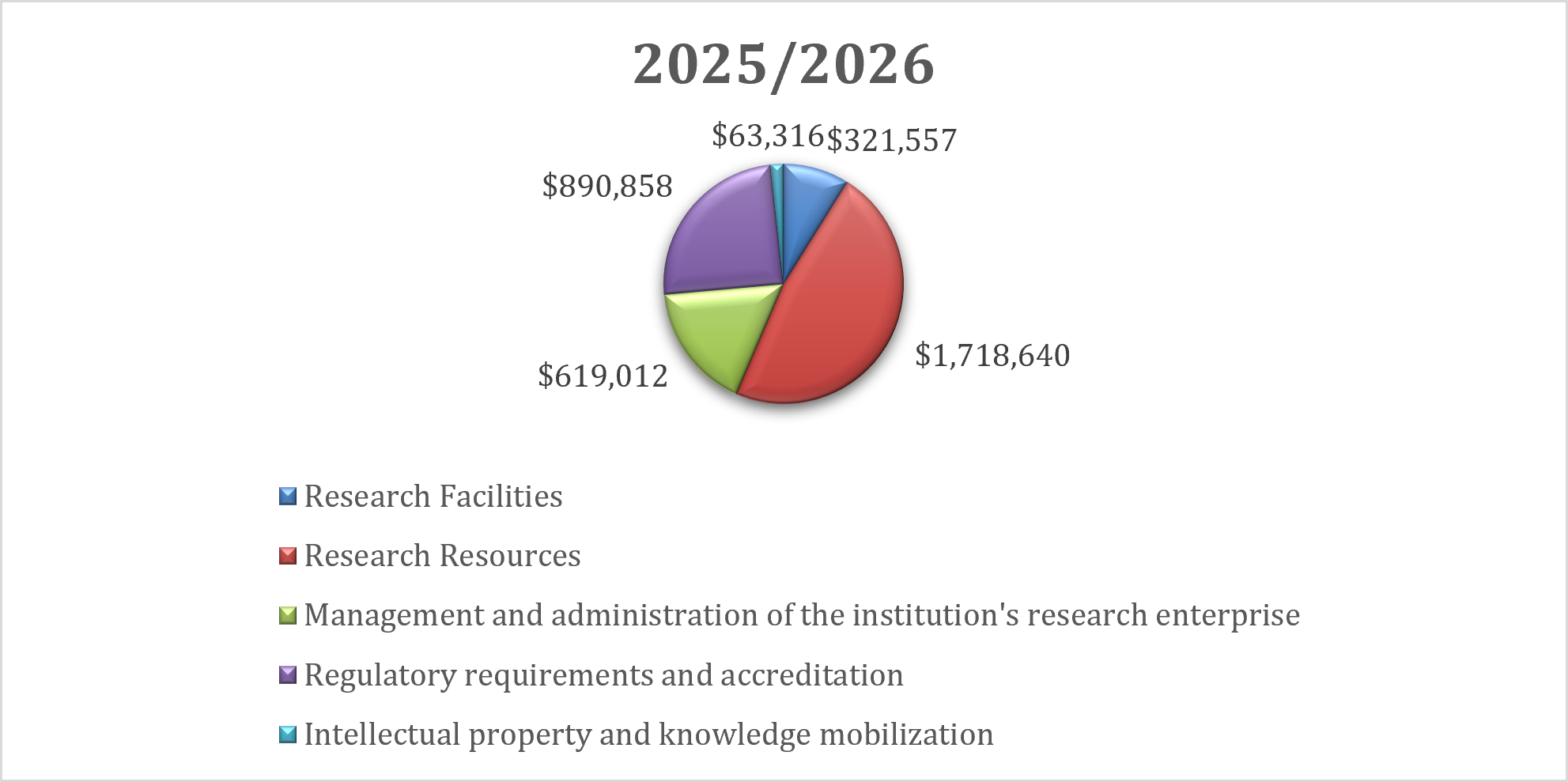
Total funding for 2025-2026: $3,613,383

Eligible expenditure category: Research facilities
- Institutional performance objective: Continual improvement of research facilities
- Indicator: Status of renovation and maintenance of research facilities
- Output: Portion of RSF grant invested in upgrades
- Target Outcome: Enhanced research capabilities and infrastructure, leading to improved research productivity and quality
- Reported Outcome: Ongoing facility maintenance and targeted infrastructure upgrades supported the continued functionality and effectiveness of research spaces across the institution.
Eligible expenditure category: Research resources
- Institutional performance objective: Provide researchers and administrators with access to citation indices to increase collaboration, facilitate literature searches and measure research impact
- Indicator: Use of research metrics tool
- Output: Portion of Research Support Fund to support license to a bibliometric tool offering access to research performance metrics
- Target Outcome: Continued subscription and usage of research metrics tools
- Reported Outcome: Access to research metrics tools was maintained, supporting research assessment, collaboration development, and evidence-based decision-making.
Eligible expenditure category: Management and administration
- Institutional performance objective: The Office of Innovation, Partnerships and Entrepreneurship (OIPE) was created in 2024 to provide support to researchers and student entrepreneurs and to promote collaboration and knowledge transfer
- Indicator: Operational efficiency and effectiveness
- Output: Portion of RSF grant invested in salaries of and professional development for OIPE staff
- Target Outcome: Maintain/increase number of grant applications and contracts submitted for funding
- Reported Outcome: Continued investment in OIPE staffing and operations supported research development, partnership activities, and innovation services across the institution.
Eligible expenditure category: Regulatory requirements and accreditation
- Institutional performance objective: Sufficient administrative personnel support for the Research Ethics Board to manage approval and monitoring processes for research involving human participants
- Indicator: Adherence to provincial, federal, and international regulatory guidelines.
- Output: Portion of grant invested in initiatives supporting regulatory requirements and accreditation
- Target Outcome: Maintain/increase support to researchers who require ethics clearance
- Reported Outcome: Administrative support helped maintain efficient research ethics processes and compliance with applicable regulatory requirements.
Eligible expenditure category: Intellectual property and Knowledge mobilization
- Institutional performance objective: Continue to support patent applications and commercialization activities in addition to agreements or partnerships with industry through the creation of the Office of Research Partnerships
- Indicator: Number of technologies disclosed and reviewed
- Output: Portion of RSF grant invested in technology assessment and IP protection
- Target Outcome: Maintain/increase the number of invention disclosures, patents, patent applications and industry partnership/agreements
- Reported Outcome: Technology assessment and commercialization support activities helped sustain institutional capacity for intellectual property management and industry engagement.
Total funding for 2024-2025: $3,639,464
Eligible expenditure category: Research facilities
- Institutional performance objective: Continual improvement of research facilities.
- Indicator: Status of renovation and maintenance of research facilities.
- Output: Portion of RSF grant invested in upgrades.
- Target Outcome: Complete renovations to the Ed Lumley Centre for Engineering Innovation to support the installation of new infrastructure to advance UWindsor's automotive/automobility capacity.
- Reported Outcome: Renovations at the Ed Lumley Centre for Engineering Innovation were completed, enabling installation of advanced infrastructure that supports automotive and automobility research initiatives. In addition, renovations were made to support research in the area of forensic sciences.
Eligible expenditure category: Research resources
- Institutional performance objective: Provide researchers and administrators with access to citation indices to increase collaboration, facilitate literature searches and measure research impact
- Indicator: Use of research metrics tool.
- Output: Portion of Research Support Fund to support license to a bibliometric tool offering access to research performance metrics.
- Target Outcomes: Continued subscription and usage of research metrics tools.
- Reported Outcome: The institution maintained its subscription to bibliometric tools, ensuring researchers had uninterrupted access to citation indices and performance metrics for collaboration and impact analysis.
Eligible expenditure category: Management and administration
- Institutional performance objective: The Office of Research Partnerships was launched in 2023 to provide support to researchers and to promote collaboration and knowledge transfer.
- Indicator: Efficiency
- Output: Portion of RSF grant invested in salaries of and professional development for Research Partnerships staff.
- Target Outcomes: Maintain/increase number of grant applications and contracts submitted for funding.
- Reported Outcome: The Office of Research Partnerships was renamed the Office of Innovation, Partnerships and Entrepreneurship. It supported an increased number of grant applications and industry contracts, improving collaboration and knowledge transfer across research units.
Eligible expenditure category: Regulatory requirements and accreditation
- Institutional performance objective: Sufficient administrative personnel support for the Research Ethics Board to manage approval and monitoring processes for research involving human participants.
- Indicator: Adherence to provincial, federal, and international regulatory guidelines.
- Output: Portion of grant invested in initiatives supporting regulatory requirements and accreditation.
- Target Outcomes: Maintain/increase support to researchers who require ethics clearance
- Reported Outcome: Administrative support for the REB was sustained, enabling timely reviews and compliance with TCPS 2 guidelines, while providing researchers with consistent ethics clearance assistance.
Eligible expenditure category: Intellectual property and knowledge mobilization
- Institutional performance objective: Continue to support patent applications and commercialization activities in addition to agreements or partnerships with industry through the creation of the Office of Research Partnerships
- Indicator: Number of technologies disclosed and reviewed
- Output: Portion of RSF grant invested in technology assessment and IP protection
- Target Outcomes: Maintain/increase the number of invention disclosures, patents, patent applications and industry partnership/agreements.
- Reported Outcome: The institution maintained strong IP support, resulting in continued invention disclosures, patent filings, and new industry partnerships that advance commercialization efforts.

Total funding for 2023-2024: $3,549,903
Eligible expenditure category: Research facilities ($522,551)
- Institutional performance objective: Continual improvement of research facilities
- Indicator: Status of renovation and maintenance of research facilities
- Output: Portion of RSF grant invested in upgrades
- Target Outcome: Completion of renovations to the Centre for Hybrid Automotive Research and Green Energy (CHARGE) Lab
- Reported Outcome: The renovations have been successfully completed, enhancing the lab's capabilities and supporting automotive research.
Eligible expenditure category: Research resources ($1,407,598)
- Institutional performance objective: Provide researchers and administrators with access to citation indices to increase collaboration, facilitate literature searches and measure research impact
- Indicator: Use of research metrics tool
- Output: Portion of Research Support Fund to support licence to a bibliometric tool offering access to research performance metrics
- Target Outcomes: Continued subscription and usage of research metrics tools
- Reported Outcome: The ongoing subscription and use of research metrics tools have improved coordination with the Office of Institutional Analysis and the Leddy Library. This collaboration has enabled the University to leverage institutional bibliometric tools more effectively, enhancing the measurement of diverse research and dissemination activities.
Eligible expenditure category: Management and administration ($602,894)
- Institutional performance objective: The University is launching the Research Partnerships Office to provide support to researchers and to promote collaboration and knowledge transfer.
- Indicator: Efficiency
- Output: Portion of RSF grant invested in salaries of and professional development for Research Partnerships staff
- Target Outcomes: Maintain/increase number of grant applications and contracts submitted for funding
- Reported Outcome: The establishment of the Research Partnerships Office has led to increased support for researchers and targeted professional development for staff which have improved efficiency and collaboration, resulting in a more robust pipeline of research initiatives and partnerships.
Eligible expenditure category: Regulatory requirements and accreditation ($896,582)
- Institutional performance objective: Sufficient administrative personnel support for the Research Ethics Board to manage approval and monitoring processes for research involving human participants
- Indicator: Adherence to provincial, federal, and international guidelines
- Output: Portion of grant invested in initiatives supporting regulatory requirements and accreditation
- Target Outcomes: Maintain/increase support to researchers who require ethics clearance
- Reported Outcome: The enhanced administrative support for the Research Ethics Board has resulted in improved compliance with regulatory guidelines. This investment has facilitated a smoother approval process for researchers, leading to an increase in the number of ethics clearances granted.
Eligible expenditure category: Intellectual property and Knowledge mobilization ($120,278)
- Institutional performance objective: Continue to support patent applications and commercialization activities in addition to agreements or partnerships with industry through the creation of the Office of Research Partnerships
- Indicator: Number of technologies reviewed
- Output: Portion of RSF grant invested in technology assessment
- Target Outcomes: Maintain/increase the number of invention disclosures, patents, patent applications and industry partnership/agreements
- Reported Outcome: The establishment of the Office of Research Partnerships has boosted our capacity to review technologies, invention disclosures, and patent applications. This proactive strategy has not only strengthened our collaborations with industry but also led to more successful commercialization efforts. Additionally, it has provided enhanced support for researchers as they navigate the patent process
Total funding for 2022-2023: $3,443,744
Eligible expenditure category: Research facilities
- Institutional performance objective: Continual improvement of research facilities
- Indicator: Status of renovation and maintenance of research facilities
- Output: Portion of RSF grant invested in upgrades
- Target Outcome: Completion of clean room construction in the Ed Lumley Centre for Engineering Innovation
- Reported Outcome: Portion of RSF has been directed to upgrades to other research facilities the Ed Lumley Centre for Engineering Innovation
Eligible expenditure category: Research resources
- Institutional performance objective: Provide researchers and administrators with access to citation indices to support increased collaboration opportunities, facilitate literature searches
and measure research impact - Indicator: Use of research metrics tool
- Output: Portion of Research Support Fund to support licensing to bibliometrics software that provides access to research performance metrics
- Target Outcomes: Continued subscription and usage of research metrics tools
- Reported Outcome: The addition of a Research Systems and Metrics Coordinator to the Office of Services (ORIS) has meant increased support for the campus community and has enabled more effective monitoring of research metrics, contracts and grant submissions. Additionally, this position has facilitated greater coordination with Office of Institutional Analysis and the Library, which has enabled the University to utilize the institutional bibliometric tools more effectively measure the broad range of research activities and dissemination activities more effectively.
Eligible expenditure category: Management and administration
- Institutional performance objective: The Office of Research and Innovation Services will continue to provide support to researchers to identify grants, partnerships and contract opportunities and support the development of grant applications. ORIS continues to identify areas for process improvements to provide strong support to our research community, while ensuring that we are adhering to the accountability framework outlined by federal and provincial funding bodies.
- Indicator: Efficiency
- Output: Portion of RSF grant invested in salaries of and professional development for Research Coordinators in ORIS
- Target Outcomes: Maintain/increase number of grant applications and contracts submitted for funding and strive for increased success rates in grant applications.
- Reported Outcome: Staff have received continued training in equity, diversity and inclusion, indigenization, knowledge mobilization, research security, and research data management.
Eligible expenditure category: Regulatory requirements and accreditation
- Institutional performance objective: Regulatory compliance with animal care
- Indicator: Maintain accreditation with standards administered by CCAC Certificate
- Output: Portion of grant invested in initiatives supporting regulatory requirements and accreditation
- Target Outcomes: Maintain/increase support to animal care unit
- Reported Outcome: Maintained compliance with regulatory standards
Eligible expenditure category: Intellectual property and Knowledge mobilization
- Institutional performance objective: Continue to support invention disclosures, patent applications, commercialization, licensing and spin-out activities. Increase the number of partnerships and agreements with industry with the goal of increasing research revenues.
- Indicator: Number of technologies reviewed through invention disclosures and the number of research partnerships
- Output: Portion of RSF grant invested in technology assessment of invention disclosures
- Target Outcomes: Maintain/increase the number of invention disclosures, patents, patent applications and industry partnership/agreements
- Reported Outcome: Increase in the number of invention disclosures while developing and cultivating new research collaborations and partnerships with industry
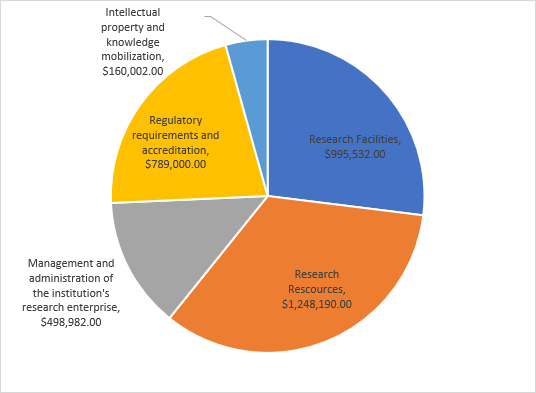
Total funding for 2021-2022: $3,327,424.00
Eligible expenditure category: Research facilities
- Institutional performance objective: Continual improvement of research facilities
- Indicator: Status of renovation and maintenance of research facilities
- Output: Portion of RSF grant invested in upgrades
- Target Outcome: Completion of clean room construction in the Ed Lumley Centre for Engineering Innovation
- Reported outcome: Due to delays related to the Covid-19 pandemic, clean room construction is ongoing
Eligible expenditure category: Research resources
- Institutional performance objective: Provide researchers and administrators with access to citation indices to increase collaboration, facilitate literature searches
and measure research impact - Indicator: Use of research metrics tool
- Output: Portion of Research Support Fund to support license to a bibliometric tool offering access to research performance metrics
- Target Outcomes: Continued subscription and usage of research metrics tools
- Reported outcome: ORIS and Leddy Library continued to collaborate to identify areas of research strength and potential collaboration using bibliometrics captured in SciVal.
Eligible expenditure category: Management and administration
- Institutional performance objective: Office of Research and Innovation services will continue to provide support to researchers to identify grants and contract opportunities and prepare grant applications and improve research administration systems and processes.
- Indicator: Efficiency
- Output: Portion of RSF grant invested in salaries of and professional development for Research Coordinators
- Target Outcomes: Maintain/increase number of grant applications and contracts submitted for funding
- Reported outcome: The addition of health and science coordinators to the research services office has meant increased support for campus community
Eligible expenditure category: Regulatory requirements and accreditation
- Institutional performance objective: Regulatory compliance with animal care
- Indicator: Maintain accreditation with standards administered by CCAC Certificate
- Output: Portion of grant invested in initiatives supporting regulatory requirements and accreditation
- Target Outcomes: Maintain/increase support to animal care unit
- Reported outcome: Increased personnel support has been essential to ensuring ongoing compliance with CCAC requirements
Eligible expenditure category: Intellectual property and Knowledge mobilization
- Institutional performance objective: Continue to support patent applications and commercialization activities in addition to agreements or partnerships with industry
- Indicator: Number of technologies reviewed
- Output: Portion of RSF grant invested in technology assessment
- Target Outcomes: Maintain/increase the number of invention disclosures, patents, patent applications and industry partnership/agreements
- Reported outcome: Innovation Administration Coordinator position has been essential for the University of Windsor’s increasing number of invention disclosures. In 2019-2020 we had four disclosures and in 2020-2021 we had six.
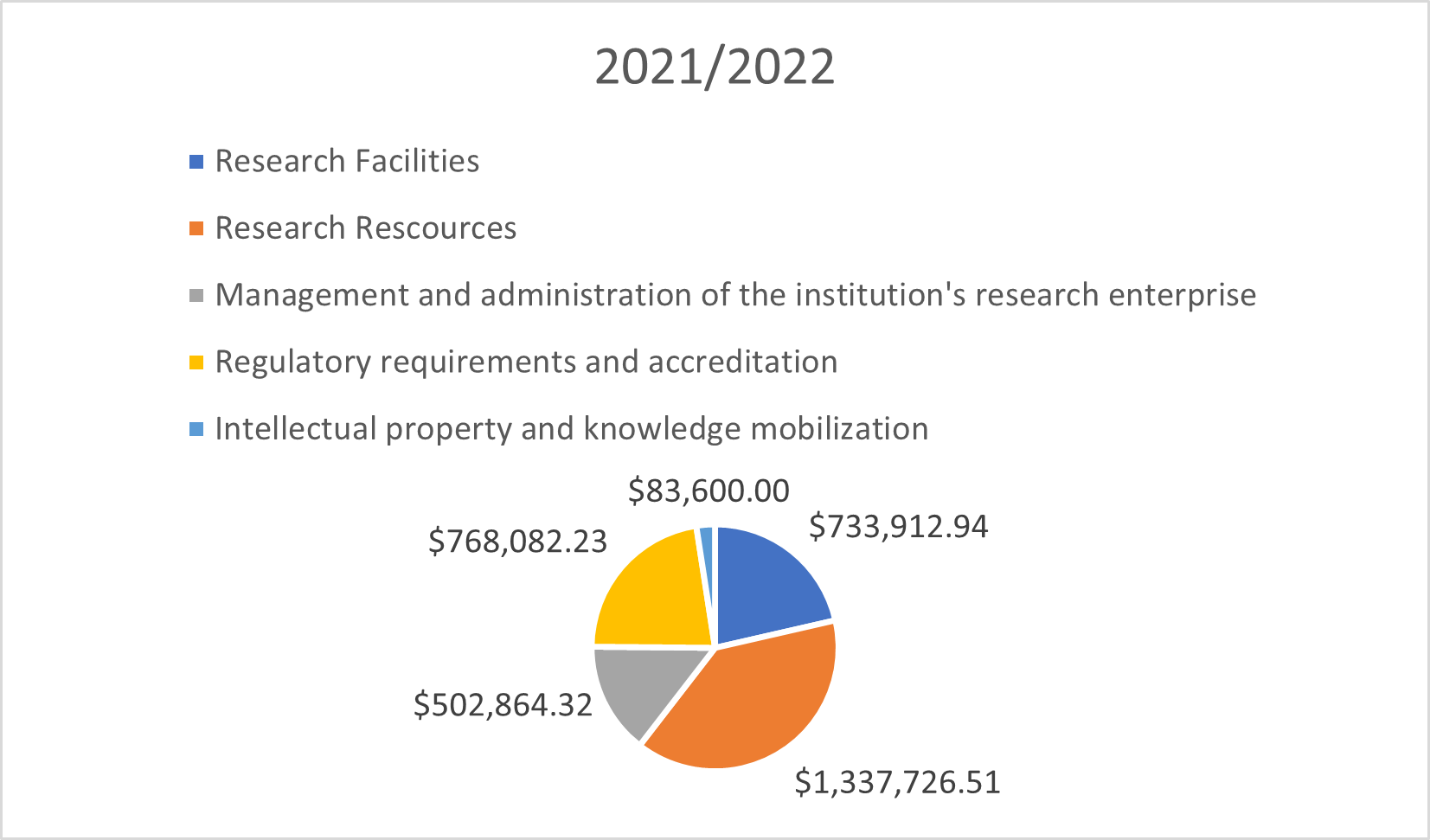
Total funding for 2020-2021: $3,236,220
Eligible expenditure category: Research facilities
- Institutional performance objective: Continual improvement of research facilities
- Indicator: Status of renovation and maintenance of research facilities
- Output: Portion of RSF grant invested in upgrades
- Target Outcome: Completion of clean room construction in the Ed Lumley Centre for Engineering Innovation
- Reported outcome: Due to delays related to the Covid-19 pandemic, clean room construction is ongoing
Eligible expenditure category: Research resources
- Institutional performance objective: Provide researchers and administrators with access to citation indices to increase collaboration, facilitate literature searches and measure research impact
- Indicator: Use of research metrics tool
- Output: Portion of Research Support Fund to support license to a bibliometric tool offering access to research performance metrics
- Target Outcomes: Continued subscription and usage of research metrics tool
- Reported outcome: ORIS and Leddy Library continued to collaborate to identify areas of research strength and potential collaboration using bibliometrics captured in SciVal.
Eligible expenditure category: Management and administration
- Institutional performance objective: Office of Research and Innovation services will continue to provide support to researchers to identify grants and contract opportunities and prepare grant applications and improve research administration systems and processes. Indicator: Efficiency
- Output: Portion of RSF grant invested in salaries of and professional development for Research Coordinators
- Target Outcomes: Maintain/increase number of grant applications and contracts submitted for funding
- Reported outcome: The addition of health and science coordinators to the research services office has meant increased support for campus community
Eligible expenditure category: Regulatory requirements and accreditation
- Institutional performance objective: Regulatory compliance with animal care
- Indicator: Maintain accreditation with standards administered by CCAC Certificate
- Output: Portion of grant invested in initiatives supporting regulatory requirements and accreditation
- Target Outcomes: Maintain/increase support to animal care unit
- Reported outcome: Increased personnel support has been essential to ensuring ongoing compliance with CCAC requirements
Eligible expenditure category: Intellectual property and Knowledge mobilization
- Institutional performance objective: Continue to support patent applications and agreements or partnerships with industry
- Indicator: Number of technologies reviewed
- Output: Portion of RSF grant invested in technology assessment
- Target Outcomes: Maintain/increase the number of invention disclosures, patents, patent applications and industry partnership/agreements
- Reported outcome: Innovation Administration Coordinator position has been essential for the University of Windsor’s increasing number of invention disclosures. In 2019-2020 we had four disclosures and in 2020-2021 we had six.
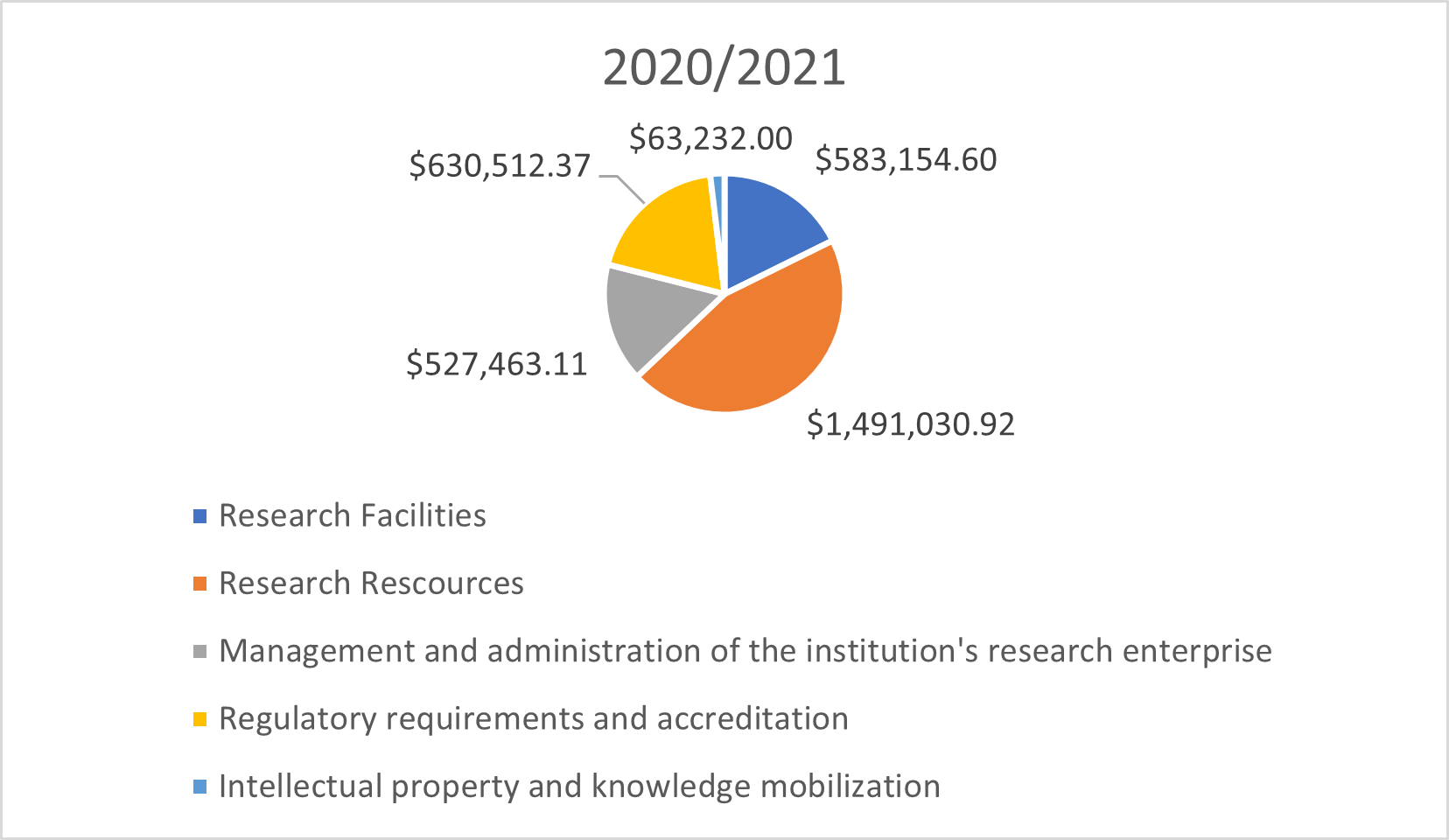
Total funding for 2019-2020: $3,288,398
Eligible expenditure category: Research facilities
- Institutional performance objective: Continual improvement of research facilities
- Indicator: Status of renovation and maintenance of research facilities
- Output: Portion of RSF grant invested in upgrades
- Outcomes reported at year end: Clean room construction in the Ed Lumley Centre for Engineering Innovation has begun but is delayed due to COVID-19 but has recently restarted and is expected to be completed by end of 2020
Eligible expenditure category: Research resources
- Institutional performance objective: Provide researchers and administrators with access to citation indices to increase collaboration, facilitate literature searches
and measure research impact - Indicator: Use of research metrics tool
- Output: Portion of Research Support Fund to support license to a bibliometric tool offering access to research performance metrics
- Outcomes reported at year end: Continued subscription and usage of research metrics tool
Eligible expenditure category: Management and administration
- Institutional performance objective: Office of Research and Innovation services will continue to provide support to researchers to identify grants and contract opportunities and prepare grant applications
- Indicator: Number of grant applications and contracts submitted
- Output: Portion of RSF grant invested in salaries of and professional development for Health-Research Coordinator
- Outcomes reported at year end: Increased number of grant applications and contracts submitted for health-related research.
Eligible expenditure category: Regulatory requirements and accreditation
- Institutional performance objective: Maintain functionality of lab space and ensure adherence to regulation
- Indicator: Maintain CCAC Certificate of Good Animal Practice
- Output: Portion of grant invested in upgrades and maintenance of research facilities and equipment to meet regulatory requirements
- Outcomes reported at year end: Renovations were conducted in the Animal Care facility to create new rodent housing rooms under CCAC Guidelines
Eligible expenditure category: Intellectual property and Knowledge mobilization
- Institutional performance objective: Continue to support commercialization activities by hiring a consulting firm to assess our automotive technologies for potential licensing with OEM and tier 1
- Indicator: Number of technologies reviewed
- Output: Portion of RSF invested in technology assessment
- Outcomes reported at year end: Licensees identified for each technology assessed
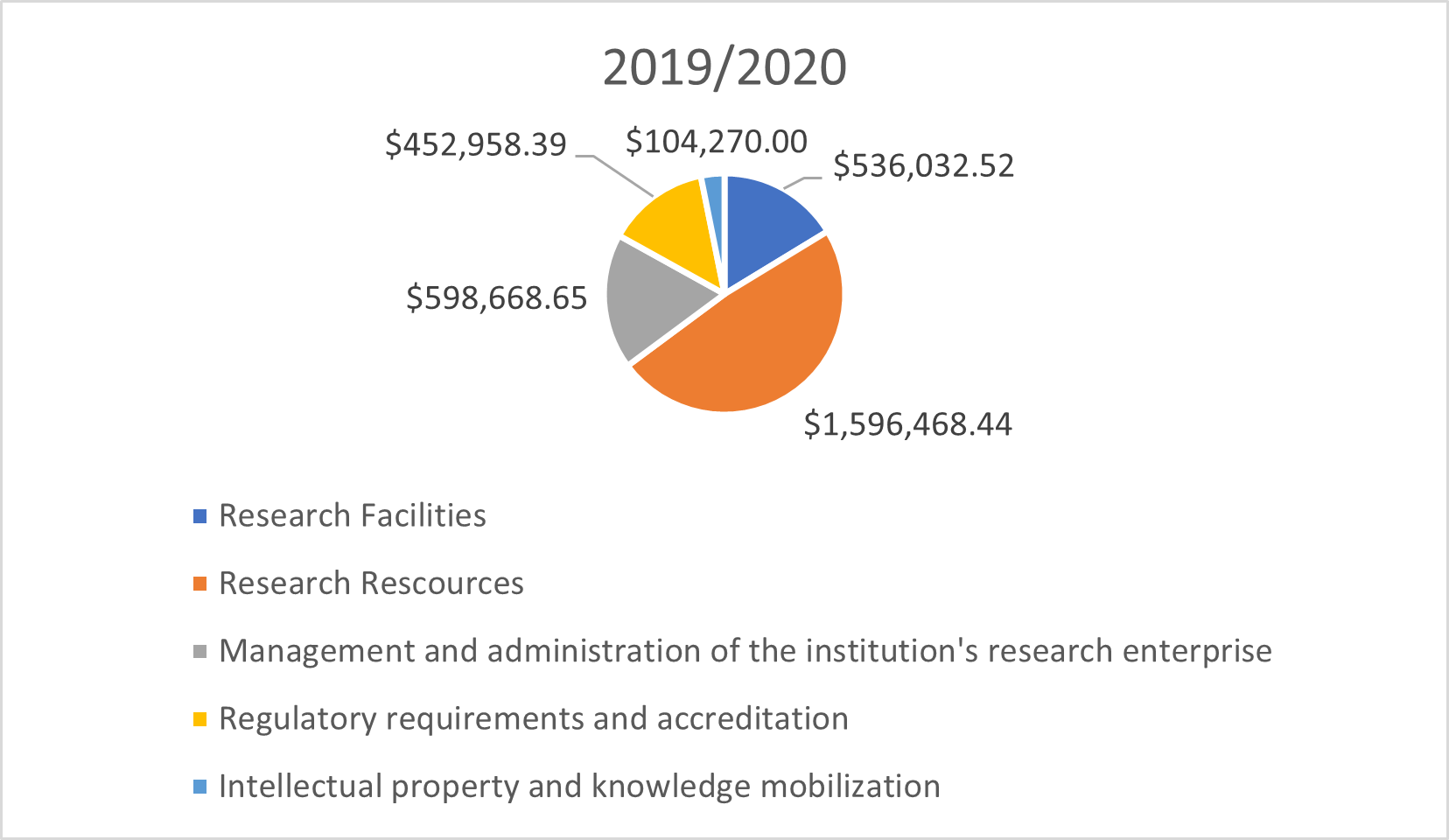
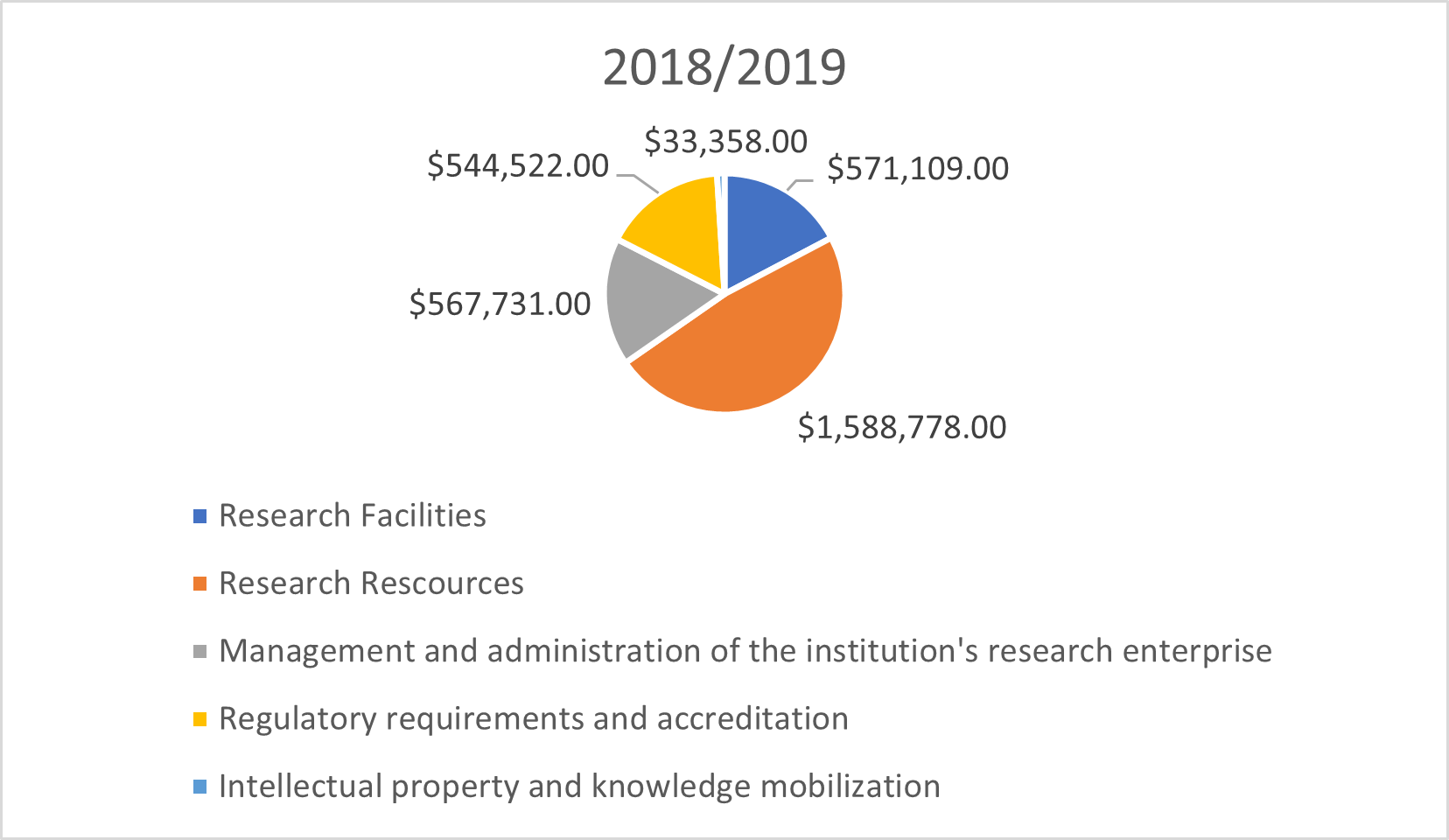
Total funding for 2018-2019: $3,305,498
Eligible expenditure category: Research facilities
- Institutional performance objective: Continual improvement of research facilities
- Indicator: Funds spent on custodial, security, and utilities
- Output: Portion of RSF grant invested in upgrades to facilities to support energy efficiency
- Outcomes reported at year end: An energy audit was conducted which led to energy efficiency initiatives in research spaces
Eligible expenditure category: Research resources
- Institutional performance objective: Manage and promote the institutional repository to support compliance with tri-agency Open Access Policy
- Indicator: Number of works uploaded to the repository
- Output: Portion of Research Support Fund to support Open Access to research (staff and IT resources)
- Outcomes reported at year end: There was a 167% increase in documents uploaded to the institutional repository. The library hired a librarian to work with the library's Academic Data Centre to provide research data management services in support of the sciences
Eligible expenditure category: Management and administration
- Institutional performance objective: Office of Research and Innovation services will continue to provide support to researchers to identify grants and contract opportunities and prepare grant applications
- Indicator: Number of grant applications and contracts submitted; workshop attendance
- Output: Portion of RSF grant invested in salaries of and professional development for Research Coordinators
- Outcomes reported at year end: The number of grant application/contract submissions stayed the same. The number of events remained the same and attendance decreased by 22%.
Eligible expenditure category: Regulatory requirements and accreditation
- Institutional performance objective: Maintain functionality of lab space and ensure adherence to regulation
- Indicator: Maintain CCAC Certificate of Good Animal Practice
- Output: Portion of grant invested in renovations to meet CCAC regulatory requirements
- Outcomes reported at year end: Repairs and upgrades were made to the mouse quarters in the barrier facility
Eligible expenditure category: Intellectual property and Knowledge mobilization
- Institutional performance objective: Continue to support commercialization activities by using an on-line platform for connecting with industry
- Indicator: Number of technologies posted to IN-PART
- Output: Portion of RSF invested in marketing innovation through IN-PART subscription
- Outcomes reported at year end: Raised profile of the 12 technologies posted to the site and led to discussions with new companies interested in licensing.
Eligible expenditure category: Research facilities
- Institutional performance objective: Continual improvement of research facilities
- Indicator: Funds spent on custodial, security, and utilities
- Output: Portion of RSF grant invested in upgrades
- Outcomes reported at year end: Fume hood replacement in Essex Hall completed
Eligible expenditure category: Research resources
- Institutional performance objective: Increase awareness of funding opportunities among faculty researchers by promoting use of Research Funding Database (e.g. Pivot)
- Indicator: Number of times online database is accessed
- Output: Portion of RSF grant invested in electronic database
- Outcomes reported at year end: Research funding database website saw an 81% increase in visits
Eligible expenditure category: Management and administration
- Institutional performance objective: Office of Research and Innovation services will continue to provide support to researchers to identify grants and contract opportunities and prepare grant applications
- Indicator: Number of grant applications and contracts submitted. Workshop attendance
- Output: Portion of RSF grant invested in salaries of and professional development for Research Funding Officers who edit and submit grants
- Outcomes reported at year end: 759 grants and contracts submitted. An Innovation Administration Coordinator was hired
Eligible expenditure category: Regulatory requirements and accreditation
- Institutional performance objective: Maintain functionality of lab space and ensure adherence to regulations. Provide ongoing support to the Research Ethics Board
- Indicator: Maintain safety levels of labs. More timely communication of certification
- Output: Portion of the RSF grant invested in subscription and training
- Outcomes reported at year end: Maintained compliance with regulatory standards. Continued to monitor time to clearance
Eligible expenditure category: Intellectual property and Knowledge mobilization
- Institutional performance objective: Continue to support disclosure of inventions in order to evaluate potential commercial opportunities
- Indicator: Number of invention disclosures annually
- Output: Portion of RSF invested in to support costs of IP protection (e.g. patent costs)
- Outcomes reported at year end: 2 disclosures. 1 patent issued
Eligible expenditure category: Research facilities
- Institutional performance objective: Continual improvement of research facilities
- Indicator: Construction of addition to Freshwater Restoration Ecology Centre addition
- Output: Portion of RSF grant invested in upgrades
- Outcomes reported at year end: Upgrades completed and maintenance ongoing.
Eligible expenditure category: Research resources
- Institutional performance objective: Increase awareness of funding opportunities among faculty researchers by promoting use of Research Funding Database (e.g. Pivot)
- Indicator: Number of times online database is accessed
- Output: Portion of RSF grant invested in electronic database
- Outcomes reported at year end: Increased usage of research funding database by 20% over previous year
Eligible expenditure category: Management and administration of an institution's research enterprise
- Institutional performance objective: Office of Research and Innovation services will continue to provide support to researchers to identify grants and contract opportunities and prepare grant applications
- Indicator: Number of grant applications and contracts submitted
- Output: Portion of RSF grant invested in salaries of and professional development for Research Funding Officers who edit and submit grants
- Outcomes reported at year end: 280 external grants and contracts submitted
Eligible expenditure category: Regulatory requirements and accreditation
- Institutional performance objective: Maintain functionality of lab space and ensure adherence to regulations. Provide ongoing support to the Research Ethics Board
- Indicator: Maintain safety levels of labs More timely communication of certification.
- Output: Portion of the RSF grant invested in subscription and training
- Outcomes reported at year end: Maintained compliance with regulatory standards. Evaluation of time to completion of applications is in progress
Eligible expenditure category: Intellectual property and Knowledge mobilization
- Institutional performance objective: Continue to support disclosure of inventions in order to evaluate potential commercial opportunities
- Indicator: Number of invention disclosures annually
- Output: Portion of RSF invested in to support costs of IP protection (e.g. patent costs)
- Outcomes reported at year end: 3 disclosures
Eligible expenditure category: Research facilities
- Institutional performance objective: Continual improvement of research facilities
- Indicator: Upgrading of fume hoods in Essex Hall
- Output: Portion of RSF grant invested in upgrades
- Outcomes reported at year end: 18 fume hoods repaired in 2015-2016
Eligible expenditure category: Research resources
- Institutional performance objective: Increase awareness of funding opportunities among faculty researchers by renewing subscription to Research Funding Database (e.g. Pivot)
- Indicator: Number of times online database is accessed
- Output: Portion of RSF grant invested in new electronic database
- Outcomes reported at year end: Subscription was renewed in July 2015. 143 visits in 2015-2016
Eligible expenditure category: Management and administration of an institution's research enterprise
- Institutional performance objective: Office of Research and Innovation services will continue to provide support to researchers to identify grants and opportunities and prepare grant applications
- Indicator: Number of grant applications submitted
- Output: Portion of RSF grant invested in salaries of Research Funding Officers who edit and submit grants
- Outcomes reported at year end: 171 grants
Eligible expenditure category: Regulatory requirements and accreditation
- Institutional performance objective: Provide training to ORIS, Research Ethics Board and Animal Care staff on research management software to effectively manage certification process
- Indicator: More timely communication of certification
- Output: Portion of the RSF grant invested in subscription and training
- Outcomes reported at year end: The Animal Care and Research Ethics Board staff have received training and increased use of research management software
Eligible expenditure category: Intellectual property and Knowledge mobilization
- Institutional performance objective: Continue to support disclosure of inventions in order to evaluate potential commercial opportunities
- Indicator: Number of invention disclosures annually
- Output: Portion of RSF invested in to support costs of IP protection (e.g. patent costs)
- Outcomes reported at year end: 8 disclosures and 19 patents filed
Incremental Project Grants
Total funding: $ 326,295
Project title: International Opportunities Research Coordinator ($ 120,000)
- IPG Priority Area: Innovation and commercialization activities
- Institutional performance objective: Innovation activities
- Indicator: Number of new international partnership opportunities and accessing the Horizons EU program
- Output: Portion of IPG grant invested in the salary and related costs of the International Opportunities Research Coordinator
- Target Outcome: Successfully applying for, and securing, Horizons EU funding.
Project title: Strengthening Inclusive Excellence through Research Supports and Education ($ 100,000)
- IPG Priority Area: Equity, diversity and faculty renewal
- Institutional performance objective: Enhance research support services and educational opportunities related to equity, diversity, and inclusion (EDI) and Indigenous Rights (IR).
- Indicator: Number of EDI and IR training sessions delivered to faculty, researchers, and staff; number of consultations and grant proposal reviews.
- Output: Portion of IPG grant invested in training programs and the salary of the coordinator and related training and supports
- Target Outcome: Increased awareness and application of EDI principles, improved recruitment, retention, and satisfaction of diverse faculty and students, and successful implementation of EDI and IR initiatives.
Project title: Innovation Coordinator ($50,504)
- IPG Priority Area: Innovation and commercialization activities
- Institutional performance objective: Strengthen innovation and commercialization capacity and support the translation of research into applied outcomes.
- Indicator: Level of engagement with innovation and commercialization supports (e.g., consultations, project development activities, partnerships).
- Output: Portion of IPG grant invested in the salary and related costs of the Innovation Coordinator.
- Target Outcome: Increased participation in innovation and commercialization activities, enhanced development of partnerships, and improved progression of research toward application and impact.
Project title: Large Projects Manager ($55,791)
- IPG Priority Area: Management and administration of the institution's research enterprise
- Institutional performance objective: Enhance institutional capacity to support and manage large, complex research projects and programs.
- Indicator: Level of support provided to large-scale funding applications and funded projects (e.g., coordinated submissions, project oversight activities).
- Output: Portion of IPG grant invested in the salary and related costs of the Large Projects Manager.
- Target Outcome: Improved coordination and competitiveness of large-scale funding applications and more effective management of complex research initiatives.
Total funding: $ 270,504
Project title: International Opportunities Research Coordinator ($120,000)
- IPG Priority Area: Innovation and commercialization activities
- Institutional performance objective: Innovation activities
- Indicator: Number of new international partnership opportunities and accessing the Horizons EU program
- Output: Portion of IPG grant invested in the salary and related costs of the International Opportunities Research Coordinator
- Target Outcome: Successfully applying for, and securing, Horizons EU funding.
- Reported Outcome: Outreach, advisory services, and opportunity identification activities enhanced institutional readiness to pursue international research funding and partnerships.
Project title: Research Ethics Support ($100,000)
- IPG Priority Area: Equity, diversity and faculty renewal
- Institutional performance objective: Strengthen institutional capacity to support ethical, inclusive, and responsible research through leadership of the Research Ethics Board.
- Indicator: Timeliness of ethics reviews; researcher consultations provided; continued compliance with TCPS 2 and institutional research ethics requirements.
- Output: Portion of IPG grant invested in the salary and related costs of the Interim Chair, Research Ethics.
- Target Outcome: Effective and timely ethics review processes, strengthened research ethics oversight, including key EDI and Indigenous Relations considerations, and continued support for equitable and responsible research practices.
- Reported Outcome: Review process was streamlined and Research Ethics leadership was revised to ensure continuity, strengthening ethics oversight and supporting compliant and inclusive research practices.
Project title: Innovation Coordinator ($50,504)
- IPG Priority Area: Innovation and commercialization activities
- Institutional Performance Objective: Strengthen innovation activities and knowledge mobilization capacity
- Indicator: Number of faculty supported in translating research into real-world applications; number of strategic partnerships formed; number of innovation-focused workshops delivered
- Output: Portion of IPG grant invested in the salary and operational costs of the Innovation Coordinator and related knowledge mobilization supports
- Target Outcome: Increased research impact through practical application, enhanced innovation culture, and expanded public/private sector engagement
- Reported Outcome: Strong partnerships with industry and community partners leading to increased research and innovation activities.
Total funding for 2024-2025: $229,670
Project title: Industrial Liaison Coordinator
- IPG Priority Area: Innovation and commercialization activities
- Institutional performance objective: Supporting commercialization
- Indicator: Number of industry-university interactions (activities, collaborations, tours, consultations, and projects)
- Target Outcome: Increased interactions with stakeholders and more grant submissions.
- Reported Outcome: Industrial liaison activities supported industry engagement by supporting automotive contract renewals, aligning with Ontario Vehicle Innovation Network, finalizing Greenhouse Technology Network participation, and establishing MOUs with Fruit and Vegetable Growers of Canada.
Project title: International Opportunities Research Coordinator
- IPG Priority Area: Innovation and commercialization activities
- Institutional performance objective: Advancing international research and innovation opportunities
- Indicator: Number of new international partnership opportunities and progress toward Horizon Europe funding
- Target Outcome: Successfully applying for Horizon Europe funding
- Reported Outcome: A coordinator was hired to build capacity for Horizon Europe engagement. Initial work included reviewing partnerships, identifying alignment with calls, and preparing faculty outreach materials.
Project title: Part-Time Research Coordinator
- IPG Priority Area: Innovation and commercialization activities
- Institutional performance objective: Innovation activities
- Indicator: Number of new Mitacs internships students and post-doctoral fellows are placed, and number of student and PDF fellowships and awards successfully applied for
- Target Outcome: Providing support for programs that fund undergraduate, graduate students, and post-doctoral fellows to more closely integrate them into the research and innovation community
- Reported Outcome: The part-time coordinator supported student and postdoctoral integration into research projects by supporting Mitacs and other applications. The position added significant capacity to support the review, development, and submission of grant applications.
Project title: Advancing Research Visibility and Capacity through a Full-Time Research Communications Coordinator
- IPG Priority Area: Information resources
- Institutional performance objective: Improve communication of research funding opportunities and successes
- Indicator: Frequency of research communications, number of training sessions, and volume of letters of support and award nominations
- Target Outcome: Increased visibility of research activities and improved institutional capacity for knowledge mobilization
- Reported Outcome: A full-time coordinator enhanced research communications through expanded newsletters, social media updates, and faculty training sessions. The role streamlined letters of support and award nominations, improving outreach and capacity for promoting research success.
Project title: Aquatic Technician – Sustaining Technical Support for Freshwater Restoration Research
- IPG Priority Area: Facilities
- Institutional performance objective: Maintain technical support for federally funded freshwater fish restoration research
- Indicator: Technician position funded and active; technical services provided (aquatic animal care and husbandry, water quality monitoring, equipment calibration, compliance)
- Target Outcome: Ensure safe and efficient operation of complex aquatic research systems and support high-impact freshwater fish restoration projects
- Reported Outcome: The aquatic technician position was sustained at the Freshwater Restoration Ecology Centre, providing essential technical services for federally funded projects. Responsibilities included providing aquatic animal care and husbandry services, maintaining complex systems, monitoring water quality, and ensuring compliance, enabling impactful research on invasive species, habitat remediation, species-at-risk recovery, and aquaculture innovation.
Total funding for 2023-2024: $157,613
Project title: Science Research Coordinator
- IPG Priority Area: Innovation and commercialization activities
- Institutional performance objective: Supporting commercialization
- Indicator: Number of industry-university interactions (activities, collaborations, and projects) with area companies
- Target Outcome: Increased number of interactions with outside stakeholders and increased grant application submissions
- Reported Outcome: The Science Research Coordinator continues to provide vital support for researchers, fostering a strong culture of collaboration with industry partners. This ongoing engagement facilitates effective commercialization activities and ensures that researchers receive the necessary resources and guidance to navigate the grant application process successfully.
Project title: Research Ethics Manager
- IPG Priority Area: Equity, diversity and faculty renewal
- Institutional performance objective: Supporting the ethical conduct of research
- Indicator: Number of research ethics applications reviewed and REB consultations
- Target Outcome: Increased number of interactions with outside stakeholders and increased grant application submissions
- Reported Outcome: The Research Ethics Manager position has led to enhanced support for researchers, fostering a culture of ethical research practices. Additionally, the increased engagement enables us to provide comprehensive education, training, and consultation related to equity, diversity, and inclusion (EDI), as well as research ethics and integrity, especially in collaboration with Indigenous communities.
Total funding for 2022-2023: $129,125
Project titles: Science Research Coordinator ($73,386) and Manager of Research Ethics ($55,339)
- IPG Priority Areas: Innovation and commercialization activities and equity, diversity in support of faculty renewal
- Institutional performance objective: Supporting the development of research activities and grant applications, and research ethics
- Indicator: Number of industry-university interactions (activities, collaborations, and projects) with area companies and resulting grant applications; number of research ethics applications reviewed and REB consultations
- Outcome: Increased research revenues through new and increased research partnerships opportunities; continued service excellence in the Office of Research Ethics for supporting the growing research community including increased consultations with researchers
Total funding for 2021-2022: $98,762
Project titles: Science Research Coordinator ($49,381) and Health Research Coordinator ($49,381)
- IPG Priority Area: Innovation and commercialization activities
- Institutional performance objective: Supporting research, innovation and commercialization activities for scientists and health researchers
- Indicator: Identification of funding opportunities, number of contacts with researchers and partners, workshops and information sessions and grant submissions
- Outcome: Continued service excellence for growing research community
Total funding for 2020-2021: $59,173
Project title: Health Research Coordinator
- IPG Priority Area: Innovation and commercialization activities
- Institutional performance objective: Supporting research, innovation and commercialization activities for health researchers
- Indicator: Identification of funding opportunities, number of contacts with researchers and partners, workshops and information sessions and grant submissions
- Outcome: Continued service excellence for growing research community
Total funding for 2019-2020: $49,309
Project title: Health Research Coordinator
- IPG Priority Area: Innovation and commercialization activities
- Institutional performance objective: Supporting research, innovation and commercialization activities for health researchers
- Indicator: Identification of funding opportunities, number of contacts with researchers and partners, workshops and information sessions and grant submissions
- Outcome: Continued service excellence for growing research community

Research Security
Total funding: $133,836
Project title: Research Security Coordinator ($123,330)
- Institutional Performance Objective: Support and coordinate research security activities across the institution.
- Indicator: Support in identifying, mitigating and communicating research security risks
- Output: Portion of IPG grant invested in salary and benefits of the institutional Research Security Coordinator
- Target Outcome: Identify and mitigate risk and clear communication with researchers on risks to research enterprise. (e.g. physical, cyber, partnerships, IP, people)
Project title: Software licensing, education and training to support knowledge base of research security ($10,506)
- Institutional performance objective: Supporting Research security knowledge and ability to support research security risk mitigation.
- Indicator: Aid and support in identifying, mitigating and communication research security risks.
- Output: Portion of IPG grant invested in software, educational materials and training supports.
- Target Outcome: Ability to identify, mitigate and communicate potential risks for researcher teams.
Total funding: $132,016
Project title: Research Security Coordinator ($115,000)
- Institutional performance objective: Assist in coordinating research security across the institution
- Indicator: Aid in identifying and mitigating research security risks
- Output: Portion of IPG grant invested in the salary and benefits of the Research Security Coordinator
- Target Outcome: Identify and mitigate risks to research security (e.g. physical, cyber, partnerships, intellectual property, people)
- Reported Outcome: Secured research grants with minimal additional reviews for multiple grant types and increased training and awareness for faculty.
Project title: Software licensing, education and training to support knowledge base of research security ($17,016)
- Institutional performance objective: Build research security knowledge base across the research and innovation community
- Indicator: Aid in identifying and mitigating research security risks
- Output: Portion of IPG grant invested in software licenses, educational materials, and training programs
- Target Outcome: Identify and mitigate risks to research security (e.g. physical, cyber, partnerships, intellectual property, people)
- Reported Outcome: Secured research grants with minimal additional reviews for multiple grant types and increased training and awareness for faculty.
Total funding for 2024-2025: $133,849
Project title: Research Security Coordinator
- IPG Priority Area: Research security
- Institutional performance objective: Strengthen institutional research security posture and compliance
- Indicator: Number of grants supported, successful grant applications, and interactions with provincial/federal programs when risks identified
- Target Outcome: Maintain compliance with evolving research security standards and implement institutional risk-mitigation strategies
- Reported Outcome: The coordinator advanced research security by opening and maintaining communication channels across faculties, promoting best practices, and initiating development of the institutional research security plan mandated by the federal government and Province of Ontario. These efforts positioned UWindsor as a leader in research security among small and medium-sized universities.
Project title: Software licensing, education and training to support knowledge base of research security
- IPG Priority Area: Research security
- Institutional performance objective: Integrating software and automated systems to operationalize policy and ensure compliance across research security.
- Indicator: Implementation of systems to support due diligence and management of the Research security program.
- Target Outcome: Provide efficient support for safeguarding research
- Reported Outcome: Licensed tools were used to provide more streamlined risk assessments and support faculty in developing risk mitigation strategies.
Project titles: Research Security Coordinator
- Total funding for 2023-2024: $126,247
- Institutional performance objective: Assist in coordinating research security across the institution
- Indicator: Aid in identifying and mitigating research security risks
- Target Outcome: Identify and mitigate risks to research security (e.g. physical, cyber, partnerships, intellectual property, people)
- Reported Outcome: In November 2023, the University of Windsor appointed a Research Security Coordinator (RSC) to align research practices with Federal and Provincial security policies. The RSC established workflows, resources, and tools to support researchers in risk mitigation, compliance, and secure partnerships, while also contributing to national best practices through "Team Canada." UWindsor is now recognized as a leader in research security, with the RSC providing tailored risk assessments and mitigation strategies for sensitive technology research.