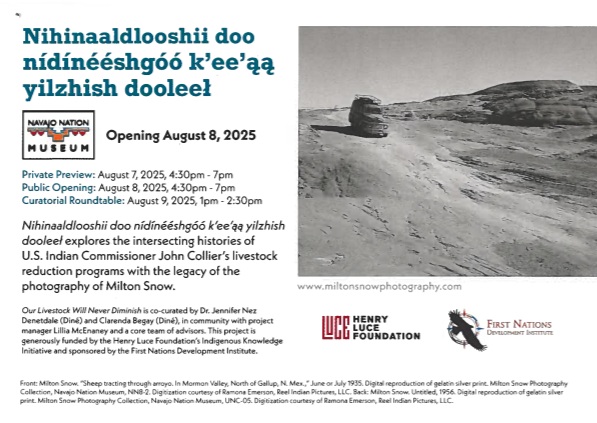
Nihi naaldlooshii doo nídínéshóó k’ee’ąá yilzhish dooleeł, Our Livestock Will Never Diminish, features the photographs of Milton Snow and the Legacies of Livestock Reduction (1935-1959) on the Navajo (Diné) Nation, during John Collier’s tenure as Commissioner of Indian Affairs. Co-curated by historian Dr. Jennifer Denetdale and Clarenda Begay, and a core team made up of primarily Diné scholars and museum personnel, the year-long exhibit opened August 8, 2025. The live-streamed event has reached thousands of viewers on Face Book.
Snow’s camera lens captures the ways in which the Bureau of Indian Affairs sought to “modernize and develop” the largest population of Indigenous People within the United States. Although Snow produced over 15,000 images of Diné people and their surroundings, the carnage that ensued when Collier ordered fifty percent of their sheep destroyed is not depicted. Diné were blamed for allowing their “scrub” sheep to overgraze the range.
Sweeping changes introduced patriarchy, undermining the matrilineal, matrilocal kinship system which shaped the handling of the herds that provided the best wool for thousands of weavers. The political consequences of stock reduction reverberate today. Unemployment rates are high, and many Diné must travel long distances to find work or relocate elsewhere. Much of the land is polluted due to intensive non-renewable resource extraction, including coal, oil, uranium and fracked gas.
Anthropologist and activist Kathy M’Closkey served as a collaborator, periodically providing detailed notes about stock reduction drawn from Senate Sub-committee Hearings on Indian Affairs (1931, 1933, 1937), and reports authored by scientists working for the Soil Conservation Service. She also reviewed the book manuscript of the same title. Slated for publication by the University of New Mexico Press, summer 2026, the book contains over 150 images taken by Snow. Chapters authored by eight Diné draw from family oral histories describing the trauma, horror and severe poverty that ensued when thousands lost their non-human relatives and their livelihoods.
The Henry Luce Foundation’s Indigenous Knowledge Institute funded this groundbreaking project. The First Nations Development Institute provided sponsorship.
M’Closkey authored Swept Under the Rug: A Hidden History of Navajo Weaving (2002, 2008), and Why the Navajo Blanket Became a Rug: Excavating the Legacy of Modernization and Development (forthcoming, University of New Mexico Press).