
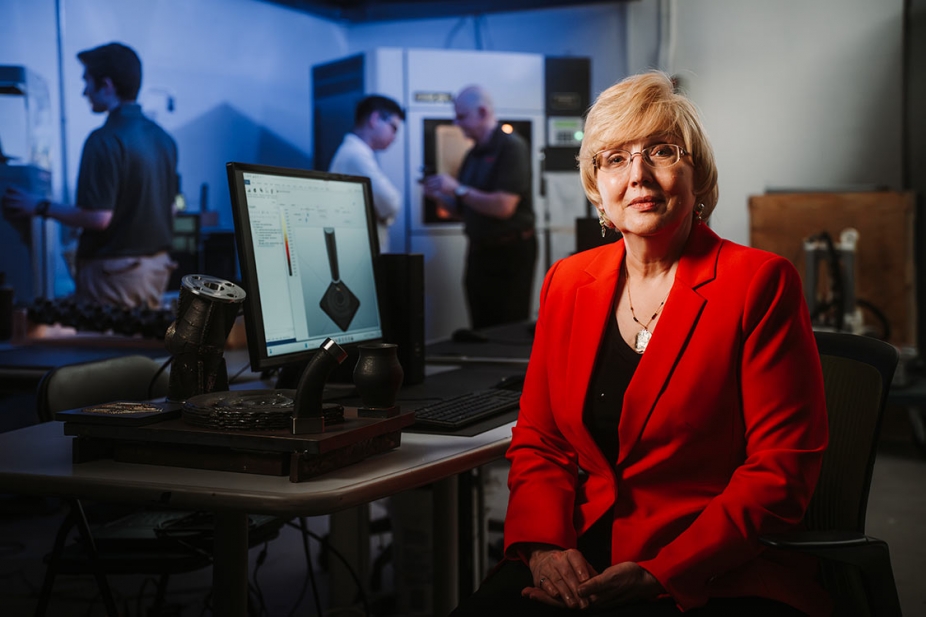
 Dr. Jill Urbanic, professor in the Department of Mechanical, Automotive & Materials Engineering and co-founder of CAMufacturing Solutions, sits in her lab at the University of Windsor, where she leads cutting-edge research in additive and hybrid manufacturing technologies. Her work is driving global advances in Industry 4.0, creating pathways from research to commercialization, and preparing the next generation of manufacturing innovators. (MIKE WILKINS/The University of Windsor)
Synergies between research and manufacturing industry leading to commercial impact for University of Windsor and its partners
CAMufacturing Solutions, Inc. is a Windsor-based company created from fundamental engineering research at the University of Windsor (UWindsor). Providing specialized software to program, simulate and interact with manufacturing systems, it has evolved into a firm with global reach; its software is today used in more than 47 countries.
CAMufacturing Solutions is one example of the ways in which UWindsor’s research and innovation in advanced manufacturing is making a commercial impact in the global marketplace and helping manufacturers solve their most pressing challenges.
One of the university’s strengths in manufacturing innovation is the integrated network of foundational researchers and industry players. “This network is key and is yielding benefits for companies, researchers and the students, who acquire knowledge and training in the latest technologies,” says Jill Urbanic, a professor in the Mechanical, Automotive and Materials Engineering Department and a co-founder of CAMufacturing Solutions.
“Using research to help inform innovation and then commercialization is powerful because we establish a pipeline and a feedback cycle, where the commercial firms come back and tell us what the next research problems are,” says Dr. Urbanic. “In that way, we are collaborating to fuel progress and further innovations in manufacturing.”
The international nature of the industry-university network is driving widespread change and supporting Canada’s manufacturing competitiveness on the global stage.
JBM Engineering in Japan is one of CAMufacturing Solutions’ partners, and it uses the Canadian software in solutions for customers that include some of Japan’s largest automotive, transportation and electronics companies.
“Our partnership with CAMufacturing Solutions allows us to provide our customers with high-quality, stronger parts at lower cost,” says Kunihiro Kihara, Chief Technology Advisor with JBM Engineering. “And we believe it will help us expand customers in additive manufacturing within Japan and in neighbouring countries.”
Now in its eighth-year of collaboration with CAMufacturing Solutions, JBM Engineering is finding the connections with the company and UWindsor are helping manufacturers prepare for future challenges.
“When our customers request an update or identify a problem, CAMufacturing and the university consider how to solve the customers’ problems and improve the product function,” Mr. Kihara says. “This is very important because manufacturing is moving into unknown areas, and we need research and the generation of new, creative ideas to transform manufacturing materials and processes.”
Meeting the challenges of Industry 4.0
The latest developments in manufacturing are often described as the Fourth Industrial Revolution or Industry 4.0. These changes, which are underway but still not completed, integrate technologies like artificial intelligence (AI), the Internet of Things (IoT) and cloud computing into connected, data-driven and more highly automated factories.
One of the new technologies driving this revolution is additive manufacturing, with 3D printing its most common form. Traditional manufacturing has been “subtractive” – where machines remove material and shape it into the desired form. The additive method builds items layer by layer, and its advantages are numerous including supporting complex, customized parts on demand, rapid prototyping, and reducing waste and inventory costs.
It was the need for industry to enhance its additive-manufacturing capabilities that drove Dr. Urbanic’s research leading to the founding of CAMufacturing Solutions. Collaborating with her husband and co-founder, Bob Hedrick, they developed computer-aided manufacturing (CAM) and computer-aided design (CAD) software for additive and hybrid manufacturing systems.
Specialty additive manufacturing and hybrid manufacturing systems are among the areas of engineering excellence that set UWindsor apart. Through hubs that include the Advanced Production and Design Lab, the university is also innovating in simulation, cognitive ergonomics and design for manufacturability, as well as in reverse engineering and optimization of production systems.
UWindsor is also demonstrating leadership in national research collaborations. Among them is a large-scale Ontario Research Fund-Research Excellence (ORF-RE) project in partnership with Yeganeh Bahoo of Toronto Metropolitan University (TMU).
Dr. Bahoo is bringing her expertise in computational geometry together with UWindsor’s design and manufacturing knowledge to develop tools that make it faster and easier for users to develop CAD models for building parts, including components for medical use (for example, a 3D printed hip or knee).
If no CAD model is available, current methods to create one are labour-intensive and expensive, Dr. Bahoo explains. “Our goal is to use geometric algorithms, deep learning and other innovations to scan information that allows us to build a CAD model in a matter of minutes or seconds. Industry is telling us the need for such technologies is critical, and achieving success has the potential to be revolutionary.”
Student training in cutting-edge manufacturing technologies


As part of his co-op program at CAMufacturing Solutions, Engineering student Jacob Altenhof customized software for 3D printing on a desktop printer. (MIKE WILKINS/The University of Windsor)
Jacob Altenhof is in the third year of his studies to earn a Bachelor of Applied Science in Mechanical Engineering – Materials Option. He chose the co-op program because he was keen to gain practical experience in an industry setting and welcomed his placement with CAMufacturing Solutions.
The company gave him a project to customize software for 3D printing on a desktop printer. “Traditionally, desktop printers don’t run 3D curves or toolpaths,” Mr. Altenhof says. “It was challenging, but with the company’s program I was able to make it work. ”
Mr. Altenhof was able to contribute to industry advances and found the experience intensified his interest in building a career in additive manufacturing. “I believe that additive manufacturing has an exciting future and in many ways, is an untapped resource. It appeals to me to be part of bringing more innovations to the field.”
“It’s so valuable that the synergies between the university and industry are helping prepare the manufacturing experts of the future,” says Dr. Urbanic.
“Our research leads to new labs and courses at the university and paves the way for continuous skills development. This is critical at a time of tremendous transformational change in the manufacturing space.”