
 Guadalupe Yesenia Hernández Márquez takes a sunset photo in Point Pelee National Park. [MICHAEL WILKINS/University of Windsor]
By Sara Elliott
Bald eagles circled overhead as more than 50 biodiversity experts, Indigenous knowledge holders and science-policy leaders from around the world gathered at the Caldwell First Nation restoration site in the Carolinian forest of southwestern Ontario.
The landmark international biodiversity workshop was hosted by the University of Windsor, UNESCO Paris and the Intergovernmental Platform on Biodiversity and Ecosystem Services (IPBES).
This is the first time IPBES – an independent intergovernmental science-policy platform, affiliated with multiple United Nations organizations – convened in the Great Lakes Basin.
“Early-career researchers, local youth and knowledge holders – in addition to scholars - are all part of this global workshop,” said Dr. Catherine Febria, Canada Research Chair in Freshwater Restoration Ecology and associate professor in integrative biology and a researcher with the Great Lakes Institute for Environmental Research (GLIER).
“Local communities need access to the best available science, knowledge and networks to shape a more sustainable and resilient future. Equally we need dialogues and policy at global levels to accelerate change everywhere.”

Caldwell First Nation welcomes participants to visit an ecosystem restoration site. [MICHAEL WILKINS/University of Windsor]
As part of the weeklong workshop, participants joined a full-day event hosted in partnership with Caldwell First Nation and Parks Canada’s Point Pelee National Park. In the morning, the group participated in the first water ceremony held at a Caldwell First Nation wetland restoration site following a large-scale partnership-driven effort.
The water ceremony included all participants, enabled cross cultural spiritual practices and deepened connections with People and Place.
In a welcoming address earlier in the week, Caldwell First Nation’s Chief Nikki van Oirschot shared that First Nations Peoples have been the caretakers of the Great Lakes and surrounding lands since time immemorial.
"It is time that the wisdom of Indigenous Peoples around the globe are recognized for our knowledge and role in fostering biodiversity and sustainable ways of living in harmony with nature,” said Chief van Oirschot.
“We are happy to welcome our Indigenous brothers and sisters attending the UN Global Biodiversity Workshop IPBES to come and learn about Caldwell First Nation's connections to these lands and waters and our efforts to restore them."
In the afternoon, participants joined a local plant biodiversity & medicine tour in Point Pelee National Park led by Larry Cornelis, one of the region’s best natural historians, and Ron Sands, a well-respected Indigenous fire keeper and knowledge holder from Walpole Island First Nation, who shared healing properties of various native species and offered handmade salve from harvested plantain leaves.

Loupa Pius on a local plant and medicine walk at Point Pelee National Park. [MICHAEL WILKINS/University of Windsor]
In parallel, Caldwell First Nation cultural development officer Carrie Ann Peters and Parks Canada staff Kyrsten Burns co-led the “People of Pelee” tour which walked participants through the colonial and Indigenous history of Point Pelee, culminating in a visit to Caldwell First Nation’s dedicated area in the park, Madbin Jina, and its recently unveiled learning circle and shelter.
Throughout the week additional regional contributors also included guides from the Ojibway Nature Centre, volunteers with Pelee Island Bird Observatory, Ontario Nature and Nature Chatham-Kent.
“This region is home to rare and exceptional biodiversity, but also to community leaders who have been working together to protect it,” said Febria. “The global solution is local. It’s great to bring people here to experience that collaboration firsthand.”
Febria has worked with IPBES for more than a decade as an author, Fellow and Canada’s nominee to the Multidisciplinary Expert Panel, which supports the scientific credibility of global assessments.
She also co-chairs the IPBES Indigenous and Local Knowledge Task Force, working with global Indigenous and non-Indigenous scholars to promote ethical and robust methodologies for working with Indigenous and local knowledge in science-policy processes, building capacity including elevating Indigenous leadership and perspectives in global science-policy work.
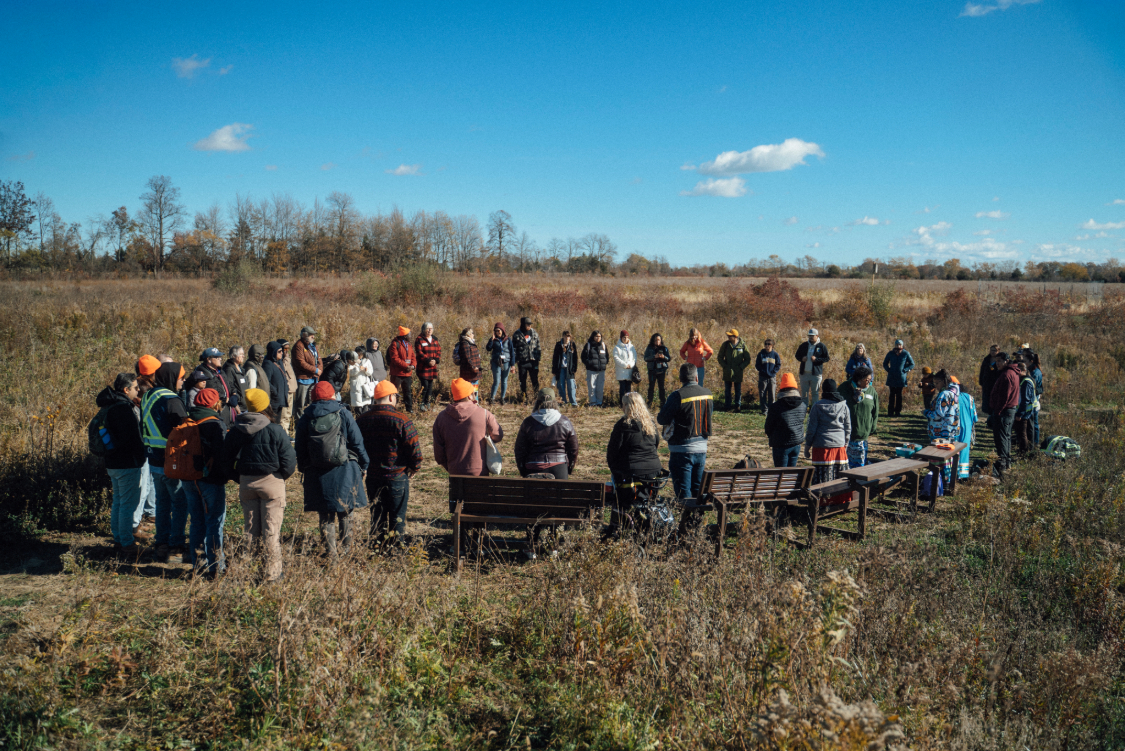
Full group participating in the first water ceremony held at a Caldwell First Nation wetland restoration site. [MICHAEL WILKINS/University of Windsor]
The week’s discussions also supported the launch of the second Global Biodiversity Assessment – a key report that will shape international biodiversity policy over the next decade.
A dedicated chapter of the assessment, led by Indigenous authors who were also in attendance at the workshop, will focus on diverse world views and the roles of Indigenous Peoples and local communities in sustaining nature.
“This was a truly unique opportunity to connect local and global communities here in Windsor. We were also able to showcase the biodiversity of the Great Lakes region and the importance of diverse knowledge systems in environmental decision-making and in delivering truly impactful science,” said Febria.