
 Students at the Windsor Engineering Competition create structures suited to the theme of 'Medieval Innovation: Re-engineering the future', evaluated by professional engineer judges. (Courtesy STANLEY MADZIYIRE/ University of Windsor)
By Lindsay Charlton
Blending history with hands-on problem solving, students at this year’s Windsor Engineering Competition put their creativity and technical skills to the test by reimagining medieval-era structures through a modern engineering lens.
Held under the theme “Medieval Innovation: Re-engineering the future,” the annual competition challenged students to collaborate in teams, apply engineering principles and think creatively under tight time constraints.
“I chose the theme because I’m really into medieval-themed shows and books,” said Esraa Kandil, vice-president of the Engineering Students Society and a third-year electrical engineering student, who helped organize the event. “A lot of today’s innovations are built on ideas from the past, and that era fits perfectly as an engineering theme.”
“We learn from past engineering to apply it in today’s world,” she added.
Working in teams of four, students in both junior and senior categories had just six hours to design, build and present a structure capable of launching a ping-pong ball and knocking over a series of cups.
Judges evaluated each project based on design quality, real-world functionality, adherence to the medieval theme, presentation and overall performance.
The judging panel included professional engineers from the University of Windsor and industry partners such as Ford, Agriculture and Agri-Food Canada and Vonage.
“Everyone went above and beyond what I expected,” Kandil said. “If you Google popsicle-stick trebuchets, you usually see small models made for bottle caps. Instead, teams built fully functioning catapults with pull-down launch mechanisms. The level of innovation was impressive.”
Senior teams faced an added layer of complexity, building their structures on a vehicle-style base and incorporating a tower-mounted launch system to hit the targets.
“There were so many different ideas and a lot of variation in what teams built,” Kandil said.
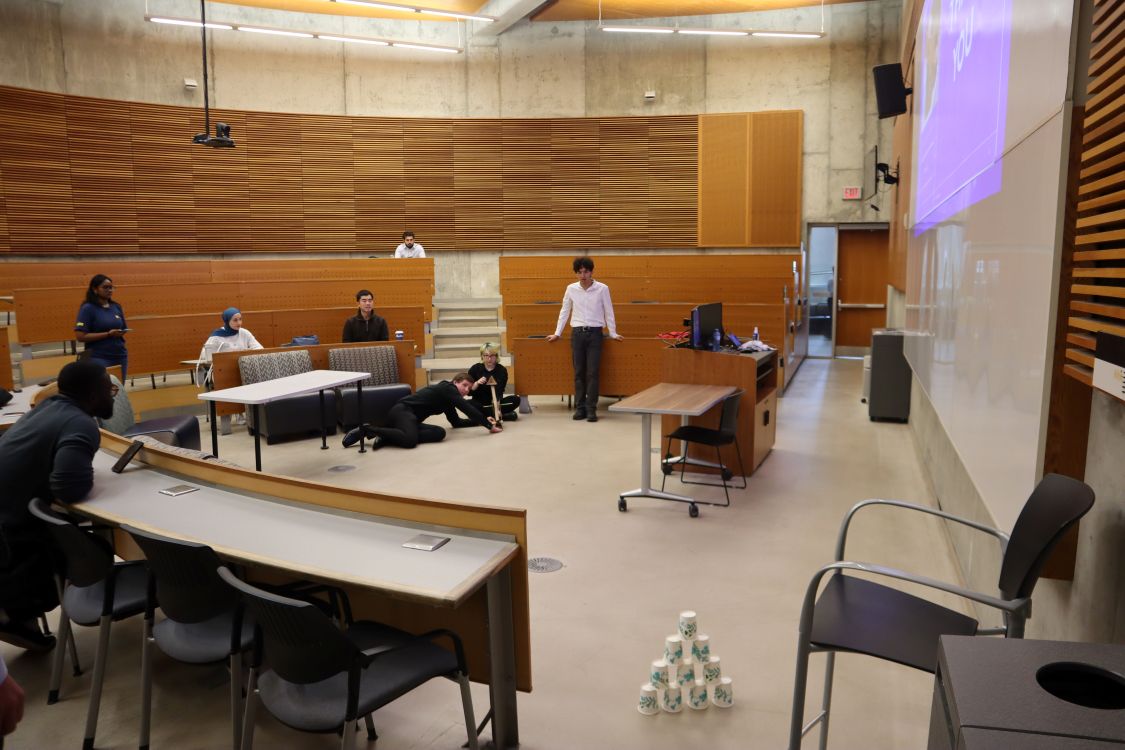
Students at the Windsor Engineering Competition create structures suited to the theme of 'Medieval Innovation: Re-engineering the future', evaluated by professional engineer judges. (Courtesy STANLEY MADZIYIRE/ University of Windsor)
One senior team designed a vehicle that moved forward before turning to launch the ball from behind — a tactical choice inspired by medieval warfare, explained third-year mechanical engineering student Stanley Madziyire, who also helped coordinate the competition.
“They said it was meant to misguide the enemy so they wouldn’t see the shot coming,” he said.
While teams were not instructed to build catapults, many gravitated toward the familiar medieval design. One group took a different approach, opting for a slingshot-style launcher.
“That was my favourite part of the event,” Kandil said. “Walking into each room and seeing ideas I never would have thought of myself was incredible.”
That team finished among the top competitors and will represent the University of Windsor at the provincial engineering competition at Carleton University on Jan. 22.
Having competed in last year’s Windsor Engineering Competition, both Kandil and Madziyire said the experience reinforced the importance of teamwork, time management and communication.
“You really have to collaborate,” Kandil said. “Dividing tasks and managing your time is critical because you’re under constant pressure.”
“If everyone is motivated and working toward the same goal, it comes together,” Madziyire added.
Both students also emphasized the value of the competition beyond the classroom, noting its impact on career readiness and employability.
“I hope more students see the value in competing,” Kandil said. “It’s a great experience to talk about in job interviews and shows you’re actively involved.”
“As mechanical engineering students, we often work on similar projects,” Madziyire said. “When you’re talking to the same employers, that can blur together. Competitions like this show creativity and innovation — something that helps you stand out.”