
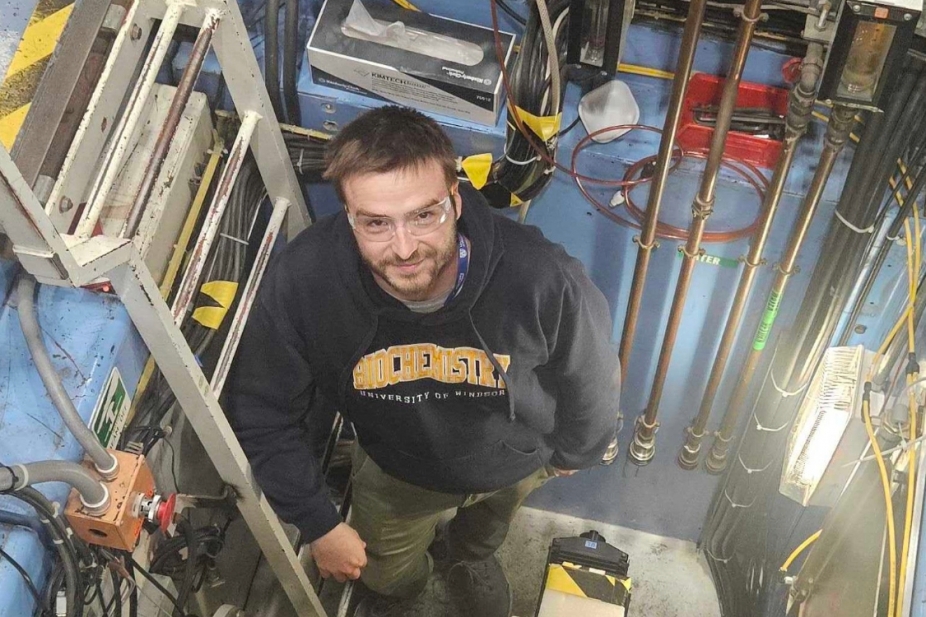
 Dr. Drew Marqurdt at the ISIS Neutron and Muon Source, a world-leading centre for research in the United Kingdom. (MAKS DZIURA/University of Windsor)
The University of Windsor is helping shape Canada’s future in nuclear science by joining an international initiative aimed at transforming how scientists access neutron technology.
Neutron beams are indispensable tools for probing the structure of materials, from advanced batteries to biological tissues, without causing damage.
“Neutron beams enable scientists to see inside materials without destroying it, making them critical for breakthroughs in energy storage, drug development and industrial quality control,” says chemistry and biochemistry’s Dr. Drew Marquardt.
Now, UWindsor is part of a global effort to expand access to this irreplaceable tool.
The University is joining a coordinated research project led by the International Atomic Energy Agency (IAEA), an independent United Nations organization.
Traditionally, neutron beams have been generated by large-scale nuclear reactors — facilities that are expensive and increasingly scarce. In Canada, access to neutron research was significantly reduced after the 2018 shutdown of the National Research Universal (NRU) reactor..
The IAEA initiative will instead focus on developing smaller, more affordable neutron sources that would be built and operated at universities and research centres around the world.
“Participation in this CRP positions UWindsor as a key player in developing compact, cost-effective neutron sources that will drive innovation in materials research, medicine and industry,” says Marquardt.
The IAEA’s project, titled “Expanding Neutron Beam Capabilities at Low and Medium Flux Sources,” supports research into Compact Accelerator-based Neutron Sources (CANS) and other alternatives to large reactors.
“These smaller and more affordable systems promise to democratize neutron science worldwide,” he says.
Marquardt is leading UWindsor’s contribution by spearheading the design of the Prototype Canadian Compact Accelerator-based Neutron Source (PC-CANS) in collaboration with TRIUMF, Canada's particle accelerator centre and Canadian Nuclear Laboratories, the country’s nuclear science and technology organization.
The PC-CANS facility will:
- Help restore Canada’s neutron research capabilities, lost after the closure of the NRU reactor in 2018.
- Enable cutting-edge studies in materials science, energy technologies and biomedical applications.
- Support medical innovations, including Boron Neutron Capture Therapy (BNCT) for cancer treatment and production of critical radioisotopes for diagnostic imaging and treatment.
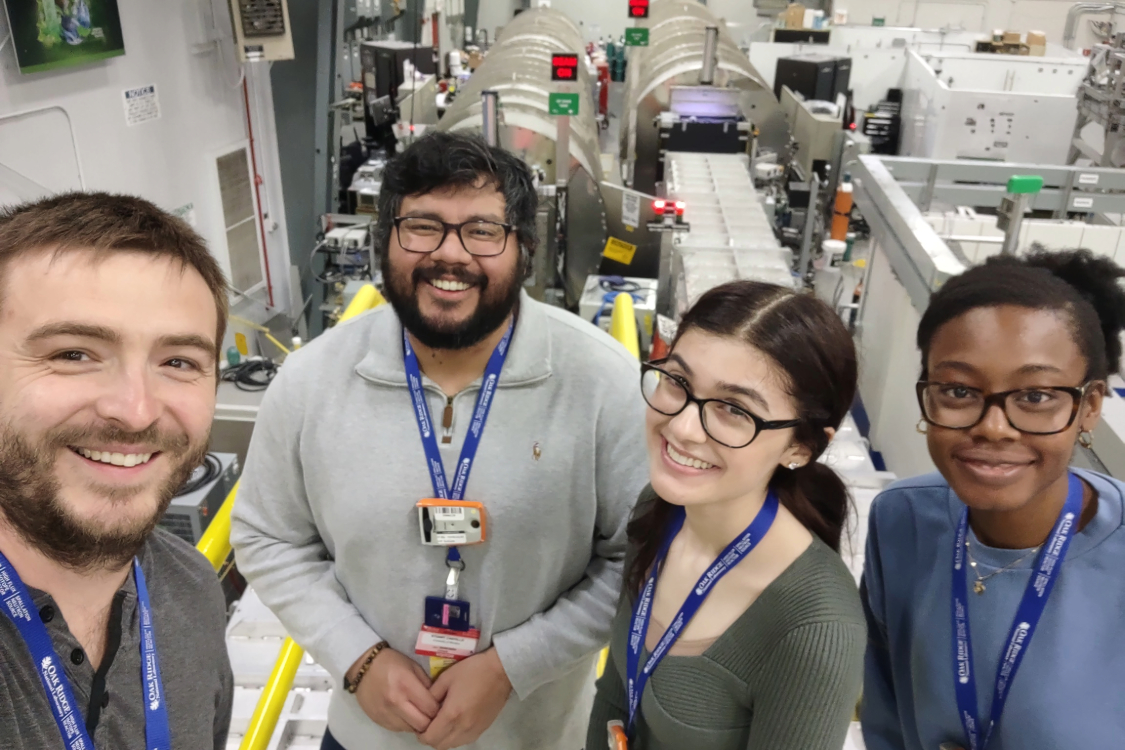
Dr. Drew Marquardt (left) along with student researchers at the High Flux Isotope Reactor at Oak Ridge National Laboratory. (DREW MARQUARDT/University of Windsor)
“The IAEA project is about more than building a neutron source, it’s about creating a platform for innovation, education and global scientific cooperation,” says Marquardt.
“By joining this initiative, UWindsor is helping shape the future of neutron science in Canada and beyond.”
Participation in the project provides significant benefits for students and early-career researchers. Through hands-on training in accelerator physics, neutron instrumentation and medical applications, trainees will gain highly sought-after skills.
The initiative aligns with Canada’s priorities in clean energy, healthcare innovation and advanced manufacturing, ensuring that UWindsor remains at the forefront of scientific progress and innovation.
As the PC-CANS project moves forward, UWindsor is poised to play a pivotal role in shaping a new era of neutron research – one that is more accessible, sustainable and globally connected.
Founded in 1957, the IAEA works to promote the safe, secure and peaceful uses of nuclear science and technology, including collaboration and research across member states to support innovation in nuclear applications, including neutron science.