
 Dr. Laurie Freeman (centre) is shown receiving support from WESpark for the NPT study, joined by Susan Fox, Johnathan Foster, Dora Cavallo, and Dominika Boron. (SUBMITTED BY LAURIE FREEMAN/University of Windsor)
By Sara Meikle
The idea began in the emergency department, where police officers and registered nurses (RN) wondered: what if they could help people before they reached the hospital?
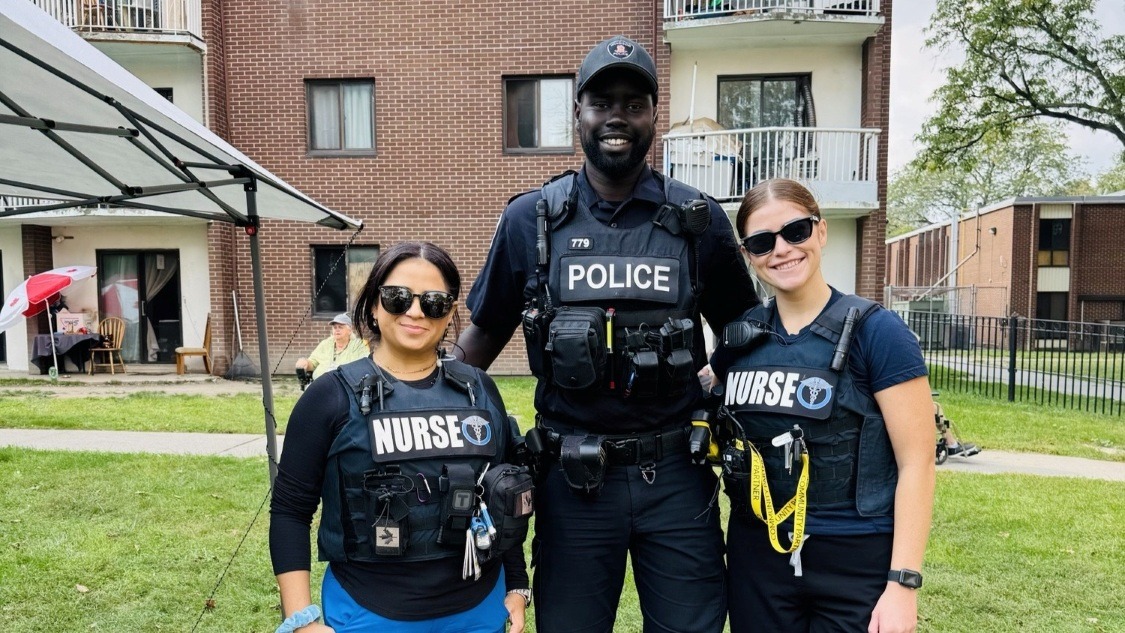
That question sparked Windsor’s Nurse–Police Team (NPT) program, which pairs officers from the Windsor Police Service with RNs from Windsor Regional Hospital to respond to calls in the city’s downtown core.
Instead of taking people to the emergency department or correctional facilities, the teams provide on-the-spot care, wound treatment, crisis support and connections to community resources.
Early research shows it is changing attitudes and outcomes across the city.
University of Windsor Nursing Associate Professor and Associate Dean Laurie Freeman is studying the initiative with a 2024 Ignite Discovery grant from the WE-SPARK Health Institute.;
Her interviews with seven officers and seven nurses revealed five key themes showing how the program is transforming frontline care.
A work in progress
At first, teams had only basic guidelines and little sense of what to expect.
Once they got out on the streets, they quickly saw how much they could achieve together.
“They learned in practice what this partnership could achieve,” said Dr. Freeman. “Both professions brought complementary strengths and experiences to reach the shared goal of keeping people safe and out of hospital or corrections.”
RNs and officers described developing teamwork and communication on the fly – learning who should approach a person in crisis, when to step back and how to de-escalate collaboratively.
Improving community trust with compassion over authority
By offering care and meeting immediate needs, the teams earned trust from people who often feel threatened by authority. Many unhoused people have had negative interactions with police or health care but responded differently when both arrived together.
“When the nurse was there, people didn’t scatter – they talked to us,” one officer told Freeman.
Freeman said the program is changing the thought pattern on authority by replacing enforcement with empathy.
“It’s redefining what help looks like,” she said.
Building community and addressing barriers
Participants said the collaboration allowed them to connect people with resources that often go unused, sometimes even driving them to shelters. Along the way, the program has strengthened connections between nurses, police and community services.
The experience has also highlighted gaps in community support and brought new opportunities for helping people to light
“They’re not only assisting individuals in crisis,” Freeman said. “They’re helping to build a stronger, more connected community network.”
Safety first
Both professions emphasized that safety remains central to the model.
Police officers assess each scene before nurses engage, and both groups said they always felt that safety was prioritized.
Officers said the presence of nurses changed how people responded.
“When a nurse is with a police officer, people recognize they’re not there to apprehend,” Freeman said. “They’re more willing to talk and accept help.”
Room to expand and improve effectiveness
Participants said they’d like to see the program expand beyond Windsor’s downtown core and operate 24 hours a day.
They also recommended additional equipment to allow nurses to perform more field assessments, such as blood sugar tests.
“They see potential for the NPTs to play a bigger role in stabilizing people in crisis, especially when ambulance resources are stretched,” Freeman said.
As a next step, Freeman plans to apply for funding to capture the perspectives of people who have interacted directly with the NPTs, as well as community partners impacted by the program.
For many participants, the experience has been transformative – turning uncertainty into pride as they see the difference their work makes.
“They’ve realized the real value of this partnership,” Freeman said. “Not only for those they serve but for how it builds trust and improves community health.”
By connecting frontline experience with academic research, the project reflects the University's role in driving practical, community-focused innovation.
Freeman shared her findings with Windsor police and participating RNs during a Nov. 19 presentation – another step in UWindsor’s commitment to generating impact through community engagement.