
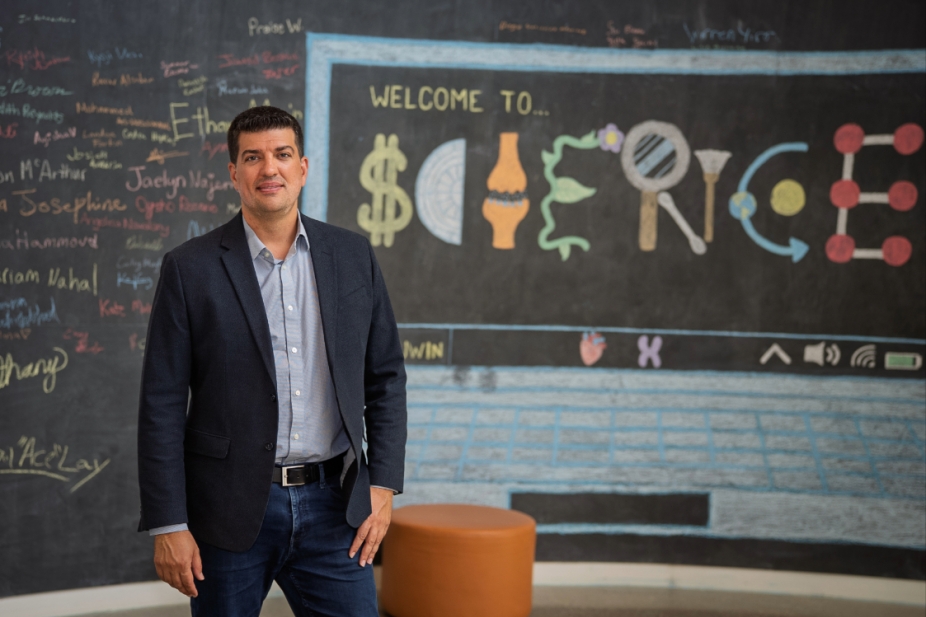
 Dr. Nick Vukotic and his research group are working on making the medicines people already take work better. (KYLE ARCHIBALD/University of Windsor)
By Sara Elliott
A University of Windsor researcher is making the medicines people already take work better – and turning that science into jobs, companies and globally commercialized technology rooted in Windsor-Essex.
Dr. Nick Vukotic, Natural Science and Engineering Research Council of Canada (NSERC), and PROTO Manufacturing Industrial Research Chair in the Department of Chemistry and Biochemistry, received a 2025 Impact Award-Innovation through the University of Windsor’s Employee Recognition Awards program, recognizing his work bridging academia and industry.
This motivation is partly personal, shaped by seeing family members undergo treatments.
“Many pharmaceuticals suffer from poor absorption, inconsistent release, or unwanted side effects,” he says.
His research group focuses not on discovering entirely new drugs, but on improving what is known as the drug “solid form” — how drug molecules are arranged and structured at the molecular level in a solid material, such as a tablet.
Although the chemical identity of the drug remains the same, the way the molecules organize and interact can differ – and those differences change everything about how the drug performs in the body.
“These structural differences can significantly influence how the drug dissolves, how it releases over time, and how it behaves in the body,” says Vukotic.
That philosophy of turning science into real-world solutions has defined Vukotic’s first six years at the University. He has secured more than $2-million in research funding, launched a startup company, generated multiple patents in instrumentation, devices, methods and drug-release materials, and also worked with industry partners to commercialize scientific instrumentation.
“Innovation doesn’t end with discovery,” he says.
“Discovery is the starting point for research translation, the process of turning new knowledge into technologies, commercialization pathways, and solutions that create impact beyond the laboratory.”
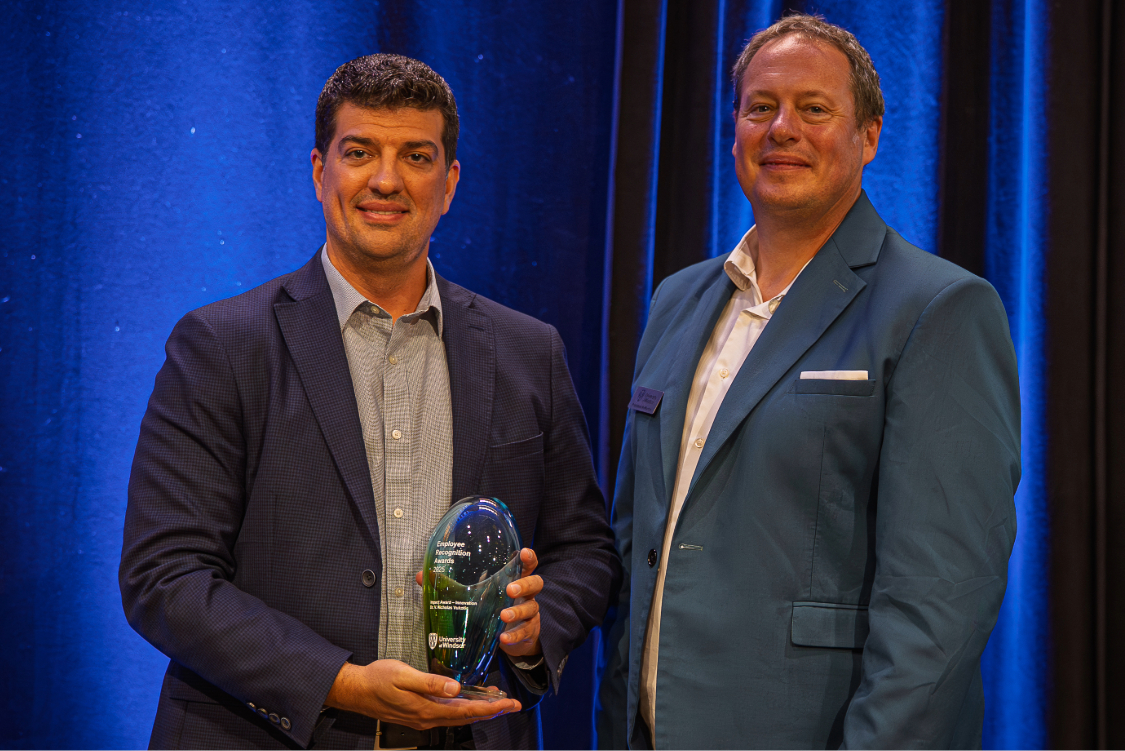
Dr. Nick Vukotic and University of Windsor President Dr. J.J. McMurtry at the Employee Recognition Awards. (KYLE ARCHIBALD/University of Windsor)
Working with LaSalle-based PROTO Manufacturing Ltd., he helped develop and commercialize a High-Throughput Laboratory Powder Diffractometer. The instrument operates 100 times more efficiently than traditional systems, requires one-tenth the amount of sample and runs 10 times faster.
The system increased the University’s testing from about 20 samples per day to more than 400.
“This is a great example of how university research can translate directly into global technology,” says Vukotic.
“The globally commercialized system has generated economic benefits locally, including advanced manufacturing jobs and training opportunities in Windsor-Essex.”
His team developed patented platforms called Modular Multiwell Devices, which allow researchers to test hundreds of reaction conditions simultaneously. The technology led to the creation of Solid4m, a UWindsor-based spinoff company whose name is a play on the term “Solid Form” which is directed by Vukotic.
“Solid4m helps accelerate pharmaceutical development timelines and unlocks new commercial opportunities,” he says.
Vukotic’s research also led to the development of Therapeutic Coordination Polymers – a new class of materials designed to control how medications are released in the body.
The work was published in Chemical Science, resulted in patent protection, and led to the creation of another venture, Complex Therapeutix, founded by doctoral students Michelle Dao and Joy-Lynn Kobti.
“Watching students take research from the lab bench to venture launch is incredibly rewarding,” he says.
Vukotic has chaired the Canadian Division of the American Crystallographic Association, serves as treasurer of the Canadian National Committee for Crystallography, and sits on the Board of Managers for the 2026 International Union of Crystallography Congress.