
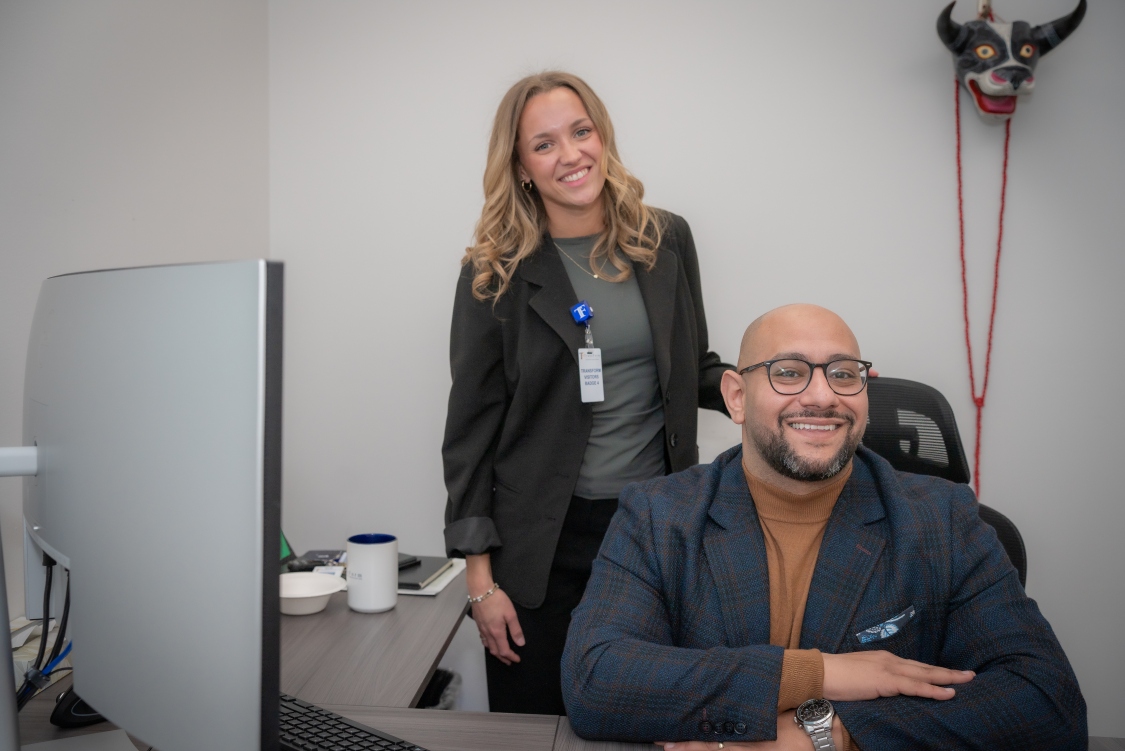
 Luke Fox meets with Kim Ramirez in her office at TransForm Shared Service Organization as part of the Executive for a Day Program, which gives UWindsor MBA students the opportunity to shadow local business leaders and gain firsthand insight into executive leadership. (KYLE ARCHIBALD/University of Windsor)
By Sara Meikle
For Master of Business Administration students at the University of Windsor, leadership lessons extend beyond the classroom.
Through the Odette School of Business’ Executive for a Day program, Master of Business Administration (MBA) students are paired with senior leaders for a one-day job shadow designed to build business acumen and leadership capacity through real-world exposure.
On Feb. 19, MBA candidates Andreya Lafontaine and Luke Fox stepped inside TransForm Shared Service Organization, a regional IT and digital health organization supporting hospitals from Windsor to Sarnia and other community partners across southwestern Ontario. What they found was a clearer understanding of executive leadership — and in Lafontaine’s case, a mentor with UWindsor roots.
From classroom to boardroom
Fox, who returned to Windsor after working in production and later in social health and the not-for-profit sector in Toronto, entered the MBA program looking to refine his leadership direction.
“The main draw was that I wanted to gain a better understanding of how different leaders approach leadership and relationship management," he said.
Shadowing Kim Ramirez, director of applications, integration and development at TransForm — and an instructor in the University’s Health Informatics Certificate program — gave him an unfiltered look.
“She mentioned that about 90 per cent of her role is relationship management,” Fox said. “There’s a lot of stakeholder engagement and relationship-building.”
For Ramirez, opening that window into executive leadership is part of her commitment to UWindsor students.
“My connection to the University of Windsor, both as an instructor and long-standing partner through TransForm, creates a strong sense of responsibility to give back,” she said. “Many of our most talented team members are Windsor alumni. It’s meaningful for students to visualize real career pathways close to home.”
Because Fox’s MBA focuses on strategy and analytics, Ramirez ensured he saw how those principles translate into practice — evaluating system-wide benefits, aligning stakeholders, and balancing innovation with risk across multiple hospitals.
“Technology alone does not create transformation,” she said. “It’s about orchestrating people, risk, capital, and change.”
For Fox, the opportunity to join candid conversations, including a strategy discussion with President and CEO Lyn Baluyot (BScN '94, BA '96), made the experience stand out.
“I felt very immersed in their workplace and not just like a student who was shadowing,” he said.
The day broadened his career lens beyond hospital-based executive roles.
“I didn’t realize how many organizations exist that feed into the healthcare ecosystem,” Fox said. “Without experiencing it firsthand, it’s difficult to understand that.”
Finding mentorship — and balance
For Lafontaine, the experience delivered exactly what she had hoped for: mentorship.
She was paired with Mina Girges, vice-president and chief information officer at TransForm — and a proud UWindsor MBA alumnus.
“When I was reviewing the positions available, I knew I wanted somebody who could be a mentor,” Lafontaine said. “They identified Mina as a good fit for me and he really was.”
Girges sees participating in the program as a way of paying forward the education that shaped him.
“The MBA program played a meaningful role in sharpening my ability to think strategically and operate across disciplines,” he said. “As leaders progress, there’s a responsibility to build the next layer of capability behind them.”
Now leading IT strategy at a regional healthcare level, Girges emphasized that executive complexity goes far beyond technology.
“The real complexity is not technical — it is organizational,” he said. “It requires building trust across executives, boards, clinicians, and technical teams, and aligning strategy across institutions.”
For Lafontaine, who holds a bachelor's degree in human kinetics, the exposure was eye-opening.
“It kept healthcare on the table for me,” she said. “It also exposed other avenues — like technology or business administration within clinics — that I hadn’t fully considered.”
She was particularly struck by Girges’ leadership presence.
“One thing that caught my attention was that less is more in leadership,” she said. “He puts his trust in his team and when he speaks, it’s powerful.”
Just as impactful was his perspective on balance.
“It was refreshing to hear that you can get to a high-level position and still have a life outside of work,” she said.
The opportunity to sit in on a management meeting, led by Baluyot, reinforced the value of representation and diversity in leadership.
“They noted that since she has been in the CEO position there has been an increase in women in the workplace,” Lafontaine said. “That was empowering to see.”
Alumni networks in action
Throughout the day, one theme surfaced repeatedly: UWindsor pride.
“People were vocal and proud about being UWindsor alumni,” Fox said. “They talked about their degrees and how that aligned with where they are now.”
For Ramirez, that visible alumni presence reinforces why experiential learning matters.
“Opportunities like this connect classroom concepts to real healthcare environments,” she said. “They build confidence and show students that leadership roles are within reach.”
For Lafontaine, the experience underscored the power of putting herself forward.
“If I didn’t put myself out there in the MBA program, I wouldn’t have met a mentor like Mina,” she said. “These experiences are what really broaden your horizons.”
As Executive for a Day continues to connect students with leaders from the UWindsor community, it underscores the strength of the University’s alumni network — one defined not just by career success, but by a shared commitment to opening doors for the next generation.
For students willing to step forward, those connections can shape far more than a single day — they can help define what comes next.