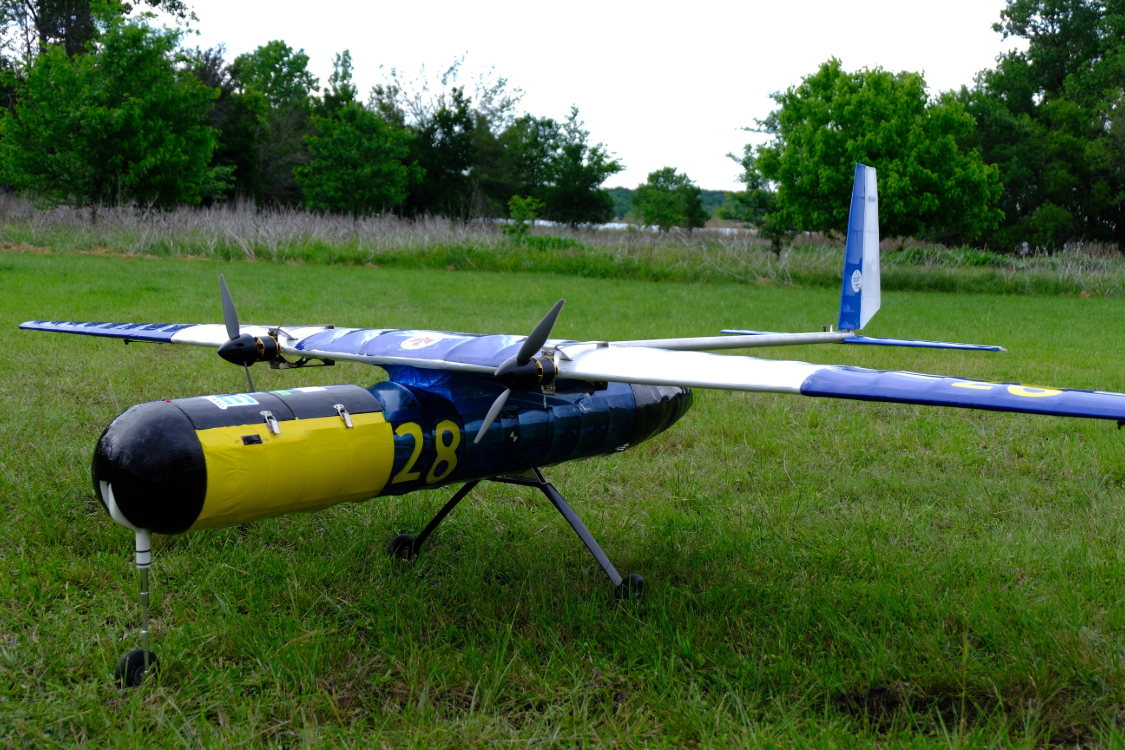
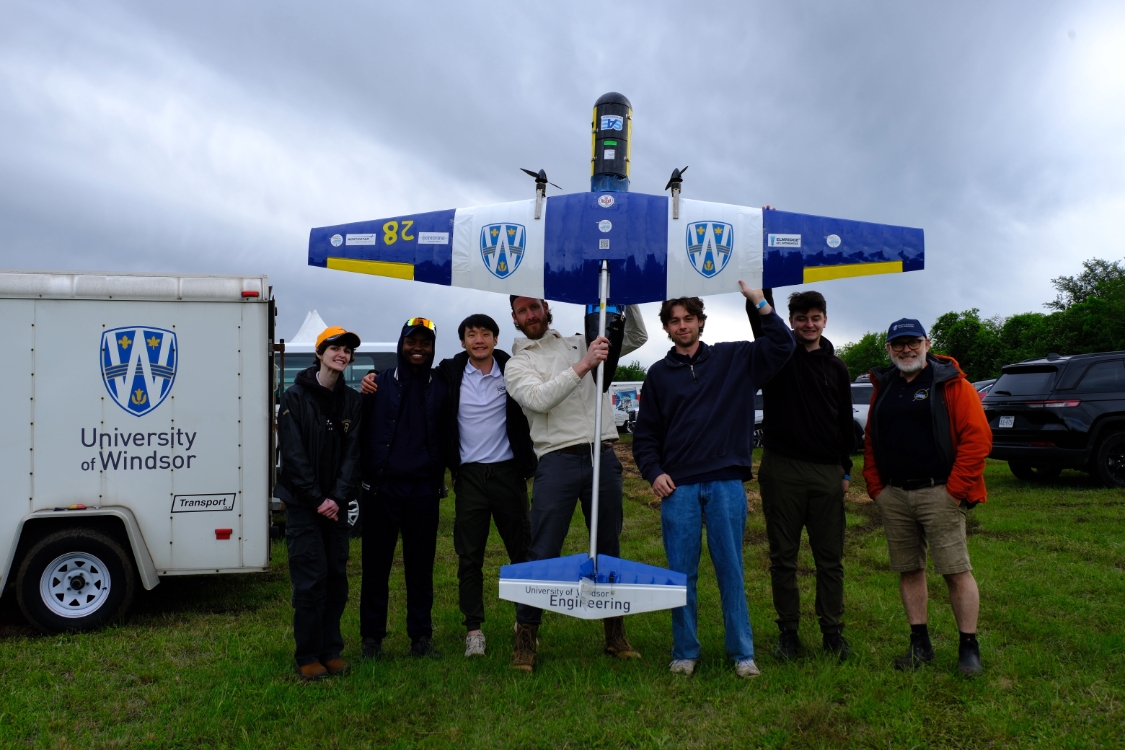
Lancer Aero Design travelled to Fort Worth, Texas to compete in the SAE Aero Design Collegiate Design Series where the team finished as the top-performing Canadian team. (Photo courtesy Tony Woo/ University of Windsor)
By Lindsay Charlton
After spending 20 hours on the road to Fort Worth, Texas, the Lancer Aero Design team watched months of hard work take flight as the aircraft they built soared into the sky for the first time.
“It was amazing,” said Tony Woo, team president. “When we saw it take off, there’s this rule that you’re not allowed to run on the runway, but I was so excited I just started running alongside it. You could visibly see my excitement.”
The fourth-year mechanical engineering student has been part of the team since his first year. Still, the April trip was his first time at the SAE Aero Design Collegiate Design Series, marking the club’s first time in eight years producing a competition-worthy aircraft capable of flight.
Student teams from around the world design, manufacture and test aircraft in the industry-style engineering competition, where the Lancers finished as the top-performing Canadian team.
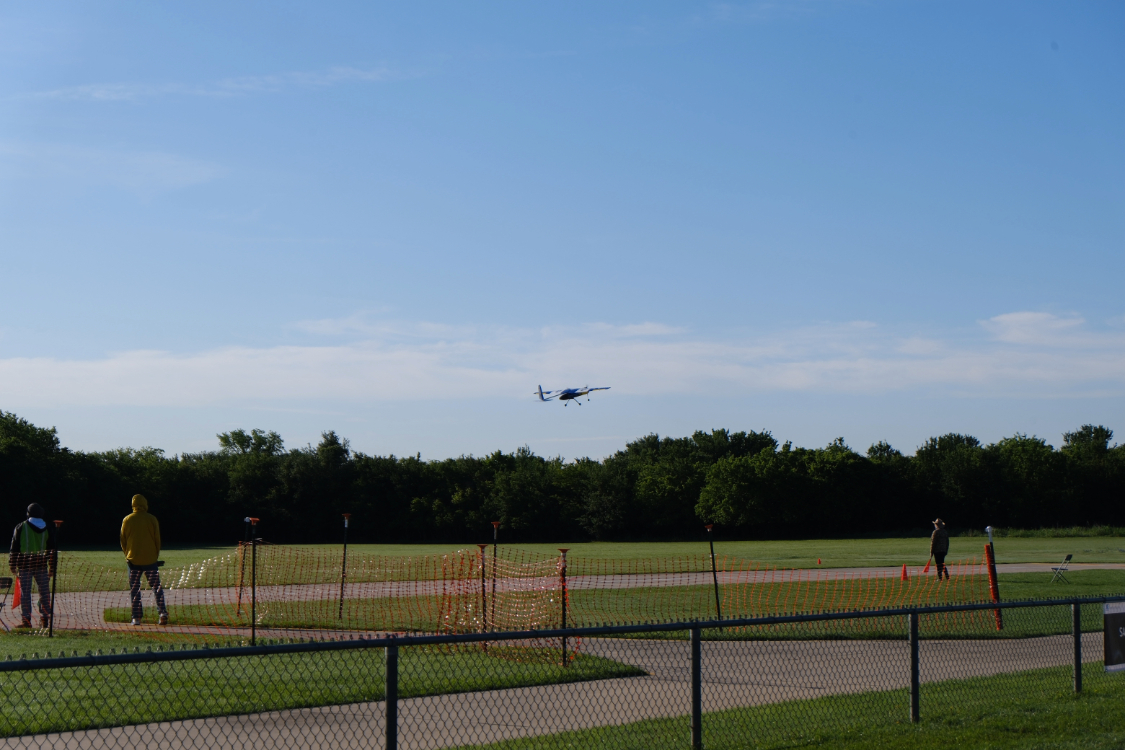
Teams have eight months to design and build a battery-powered, remote-controlled aircraft capable of carrying increasing cargo loads across multiple flight attempts, requiring students to balance aircraft weight, battery life and performance.
“There are different rule sets they give you within either the micro, regular or advanced classes. We competed in the regular class, where the more weight you can carry, the higher your score,” Woo explained.
“There are material and size limitations for the plane, and they limit the battery, so everyone’s working with the same amount of energy. There are a bunch of constraints, so you have to do the math and figure out what configuration will let your aircraft carry the most weight. That’s really the challenge.”
Seven team members, along with University of Windsor technologist Bruce Durfy, made the trip down south with their disassembled plane in tow. It has a 10-foot wingspan, is eight feet long and weighs 15 pounds.
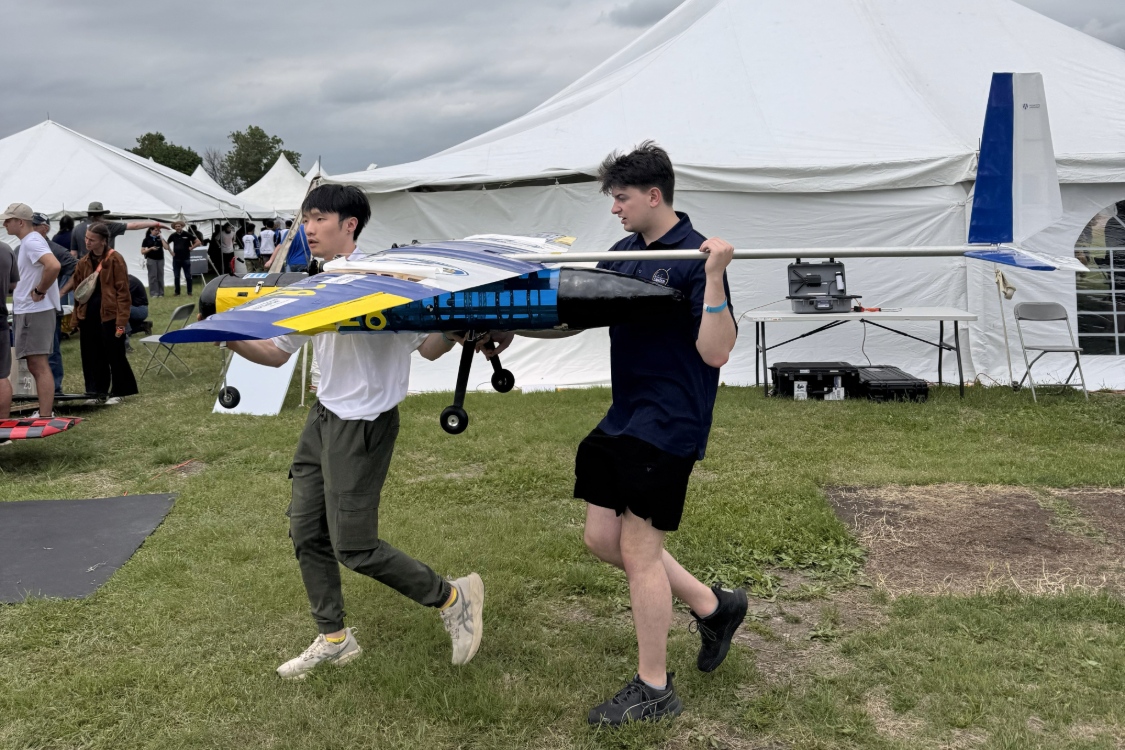
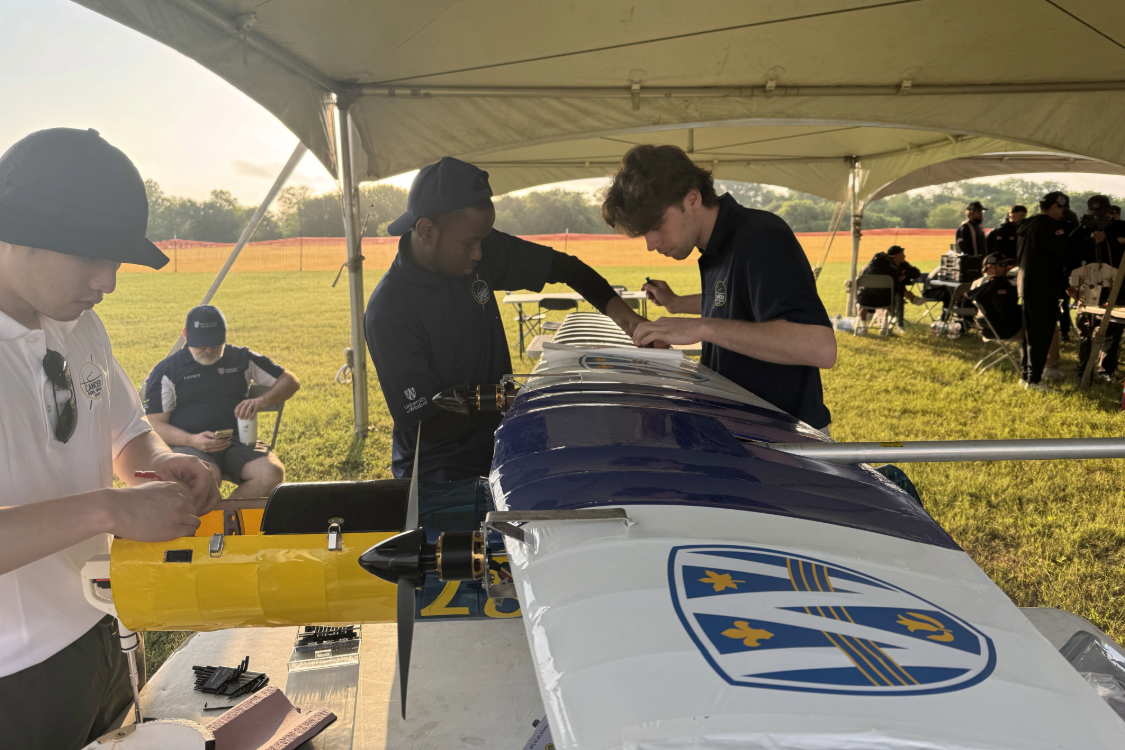
Day one was the technical inspection; the team then had a few electrical issues and minor fixes to take care of before they could take off. While day two was supposed to be flight day, they were rained out by an incoming storm for half the day.
“We didn’t have time for test flights out there because we finished the plane pretty last minute, so the first time we saw it fly was during the competition for scoring — its very first run,” said Woo.
Even though the Lancer Aero Design team had to wing it during the flight run, it still placed eighth in mission scoring and 15th overall out of 33 teams in the regular class.
The team’s aircraft could carry six pounds of cargo, allowing it to fly with 21 pounds in total, including its empty weight.
“We learned a lot from the competition about what we did well and where we can improve. Even small design decisions made a big difference in performance. It’s a good learning experience, and we’re looking forward to coming back next year with an even stronger team and competition,” said Woo.
Lancer Aero Design is a student-run team, with Dr. Jeff Defoe, a professor in the Department of Mechanical, Automotive and Materials Engineering, serving as faculty advisor — fittingly, as he founded the club when he was an undergraduate at the University of Windsor.
“It was great to see a team produce an airworthy plane and, most importantly, for the aircraft to perform exactly as predicted. This shows that the students’ design work was diligently carried out. We have had many top 10 finishes in the past, so the team getting back into competitive shape is hopefully a sign of even better things to come,” Defoe said.
“When I started an aero design team with two friends in the fall of 2004, I couldn’t have guessed that over 20 years later the club would still be going strong — and teams like this year’s are certainly doing a much better job at design than we did back then!”
Woo said he has been hearing from other students interested in joining aero design since April’s competition and reflecting on his time with the team as a soon-to-be graduate, he encourages others to get involved.
“Joining a team, not even just aero design, but any engineering team that goes to competition, is probably the best experience you can get. It’s very powerful on your resumé,” he said.
“It might be one of the most engineered things you can do in your career because it’s so design-oriented. You have to do the math so your design makes sense, then design it so it can be manufactured, and finally build and assemble it. The whole process is everything an engineer should do, and I think that’s an experience every student should have.”