
 Alex Bonadonna is a second-year Commercial Aviation Leadership student, seen here after completing his first solo flight in December 2025. (PHOTO BY JOHN-PAUL BONADONNA / University of Windsor)
Editor's Note: Alex Bonadonna is the son of PAC Communications Specialist John-Paul (J.P.) Bonadonna (BA Hons. ‘00). This is a first-person account of joining his son, now a pilot, for his first-ever passenger flight.
By John-Paul Bonadonna
When my son Alex Bonadonna was in Grade 11, his strengths seemed to point him toward a fairly conventional path.
As a student excelling in STEM, engineering seemed like the obvious direction.
The only problem — he wasn’t particularly excited about it.
Around that time, as an employee in the University of Windsor’s Public Affairs and Communications department, I happened upon footage of a student closing the canopy of a two-seater airplane before flying over campus.
“Whoa, what’s this?” I asked, before learning that the University of Windsor had partnered with Journey Air Pilot Training at Windsor Airport to offer a program known then as Aeronautics Leadership and now as Commercial Aviation Leadership.
Alex and I have always shared a fascination with aviation.
Whether through flight simulators — though the 8-bit versions I knew were far more archaic than the hyper-realistic sims of today — plane spotting, or simply following pilots on YouTube, we’ve always marvelled at the sight of aircraft overhead. It’s sometimes hard to comprehend that thousands of planes are in the sky at any given moment, moving through an expertly coordinated choreography.
The possibility that Alex could attend university in his hometown while earning a degree and learning to fly seemed like an ideal fit.
He agreed.
We took Alex to Journey Air for a sightseeing flight — partly so he could get a firsthand sense of whether this was really for him and partly to test whether our family could stomach watching him soar thousands of feet overhead.
The weather that day served up real-world conditions, with plenty of bumps and choppy winds.
It turned out to be the perfect test. The pilot told Alex that if he could handle that flight, he’d have no trouble learning to fly.
He was right.
Within weeks of starting the program, Alex was flying with instructors and learning the fundamentals of taxiing, takeoffs, cruising and landings.
And stalling. Did I mention stalling?
That’s when the aircraft’s angle of attack becomes too great for the wings to maintain sufficient lift, requiring the pilot to lower the nose, apply power and recover the aircraft.
The calm way Alex would explain tackling these vitally important scenarios has certainly taken some adjustment. As parents, there’s natural apprehension over your son merely driving to the airport, let alone climbing into an aircraft and spending an hour circling above it.
In December 2025, with about 25 hours of flight training logged, Alex completed his first solo flight. Our family gathered at the airport to watch him take off, complete a circuit and land on his own.
It was an extraordinary moment.
Since then, Alex has continued working toward his Private Pilot Licence (PPL), accumulating flight hours and completing the required examinations. Earlier this year, he passed the flight test for his PPL and, in August, passed the written portion.
He is now a licensed private pilot.
There was just one thing left to do: take a passenger.
That turned out to be me.
On a nearly cloudless afternoon, I met Alex at the airport and climbed into the cockpit of a Diamond DA20 Katana.
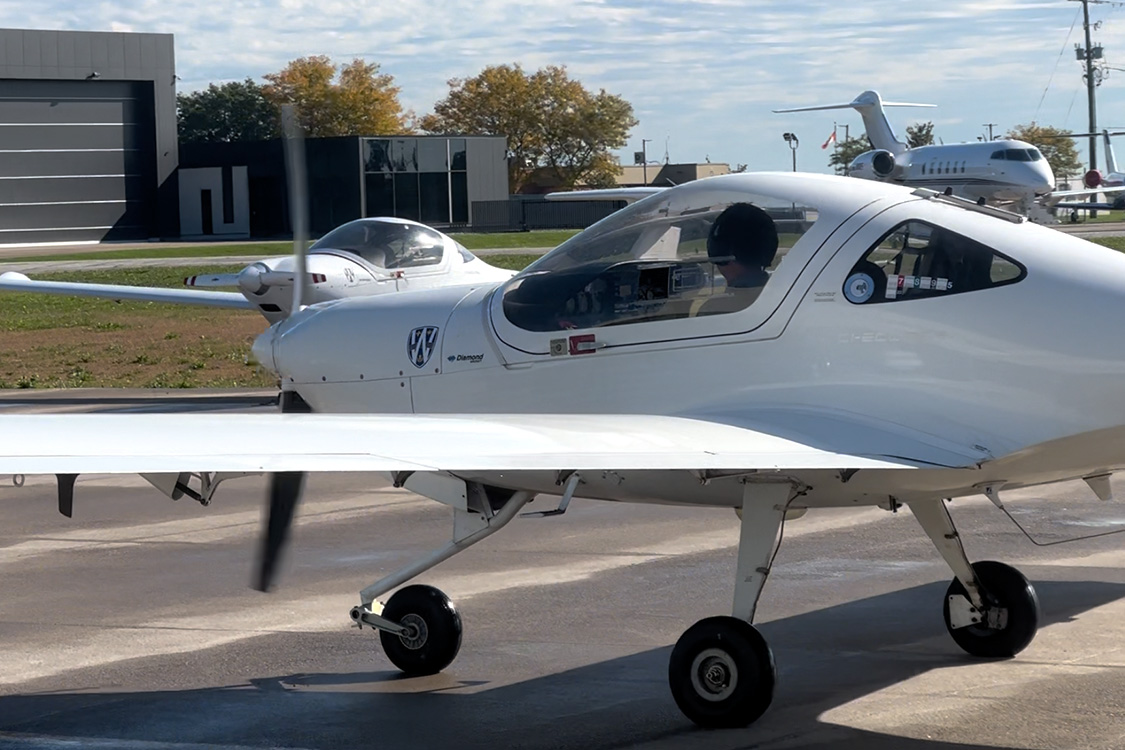
My first observation was simple: the plane is small.
One might say, go-kart-with-wings kind of small.
Alex worked through the pre-flight procedures and checklists. Watching him, I was struck by how much knowledge he had accumulated through his flight hours, weekly ground school classes and countless hours studying aviation at and away from the airport.
He wasn’t simply learning to fly. He had become a student of aviation.
We taxied onto the runway. Alex looked over.
“You ready? Here we go,” he said before applying full power.
Compared with jet-powered airliners, full power in this single-engine propeller aircraft is a relative term. In what felt like less distance than a 100-yard dash, we were airborne.
The first surprise was how different it felt compared with sitting in row 20 of a Boeing or Airbus. The DA20 is light, and you feel the plane yaw and move — or, more accurately, bounce — through the air.
It was a humid and slightly choppy day, but while the sensations were new to this passenger, Alex’s calm demeanour showed that all was normal and routine for a trained, prepared and capable pilot.
After a “river tour” from above UWindsor’s campus to Peche Island, we flew over our home and then continued to central Essex County, where student pilots do much of their training.
Were there nerves? As an aviation enthusiast, I know the rigorous inspections and protocols that help keep flying safe.
But that doesn’t eliminate the butterflies.
Watching Alex did.
His communication with air traffic control was calm and precise. His awareness of procedures was obvious. He knew exactly what he was doing at every phase, and I quickly found myself relaxing and in awe.
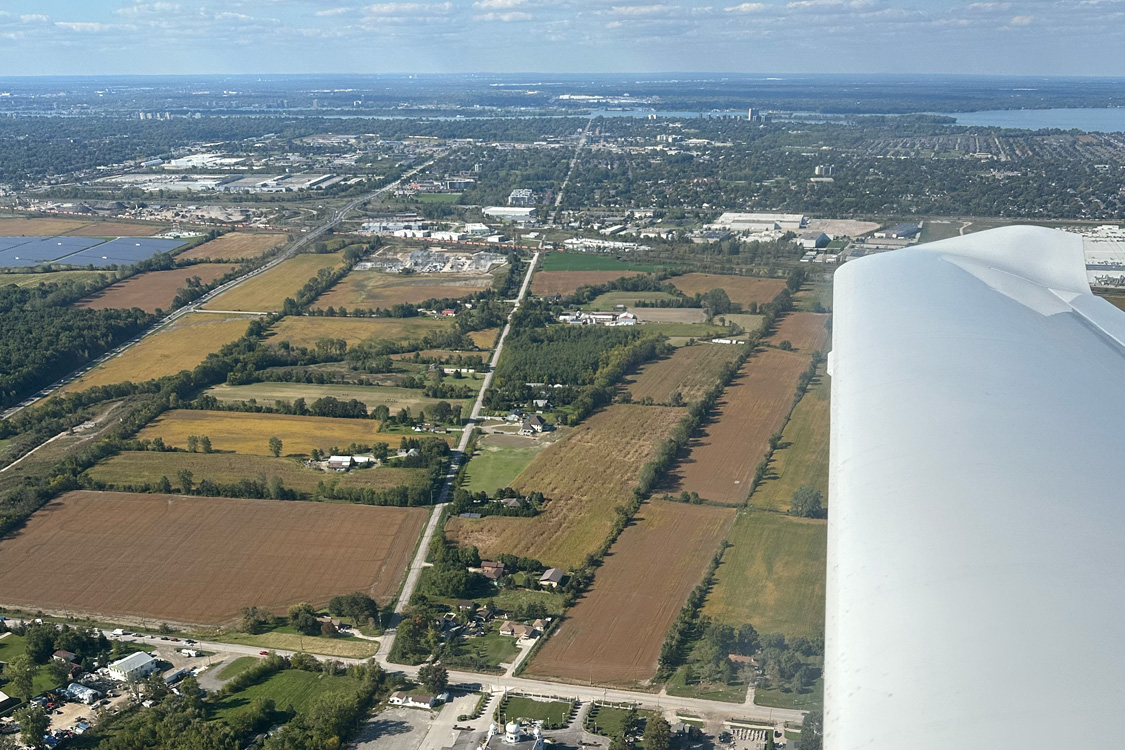
We eventually returned to Windsor for the part I found most fascinating: the landing.
From inside a small aircraft, you can appreciate the approach in a way that isn’t possible from a commercial airliner. Watching Alex line up the aircraft with the runway and ease it down was remarkable.
We landed, came to a stop and took off again for another circuit before returning for a second landing — even gentler than the first.
Well done, Alex. Safe travels and happy landings.