
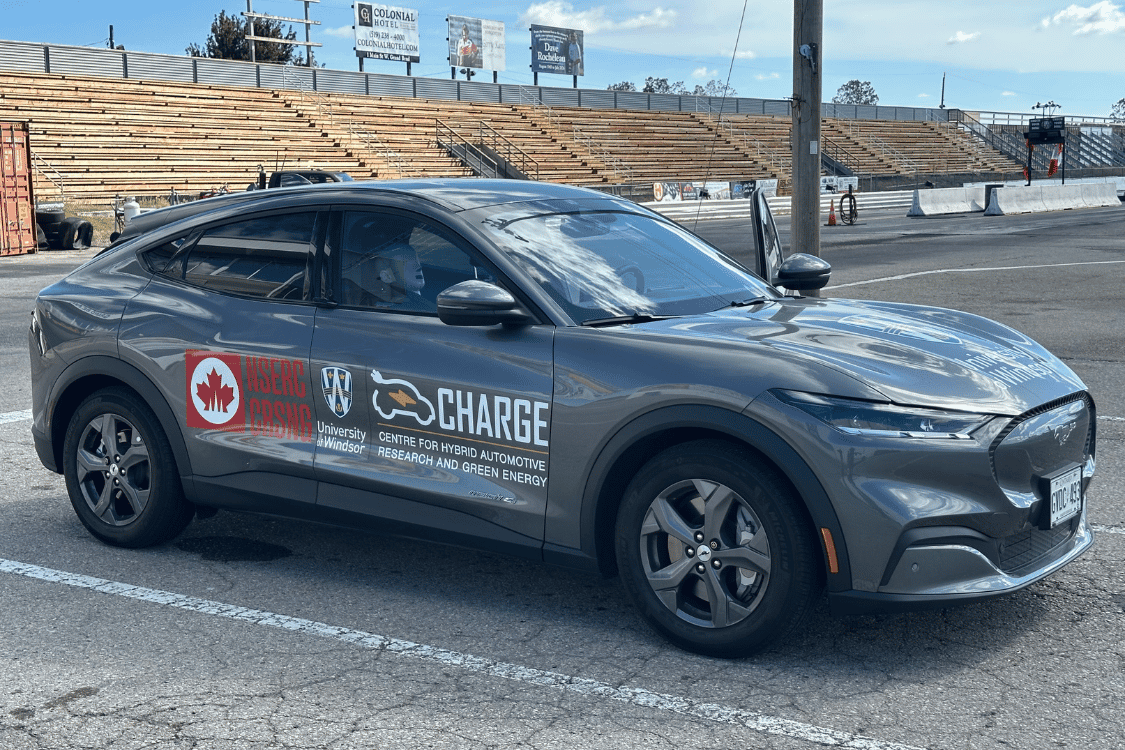
 University of Windsor researcher Dr. Lucas Bruck is investigating how autonomous vehicles (AVs) could be tested and rated to measure both safety and comfort. The team collected motion data using a vehicle from the CHARGE Lab and testing it at a racetrack. (Courtesy Dr. Lucas Bruck/ University of Windsor)
By Lindsay Charlton
Drivers have to earn their licence before they can hit the road. Why should self-driving vehicles be any different?
For University of Windsor researcher Dr. Lucas Bruck, that question is driving research into how autonomous vehicles (AVs) could be tested and rated before they share the road with human drivers.
Bruck is developing a testing protocol and five-star rating system to assess how well autonomous vehicles navigate roads, respond to their surroundings and provide a safe, comfortable ride.
“If you want to drive, you need to be allowed to drive. That process includes going to a test centre and having a person evaluate your ability to read signage, comply with traffic rules and your overall control of the vehicle,” Bruck said.
“Now, in a vehicle with an autopilot type of function, that vehicle essentially introduces an unlicensed driver onto the roads, but these vehicles can’t go through the same process we do.”
His project, Autonomous Vehicle Assessment Protocol for Testing (AV-APT), aims to establish a standardized approach to evaluating autonomous driving performance, potentially giving manufacturers and other stakeholders a clearer picture of how well these vehicles handle real-world driving conditions.
“We want to know if those vehicles are ‘apt’ for our roads,” Bruck said.
Bruck pointed to the New Car Assessment Program (NCAP), which rates vehicle safety based on crash-test results using a five-star scale.
While existing ratings focus largely on how vehicles protect occupants in a crash, Bruck wants to evaluate how effectively autonomous systems perform the driving itself.
“How are those vehicles perceiving the environment? How are they executing their driving functions? Not only how they’re complying with traffic rules, but also how smooth or comfortable is the ride for the user?”
In the project's early stages, Bruck and two master’s students are identifying the measurements needed to evaluate driving performance, including vehicle stability and passenger comfort. One challenge is translating the subjective experience of a ride into objective data.
“There are mathematical models for the inner ear organs. We call that the vestibular system, and that is essentially the sensor we have for motion in our bodies,” Bruck explained.
“So, one idea is if we can model that, maybe that could be an objective link to the subjective feeling.”
To better understand the relationship between vehicle movement and how passengers experience it, the team collected motion data during testing at a racetrack.
“We drove a vehicle and collected data on its motion to run those signals through the vestibular system model,” Bruck said.
“We measured the motion of the vehicle, but not all that we measure is all that we feel. So, the second step is understanding that.”
For Bruck, a longtime automotive researcher and enthusiast, the project offers an opportunity to help advance vehicle technology while working alongside the next generation of engineers.
“I’m lucky to be in a position where I can give my ideas and hear ideas from the students that move forward technology,” Bruck said.
Bruck's research is supported by a $190,000 Discovery Grant from the Natural Sciences and Engineering Research Council of Canada (NSERC). He is among 10 University of Windsor engineering researchers awarded more than $2.4 million in funding over five years.
Broader engineering research
Across the Faculty of Engineering, the funded projects are tackling challenges that range from making transportation more sustainable to building infrastructure that can better withstand the impacts of climate change.
Dr. Sreekanta Das, associate dean of research and graduate studies in the Faculty of Engineering, is investigating more environmentally sustainable approaches to 3D-printed construction. His project, Development of Environmentally Sustainable 3D Printed Walls and Prisms, received $440,000 over five years — the largest award among the Faculty's recipients. His application also received an “exceptional” rating for researcher excellence.
Other researchers are exploring how machine learning could make global supply chains more efficient and resilient, how advanced modelling could improve electric motor design and how new materials could improve the durability of electric vehicle components.
Additional projects are examining how digital tools and data-driven approaches can help communities plan for infrastructure challenges caused by climate change and other disruptions.
The Discovery Grants program is NSERC’s largest and longest-standing funding program. The five-year grants support ongoing research programs with long-term goals, giving researchers the flexibility to pursue avenues of research as they emerge.
Awards are based on a competitive assessment of research excellence, the merit of the proposed work and contributions to researcher training.
The 2026 Discovery Grant recipients within the Faculty of Engineering are:
- Dr. Sreekanta Das, Civil and Environmental Engineering — Development of Environmentally Sustainable 3D Printed Walls and Prisms ($440,000)
- Dr. Narayan Kar, Electrical and Computer Engineering — Driving Innovations in Sustainable e-Powertrains for Electric Vehicle Applications ($305,000)
- Dr. Ahmet Alpas, Mechanical, Automotive and Materials Engineering — Tribological Mechanisms and Interfacial Evolution of Carbon-Based Coatings under Sliding Conditions ($260,000)
- Dr. Guoqing Zhang, Mechanical, Automotive and Materials Engineering — Global Supply Chain Design and Planning Using Data-Driven Optimization ($235,000)
- Dr. Mitra Mirhassani, Electrical and Computer Engineering — Breaking the FHE Bottleneck with Custom CMOS Accelerators ($215,000)
- Dr. Rajeev Ruparathna, Civil and Environmental Engineering — City Information Modeling-Based Multi-Hazard Resilience Planning for Civil Infrastructure ($190,000)
- Dr. Eunsik Kim, Mechanical, Automotive and Materials Engineering — Enhancing Real-Time Ergonomic Feedback through Deep Learning and LLM-Driven Posture Estimation in an Extended Reality Environment ($190,000)
- Dr. Nickolas Eaves, Mechanical, Automotive and Materials Engineering — Controlling Carbon Nanomaterial Formation in Reactive Gas Flows ($190,000)
- Dr. Li Ze, Electrical and Computer Engineering — Data-Driven Surrogate Modeling for Electric Motor Design and Optimization ($190,000)
- Dr. Lucas Bruck, Mechanical, Automotive and Materials Engineering — Autonomous Vehicle Assessment Protocol for Testing (AV-APT) ($190,000)