
 Female Snow bunting in a wire-rock gabion in Iqaluit, Nunavut [photo courtesy S. Simard-Provençal].
By Sara Elliott
Next summer, a team of scientists will travel across the Arctic tundra in a new mobile research and training lab.
As they collect data in Iqaluit, they hope to better understand how the rapidly declining snow bunting — an Arctic-breeding songbird that winters in southern Canada — is responding to urban development in the North.
How these birds are reacting to urbanization and environmental change in Arctic regions is already raising concerns for researchers monitoring populations in the low Arctic.
“Climate change is warming the Arctic at rates five to six times faster than the global average, bringing with it a range of complex challenges for wildlife,” said Oliver Love, lead researcher and professor in the Department of Integrative Biology.
“Our work already suggests that when temperatures rise above just 11.7 degrees Celsius, buntings reduce the rate at which they feed their young to avoid overheating. This affects breeding success and could have long-term consequences for their populations.”
A key part of the work involves engaging community scientists.
“The lab gives our students the chance to train in the North, and it also opens the door for Indigenous and local students — and young people more broadly — to learn about science and get involved,” said Love.
“It means parents and elders can see what opportunities exist for youth, and how they can participate in monitoring the wellbeing of songbirds in their own communities. The lab helps build the skills to do this kind of work locally.”
The fully equipped field lab is funded through a $150,000 grant from the Natural Sciences and Engineering Research Council of Canada’s Research Tools and Instruments program. The interdisciplinary team includes three co-applicants, including UWindsor researchers Christina Semeniuk and Hannah ter Hofstede, both from Integrative Biology.
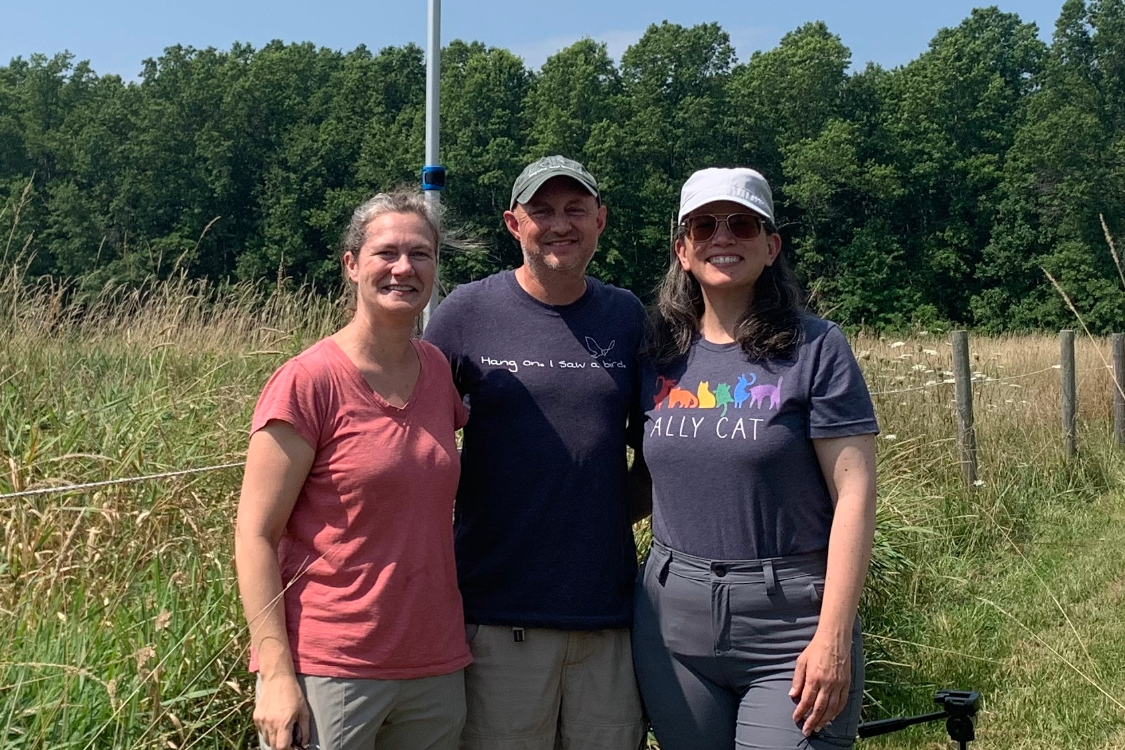
Researchers (Left to Right) Hannah ter Hofstede, Oliver Love and Christina Semeniuk, along with their student researchers, plan to return to Iqaluit in summer 2026 for further ecological and community-focused work with the region’s snow bunting populations. [Photo courtesy of Oliver Love]
“We can bring the mobile lab, packed with equipment to monitor the environment and bird physiology and behaviour, to a site in Iqaluit, collect data on location, and then move to another site,” said Love.
“By collecting data in real time and using temperature sensors across the city, we can identify which areas are warming more quickly. The mobile lab lets us respond to those changes and measure them as they happen.”
In response to critical knowledge gaps, the lab will support the development of heat-tolerance models to assess how urban life in the low Arctic affects the health and performance of snow buntings.
“Without this data, we can’t predict when bunting parents will begin to reduce feeding to protect themselves from overheating,” said Love. “Without this information, we risk underestimating how climate change may affect this species and other Arctic songbirds already in decline.”
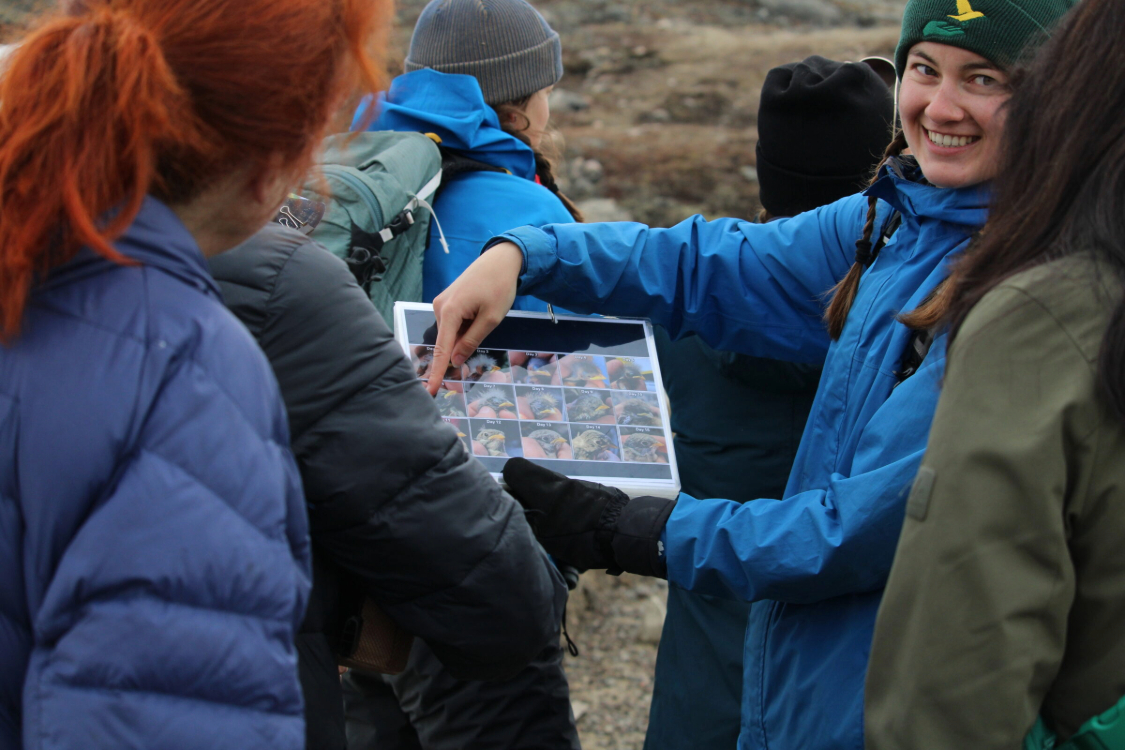
Graduate student Elena Tranze-Drabinia helps lead a community bird walk in 2025 in Iqaluit, Nunavut. [photo courtesy of Arty Sarkisian, Nunutsiaq News]
Dr. Semeniuk, who also recently received funding from the Diversity, Indigeneity and Anti-Racism Professional Development Fund to support the team’s community-based work, said engagement with the community is just as important as the scientific training the lab enables.
The project also challenges traditional approaches to northern research.
“Historically, southern researchers working in remote parts of the Arctic have often acted as ‘parachute scientists,’ engaging little or not at all with local communities,” said Semeniuk. “Our decision to place the lab in the heart of Nunavut’s capital and make it accessible to residents is a conscious effort to reverse that legacy.”
Drs. Love, Semeniuk and ter Hofstede, along with their student researchers, plan to return to Iqaluit in summer 2026 for further ecological and community-focused work with the region’s snow bunting populations.