
 The University of Windsor’s Real-time Aquatic Ecosystem Observation Network (RAEON) is leading a citizen science initiative to protect the Great Lakes. The project engages community members in collecting water quality data to support research and environmental stewardship.
WINDSOR, Ont. — Armed with water sampling kits and scientific curiosity, citizen scientists can soon join forces with University of Windsor researchers to protect the Great Lakes through a bold new initiative led by the Real-time Aquatic Ecosystem Observation Network (RAEON).
This participatory science project invites volunteers to work alongside researchers to collect vital water quality data and deepen our understanding of the health of these critical freshwater resources.
Starting in May, RAEON will host bi-weekly community science events where participants will gather baseline water quality samples and learn about the factors that influence the health and ecological integrity of their local watersheds.
This hands-on approach not only strengthens scientific research but also builds environmental awareness and a deeper connection to the Great Lakes.
"The benefits of having individuals participate in the science are twofold: first, their input will help expand and supplement data collection," said Katelynn Johnson, project co-lead and research and operations director for RAEON. "But perhaps even more important, participants will learn more about the scientific process and the challenges facing the environment in which they live."
Data collected through the initiative will contribute to research publications, conference presentations, and the development of adaptive management plans and environmental policies. By combining citizen-collected data with traditional scientific research, the project aims to equip decision-makers with more comprehensive information to guide evidence-based policies and management strategies.
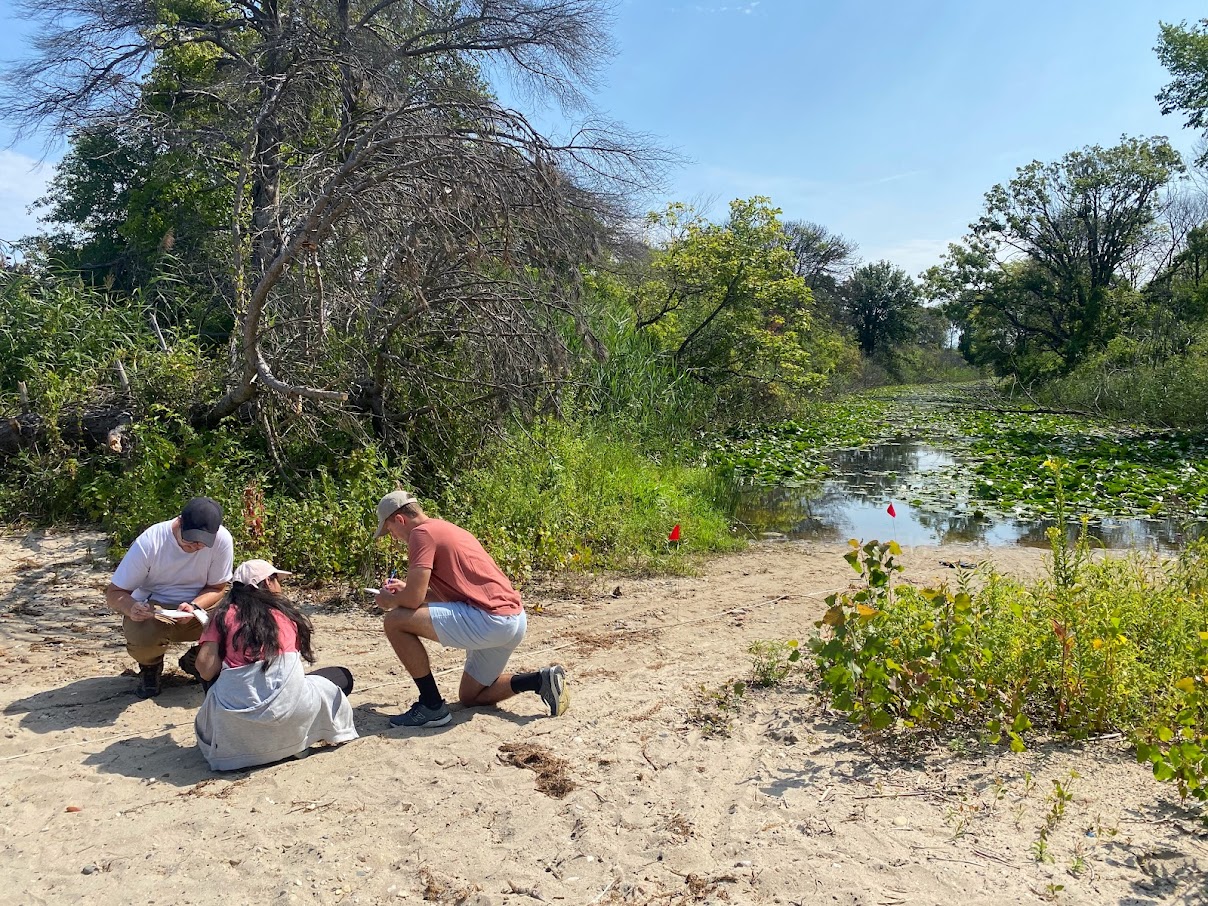
Students Brian Kountourogiannis, Rucha Patel, and Ryan Gilham set up transects to collect samples on Peche Island. (Photo by RAEON)
The project is a collaborative effort involving institutions across the Great Lakes region, including municipal, provincial, and federal government scientists, nonprofit agencies, and underrepresented groups such as nontraditional fishers. A dedicated community science liaison will connect with a broad range of stakeholders, including K-12 schools, universities, water utilities, and recreational water users, to encourage wide participation.
In addition to Johnson, the project is led by Aaron Fisk, co-lead and science director of RAEON, professor in the School of the Environment, and Tier 1 Canada Research Chair in Changing Great Lakes Ecosystems; and RAEON community science liaison Edward Millar.
The initiative is supported by a $540,000 grant from the Canadian Water Agency, supplemented by $672,667 in-kind funding, totalling $1,212,667.