
Indigenous Student Success Centre
The Indigenous Student Service Centre supports the academic, cultural, emotional, and spiritual wellbeing of Indigenous students by creating a welcoming and culturally grounded space that fosters belonging, identity, and achievement. Guided by community knowledge and the principles of the Truth and Reconciliation Commission of Canada and its Calls to Action, the Centre works to advance reconciliation and Indigenization within the institution.
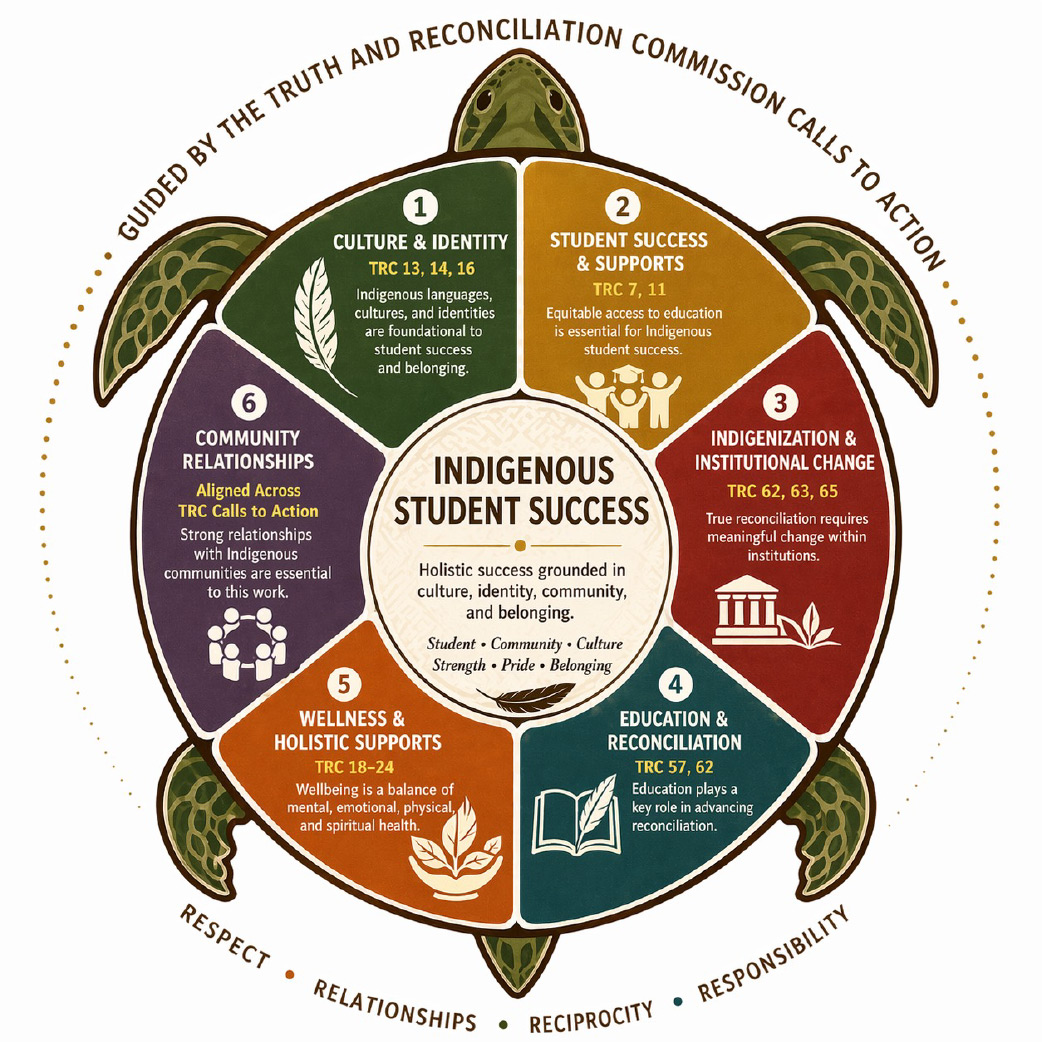
Our Framework: Guided by the Truth and Reconciliation Commission Calls to Action
Our work is grounded in the Calls to Action from the Truth and Reconciliation Commission of Canada, guiding how we support Indigenous students, strengthen community, and create meaningful change within post-secondary education.
TRC Calls to Action: 13, 14, 16
Indigenous languages, cultures, and identities are foundational to student success and belonging.
- TRC 13 recognizes Indigenous languages as a vital part of Canadian society and supports their revitalization
- TRC 14 affirms the rights of Indigenous peoples to preserve and strengthen their languages
- TRC 16 calls on post-secondary institutions to create Indigenous language programs
Our Commitment
We support cultural pride and identity by creating space for language, ceremony, and cultural learning within the student experience.
TRC Calls to Action: 7, 11
Equitable access to education is essential for Indigenous student success.
- TRC 7 calls for closing educational gaps between Indigenous and non-Indigenous students
- TRC 11 focuses on improving access to and completion of post-secondary education
Our Commitment
We work to improve access, retention, and graduation by offering culturally grounded supports, outreach, and student-centered services.
TRC Calls to Action: 62, 63, 65
True reconciliation requires meaningful change within institutions.
- TRC 62 calls for integrating Indigenous knowledge and perspectives into education
- TRC 63 emphasizes intercultural understanding and anti-racism education
- TRC 65 supports research that advances reconciliation
Our Commitment
We contribute to transforming institutional practices by centering Indigenous knowledge, supporting learning, and advancing research that reflects community priorities.
Education plays a key role in advancing reconciliation.
- TRC 57 calls for education of staff and faculty on Indigenous histories, rights, and cultural competency
- TRC 62 supports embedding Indigenous perspectives across education systems
Our Commitment
We foster awareness and understanding through education, training, and ongoing learning opportunities grounded in respect and responsibility.
TRC Calls to Action: 18–24
Wellbeing is understood as a balance of mental, emotional, physical, and spiritual health.
- Recognizing holistic approaches to Indigenous health
- Addressing inequities and barriers to care
- Supporting culturally safe services and healing practices
Our Commitment
We support whole-student wellbeing by creating space for balance, connection, and culturally grounded care.
Aligned Across TRC Calls to Action
Strong relationships with Indigenous communities are essential to this work.
- Partnership with Indigenous communities
- Respect for Indigenous ways of knowing and doing
- Ongoing relationship-building grounded in trust and reciprocity
Our Commitment
We build and maintain meaningful relationships with community partners, guided by respect, accountability, and doing things in a good way.
How It All Connects
Together, these pillars guide our approach to Indigenous student success:
- Removing barriers to education
- Uplifting culture, language, and identity
- Transforming institutional systems
- Supporting holistic student wellbeing
- Strengthening relationships with Indigenous communities