
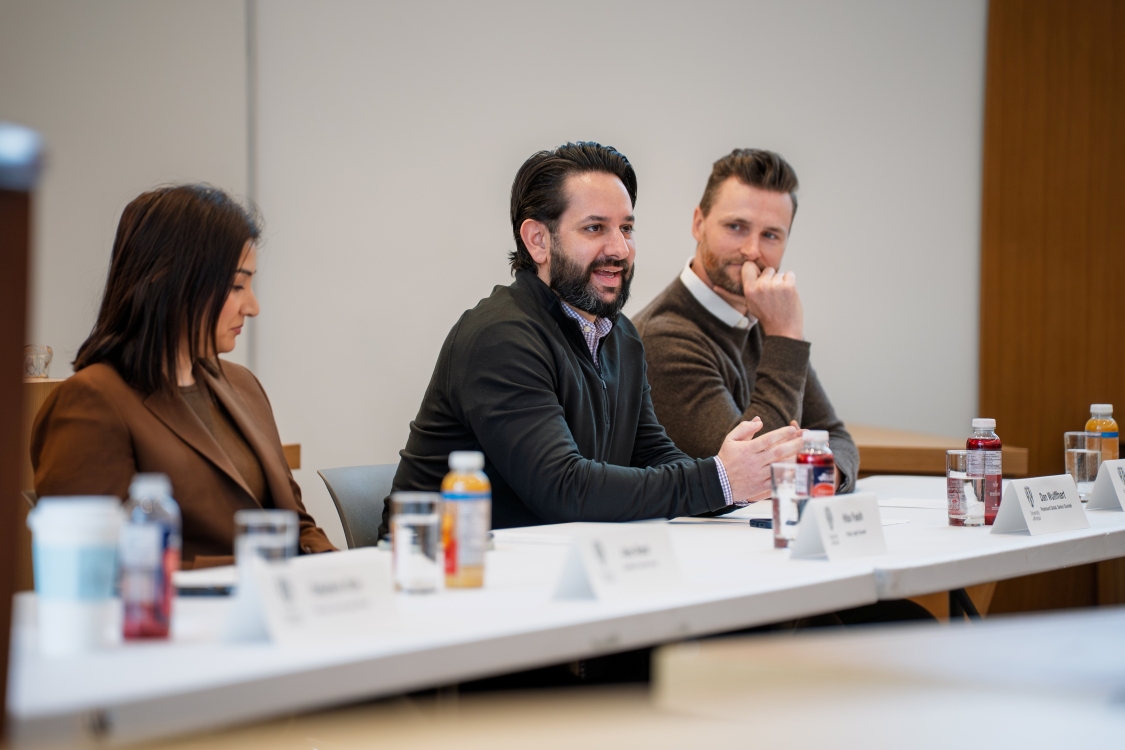
 Windsor Law students listen to alumni insights during In-House Counsel Day, gaining firsthand perspectives on careers in corporate and organizational legal practice. (KYLE ARCHIBALD/University of Windsor)
By Sara Meikle
There is no single blueprint for a legal career — and that was precisely the point.
On Feb. 11, students gathered for the University of Windsor Faculty of Law’s annual In-House Counsel Day, an event that continues to grow as one of the faculty’s most meaningful opportunities to connect current students with accomplished alumni.
Hosted by the Windsor Law Career Services Office and the Corporate Law Club, a panel of alumni offered an inside look at the evolving and often non-linear paths that lead lawyers into in-house practice.
This year’s panel featured five Windsor Law alumni working across various industries: Michael Britton of Coca-Cola Canada Bottling Limited; Hiba Fasih of Ornge Inc.; Stephen Kim of Avicanna USA Inc.; Alex Rand of QuadReal Property Group; and Dan Wulffhart of Paramount Global.
Together, they represented industries spanning biopharmaceuticals, consumer goods, global real estate, entertainment and healthcare — underscoring the breadth of opportunity available within in-house practice.
For Selma Osmancausevic, co-president of the Corporate Law Club and event moderator, the most memorable takeaway was hearing how each panelist described growing into their roles over time.
“Some began their careers in private practice, while others started in-house, but all spoke openly about periods of transition, which was reassuring to hear as a student,” she said. “What resonated with me most was their emphasis on curiosity and adaptability.”
Panelists spoke candidly about learning the business beyond the law — understanding operations, building relationships across departments and evolving alongside their organizations.
For Osmancausevic, this reinforced an important perspective.
“It reminded me that a legal career is not linear, rather it is shaped by experience, mentorship and being open to opportunity,” she said.
That theme echoed throughout the afternoon. Several panelists began in private practice before moving in-house, while others charted more unconventional paths. Some described building their careers through progressively senior positions within corporations, taking on increasing responsibility before ultimately stepping into executive leadership. Others spoke about the pivotal role mentorship and hands-on industry experience played in shaping their transitions.
Jessica Kabuli, a third-year law student, said one of her biggest takeaways was hearing about success beyond the traditional big law model.
“As students, we’re often exposed to the life of firms as the primary benchmark of success, so it was refreshing to see that in-house counsel can be just as dynamic, strategic and fulfilling,” she said. “I especially appreciated the stories about transitioning from big law to in-house roles. It made the path feel intentional and attainable rather than accidental.”
One piece of advice that particularly resonated with Kabuli was the idea of becoming an expert either “vertically” or “horizontally” — mastering a specific industry or specializing deeply in a particular area of law.
“That framework gave me a clearer way to think about long-term growth in the profession,” she explained.
Students were also struck by how integrated in-house lawyers are within their organizations. Rather than acting solely as legal advisors, panelists described serving as strategy leaders, balancing legal analysis with commercial judgment.
“Hearing from lawyers practicing in-house broadened my understanding of what a legal career can look like,” Kabuli said. “They’re not just answering legal questions — they’re involved in decision-making, risk assessment, and long-term strategy. That blend of legal analysis and business judgment really resonated with me.”
Maxmin Metzler, co-president of the Corporate Law Club, reflected on the broader impact of the event.
“What stood out most was the candor of the speakers and their genuine willingness to return to Windsor Law to connect with students,” he said. “Hearing alumni speak openly about their journeys encourages us to think more broadly about what a law degree can lead to.”
For Metzler, the panel helped expand his perspective. “The discussion reinforced how diverse legal careers truly are and how important it is for students to see that there is a place for them within the profession, even if they haven’t found it yet.”
Practical advice was another key theme of the afternoon. Panelists emphasized the importance of developing business literacy alongside legal expertise — understanding how legal decisions affect operations, growth and risk.
“One of the most practical pieces of advice was the importance of developing strong business literacy alongside legal skills,” Kabuli noted. “Preparing for a legal career isn’t just about mastering doctrine — it’s also about staying curious about industries, following market trends and understanding how organizations function.”
For the student organizers, the most rewarding moment came after the formal discussion ended. Conversations continued well beyond the scheduled time, as students gathered around panelists to ask candid questions and exchange contact information.
“Watching students ask thoughtful, candid questions made the experience especially meaningful,” Osmancausevic said. “In-house career paths are not always as visible in law school, so broadening students’ understanding of the legal profession is important.”
Ultimately, In-House Counsel Day did more than showcase career options; it reflected Windsor Law’s foundational commitment to access, mentorship and community. By creating space for alumni to return, share candidly and invest in the next generation, Windsor Law reinforces that its strength lies not only in the education it provides, but in the network it sustains.
For students, that network makes the profession feel less abstract and more accessible, a reminder that the paths ahead are varied but never navigated alone.
As Metzler put it, “There isn’t one right way into the career you want. Everyone’s path looks a little different, and it’s often those differences that shape us into the advocates we want to become.”