
 Shifting Borders, an exhibition developed by guest curator Niku Koochak (left) in collaboration with Dr. Rodney to examine how borders are shaped by access, power and lived experience through contemporary art, archival materials and student-led research. (PETER MARVAL/University of Windsor)
By Victor Romao
An exhibition that ran March 12 to 20 at the University of Windsor’s School of Creative Arts (SoCA) Gallery invited visitors to reconsider the border not as a fixed line on a map, but as a shifting experience shaped by politics, access and personal history.
Shifting Borders examined how the international boundary between Windsor and Detroit — often perceived as close and easily crossed — can carry very different meanings depending on an individual’s circumstances.
Guest curator Niku Koochak (MFA ’24) said personal experience played a central role in shaping the exhibition.
“For someone who doesn’t need a visa, the experience of that border might remain very much within the Windsor–Detroit context,” said Koochak. “For me, when I look across the river, I don’t just see another state — I see another country, even another continent.”
The exhibition was presented in two parts.
Contemporary works by six artists addressed global border politics, while archival materials from the Border Bookmobile Project offered insight into a period when the Canada–U.S. border was presented as accessible and even welcoming.
Tourist brochures, maps and souvenirs from the mid-20th century portrayed the border as a casual destination — part of an economy built around short-day trips, said Dr. Lee Rodney, a professor in the School of Creative Arts.
“This phenomenon is entirely absent in the present,” said Rodney. “The nature of travel has changed significantly since 2001, and it continues to.”
Students in Rodney’s “Curating as Cultural Practice” course selected objects from the Leddy Library Archives and Special Collections and responded to them through research, writing and curatorial interpretation. Their reflections were displayed alongside the archival materials.
“The exhibition situated that archive in relation to the seismic changes we’re seeing in border control, both locally and globally,” Rodney said. “It made visible how much everyday experiences like crossing the border have changed.”
Among the participating artists was Amin Rehman (MFA ’11), whose neon installation English is a Foreign Language is part of a long-term research project examining borders in post-colonial regions of South and Central Asia.
“The aim of this project was to document the economic hardship, identity crisis and effects of border conflicts on ordinary citizens,” Rehman said. “Many of these conflicts originate from borders that were drawn quickly and imposed without regard for communities.”
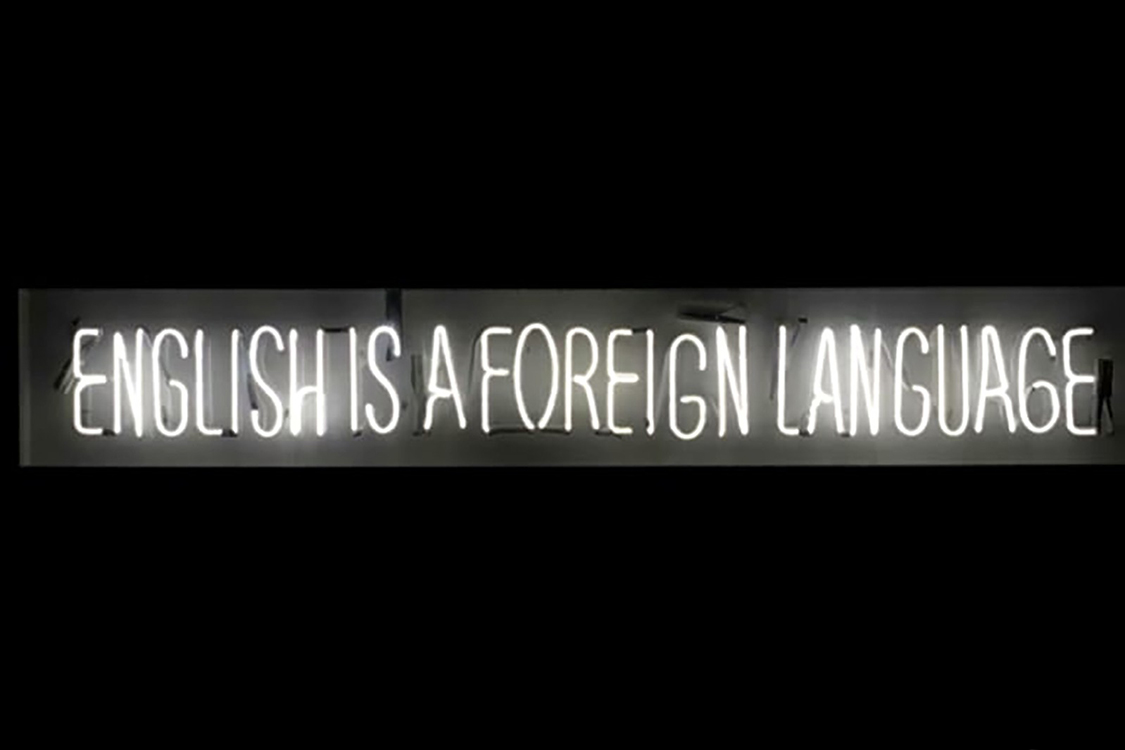 Amin Rehman’s English is a Foreign Language is part of Bleeding Borders, a five-year research project inspired by his 2018 to 19 travels to the borderlands of Afghanistan, India and Iran. The work was displayed on a video monitor as part of the Shifting Borders exhibition. (SUBMITTED BY AMIN REHMAN/University of Windsor)
Another focal point of the exhibition was a circa-1950 decorative pillowcase titled Hands Across the Border, selected by undergraduate student Chayu Chandramohan.
Printed on velvet and mass-produced as a tourist souvenir during the mid-20th century, the object reflects an era when short cross-border day trips were a common leisure activity.
Featuring imagery from Niagara Falls alongside Canadian and American symbols, the pillowcase illustrates how the Canada–U.S. border was marketed as friendly, accessible and celebratory during this period.
“The term ‘Hands Across the Border’ was associated with peace events where people would gather near the border to greet one another,” Chandramohan said. “Despite today’s tensions, there’s a sense of humanity and hope embedded in this object.”
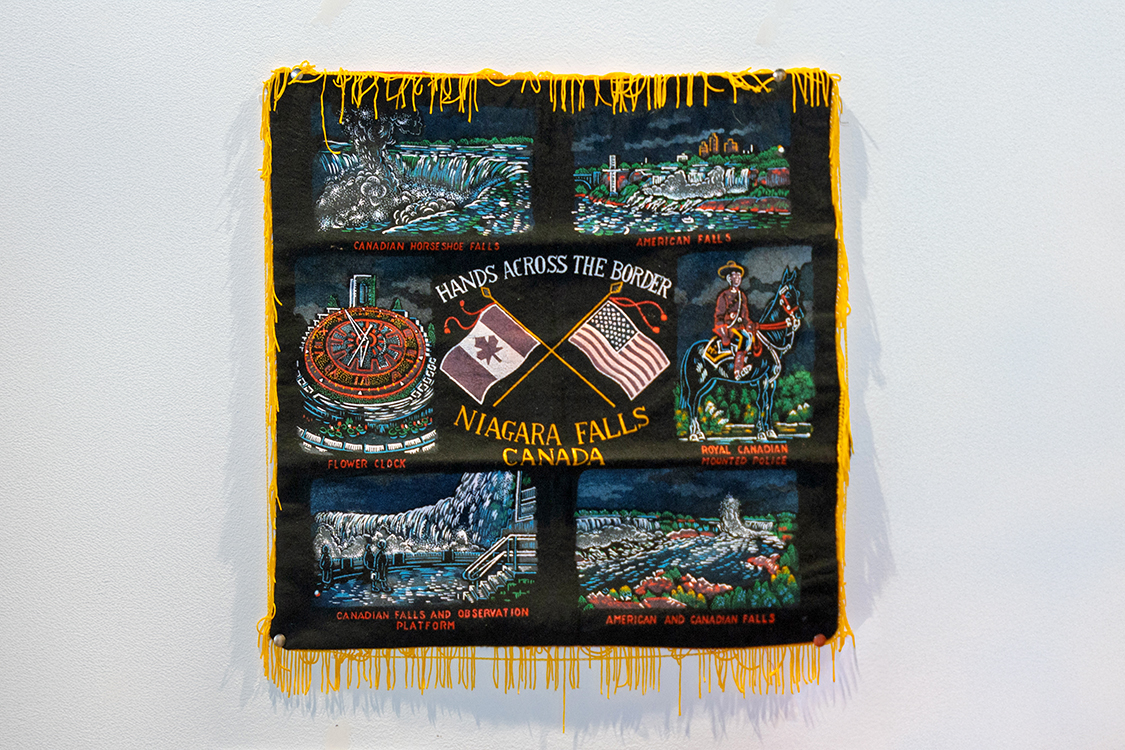 Hands Across the Border, c. 1950. Velvet pillowcase featuring tourist imagery from Niagara Falls and symbols of Canada–U.S. relations. Archival object selected by Chayu Chandramohan, an undergraduate SoCA student, as a point of reflection on how borders are represented through everyday and touristic objects. Courtesy of Leddy Library Archives and Special Collections. (PETER MARVAL/University of Windsor)
For Koochak, placing archival objects alongside contemporary artworks was central to the exhibition’s purpose.
“Revisiting these materials allowed us to ask when and how the meaning of the border began to shift,” she said. “Was it ever equally open for everyone, or did that invisibility depend on who you were?”