
 Andrew Moukled, founder and CEO of MAP and a University of Windsor alumnus, speaks to secondary school teachers during the Entrepreneurship for Public Board Business Teachers professional development event at the Odette School of Business on April 29. (VICTOR ROMAO/University of Windsor)
By Victor Romao
Local business leaders, University of Windsor faculty and student entrepreneurs gathered at the Odette School of Business on April 29 for a full-day professional development session to connect classroom learning with the regional economy.
The event, Entrepreneurship for Public Board Business Teachers, was held in partnership with the Greater Essex County District School Board (GECDSB) and organized by Jacqueline Hebert, Odette’s recruitment and retention coordinator.
Participant Silvana Nawalany, experiential learning teacher with the GECDSB, said the day reinforced her approach to experiential learning.
“The ideas and frameworks shared reinforced — and expanded — my long-standing belief in integrating entrepreneurship into experiential learning,” said Nawalany.
She added that Ministry funding plays an important role in enabling schools to translate ideas into action through partnerships, student-led projects and problem-solving opportunities tied to real contexts.
Featured speaker Andrew Moukled (BComm ’15, MBA ’17), a University of Windsor alumnus and founder and CEO of MAP, supports more than 100 healthcare professionals across southwestern Ontario.
“I really think it’s important to recognize your choices as opportunities to move toward your next steps,” said Moukled. “How can your surroundings help you get to the next phase of what you want to do?”
He encouraged teachers to emphasize transferable skills over technical content.
“It’s not necessarily about teaching the components of an accounting equation,” he said. “It’s about teaching how to think — how to recognize opportunity and learn from others.”
“You play such an important role,” he told teachers. “Students may not appreciate it at the time, but they’ll come back and say thank you.”
Ryan Donally (BComm ‘13, MBA ‘14), president and CEO of the Windsor Essex Regional Chamber of Commerce, offered a broader perspective on the region’s business landscape and the challenges entrepreneurs face when starting out.
“When it comes to starting a business, most people don’t have a map and have no idea where to start,” he said. “It’s important for teachers to understand where students can go if they have a viable business idea.”
Donally explained that the Chamber represents about 775 businesses and 40,000 employees across Windsor-Essex, serving as a key connector between industry, government and the community.
“If you’re trying to build your credibility, your network, your profile — we facilitate those types of relationships,” he said.
He noted that giving students early exposure to these networks can demystify the process of starting a business and help them understand how ideas move from concept to execution.
“You don’t need to have everything figured out on day one,” said Donally. “But you do need to know where to go, who to talk to and what supports are available — and that’s something educators can help introduce early on.”
Nawalany said the event is already opening new opportunities for students, including continued participation in programs like Ascent and the development of initiatives such as Market Day, where students engage directly with local entrepreneurs.
She also pointed to interdisciplinary projects connecting entrepreneurship with sustainability and Indigenous perspectives, and collaborations with community leaders to help students understand real economic issues.
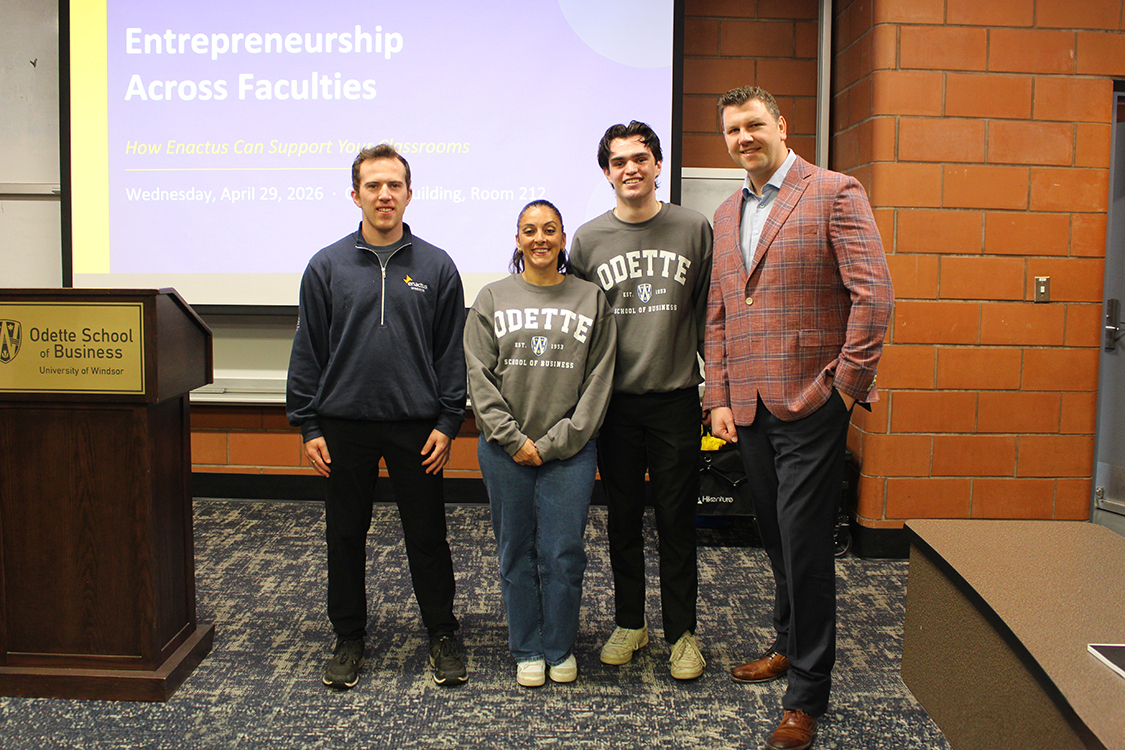
UWindsor business students Andrew Booth and Matthew Tracey, members of the Enactus entrepreneurship program, highlighted the impact of student-led ventures.
“Business is so much more than just two accountants working together,” said Booth. “It’s about people from different backgrounds coming together to make an idea work.”
“We’ve dedicated over 24,000 volunteer hours across just over 100 students,” he said. “Today, we’re going to show you how your students can do the same.”
They described Enactus as a platform that enables students to launch ventures, collaborate across disciplines and compete nationally.
“We’re undergraduate students — we’re still learning,” said Booth. “But we partner with alumni to help ensure our businesses can thrive.”
“A business student can’t always do it all,” said Tracey. “Working with engineering, science and other disciplines allows us to take our ventures to the next level.”
“By hearing from industry leaders and academic experts,” said Hebert, “teachers gain fresh perspectives and tools for their classrooms.”