
 University of Alberta scholar Dr. Nicolette Little will discuss Feminist Activism and Digital Technologies and launch her new book, From Red Dresses to Memory Stones: Multimedia Activism and Gender-Based Violence in Canada, at the CCA annual conferece at the University of Windsor on June 2, 2026. (University of Windsor)
By Lindsay Charlton
In the age of online dating, women are turning to each other and technology to stay safer when meeting someone offline for the first time.
A rapidly expanding Facebook safety network has tens of thousands of women across the country turning to groups such as Are We Dating the Same Guy, using it as an informal tool for crowdsourcing safety and sharing stories of infidelity, emotional or physical abuse, or other harmful experiences they have had with a certain man.
“Women have taken to these informal mechanisms primarily to try to keep themselves and each other safe,” said Dr. Nicolette Little, a University of Alberta researcher who studies contemporary media culture and digital activism, specifically feminist media interventions in gender-based violence.
“I've been interviewing women who participate in the site and learning more about their uses of it, as well as some of the consequences and problems, of which there are many, too.”
Little will chair a panel session, Feminism Activism and Digital Technologies, on Wednesday, June 2, at the Canadian Communication Association (CCA) conference hosted by the University of Windsor’s Department of Communication, Media and Film (CMF), where she will discuss her recent study.
Posts made by members of the private groups, which Little says are active in many major Canadian cities, typically feature a man’s dating profile, alongside requests for “red flags” or other information to prompt members to share experiences they may have had with this person.
“There are some really shocking dating behaviours that are being called out,” Little said. “There are also members being quite rough with each other. The fact that some women have been harmed because they were found to post there, or some have been threatened with legal ramifications, is also .worth in-depth exploration.”
Little received a Social Sciences and Humanities Research Council (SSHRC) Insight Development Grant to carry out her study, which explores this site and the ways women participate in informal gender-based violence (GBV) prevention activities in Canada.
The study guiding the June 2 talk asks questions about what conditions and experiences are driving the rapid expansion of the Facebook groups, what benefits and harms participants encounter, and how the groups illuminate systemic shortcomings in Canada’s gender-based violence response infrastructure.
“It explores mediated interventions in gender-based violence in a context where survivors haven’t had adequate legal support, everything is referred to as a ‘he said, she said,’ and it’s hard to get charges laid; only three in 1,000 charges lead to a conviction,” Little said.
The panel will also hear insights from scholars Dr. Ana Contreras of Simon Fraser University, who will discuss her work on data visualization and feminicide and feminist activism in Mexico, as well as Dr. Anna McWebb of the University of Waterloo, whose work explores the digital tactics of “cultural warfare.”
Little said this latest study has grown out of research she conducted for her new book, From Red Dresses to Memory Stones: Multimedia Activism and Gender-Based Violence in Canada.
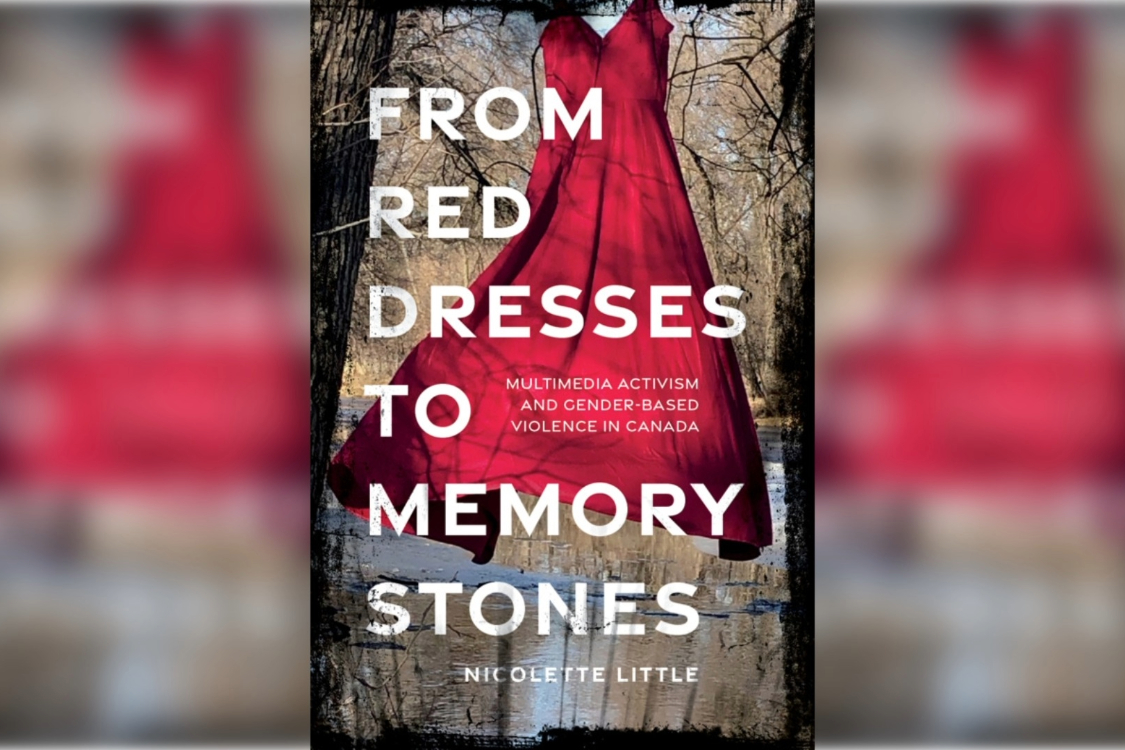
“The book is a culmination of years of research on activism in Canada by several really visible activists working to address gender-based violence and push back against some of the problematic narratives about it,” she said.
“It looks at the ways that they are very creatively using different media — media that’s immediately accessible and very easily used.”
Referred to as the country’s “shadow pandemic” by the United Nations, reported incidents of gender-based violence increased throughout the pandemic. Little said it is also one of the only violent crimes in Canada for which — up until this year — rates have been increasing rather than decreasing.
“And yet still it tends to be swept under the rug, or survivors are disbelieved,” she said.
By exploring five case studies of media activism by leading advocates across Canada, Little examines efforts ranging from indie documentaries and social media memorialization of the Montréal Massacre to community awareness initiatives for survivors and artistic responses to the Missing and Murdered Indigenous Women and Girls crisis.
“The creativity of this work captivated me and had me go down that path of what's going on in Canada and how are these creative activists using media in unique ways?” she said.
“I hope readers of the book will see the incredible thoughtfulness and creativity the activists are demonstrating. I think the fact that some of them have been through harsh things, and they keep showing up at the table with these sometimes very beautiful messages.”
The book will have its official public launch and a roundtable during the CCA conference on June 2 in Dillon Hall.
“We really pushed for the publication to come out in time for CCA. I consider it my home conference as a Canadian media and communications scholar,” she said. “I feel it’s a good atmosphere and great conversation, and I’m so excited for the book’s launch to be part of it.”
Building on themes explored in the book, the roundtable at the launch of From Red Dresses to Memory Stones will include Dr. Milena Radzikowska of Mount Royal University, Dr. Nelanthi Hewa of the University of Pennsylvania, and Dr. Rena Bivens and Kathryn Fedchun of Carleton University, who will share insights from their research on media activism and gender-based violence.
“We usually have some really engaged people, practitioners and scholars who attend,” she said. “So there's always an interesting Q&A afterwards and conversations. I'm always seeing great connections between panellists, and I'm always learning too, which is great.”
The CCA conference will take place at the University of Windsor from June 2 to 4. Details on programming, speakers and registration are available on the conference website.