
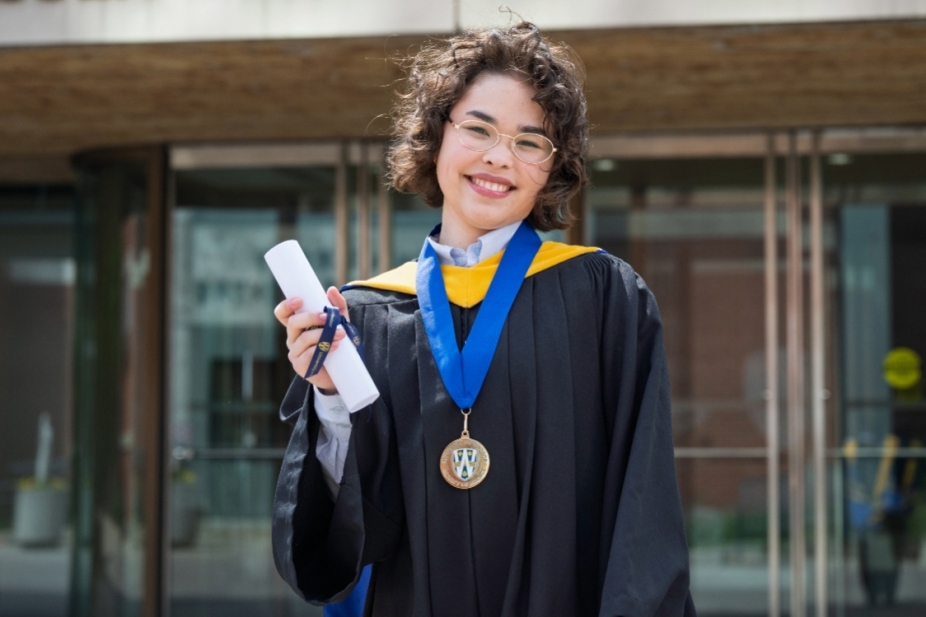
 Avery Ng is graduating from the behaviour, cognition and neuroscience science program. (PETER MARVAL/University of Windsor)
By Sara Elliott
From leading a group of art-loving scientists, to helping organize summer symphony performances for the Windsor Symphony Youth Orchestra, Avery Ng builds community in every role she takes on.
This commitment helped the fourth-year behaviour, cognition and neuroscience student earn a science medal. At spring convocation, she will sport a Leadership, Engagement, Application and Discovery (LEAD) gold medallion.
Read on to learn how Ng makes balancing it all look effortless.
How did you earn LEAD gold medallion?
In part, I co-led Science Meets Art (SMArt) with Sophia Egidio. My leadership goal was to create an even stronger community. I just got to enjoy art the way I love to enjoy it for a whole year. What a privilege.
I also helped with the Windsor Symphony Youth Orchestra. For the completely student-driven effort, they get to program their own music and conduct themselves in their own chamber orchestra experience.
My job is helping them program that and to also pull in professionals if we need it. It’s really fun to pick music. We know that kids will like whatever's popular this year and then you can get them hooked when you play them Mozart.
Why is it important to have SMArt as a creative outlet for science majors?
I think a lot of people feel that they need to pick or choose science or art and that they don't coexist, but they absolutely do.
When you have a greater community of people who want art in their lives, even though they're committing their careers to something different than the time you spend doing your art or enjoying your art isn't wasted and it really is enriching.
How did you complete the Application component of LEAD?
I was a TA for cell biology where I learned that when you get to know to your students, you can help to bring out their best qualities.
I found that incorporating humour, or mnemonic strategies can help students feel more at ease, making new concepts easier to learn and remember.
When students are around peers their own age who have already done the task at hand, it can be anxiety-inducing. It’s nice to be the person you may have wished was in the room during your own first labs — especially when you’re also navigating a new city for the first time.
How else did you round out your LEAD experience?
I am an Outstanding Scholar, which is a fantastic way to get involved in lab work. I also completed an honours thesis, co-advised by Drs. Catherine Febria and Dennis Higgs.
Facing those challenges firsthand, I think, helps you put into practice everything from the last four years — breaking down a problem, reaching out to the community, asking for new perspectives.
Describe your thesis.
I took an animal behaviour course with Dr. Christina Semeniuk and as a person who spent three years examining aquatic invertebrates under a microscope, it made me wonder what we know about invertebrate behaviour.
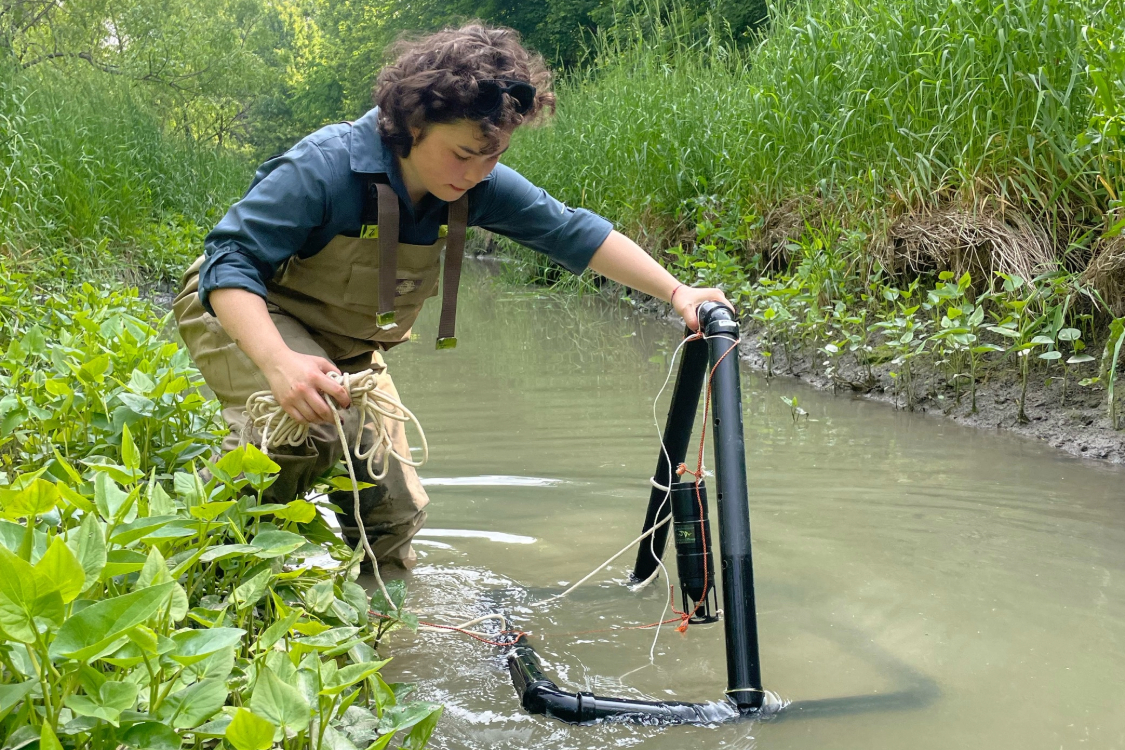
Avery Ng conducts summer field work in the River Canard. (ALEXIA MACRI/University of Windsor)
How insects perceive the world is underexplored, and yet behaviour is a precursor to environmental change. I wanted to know whether we could detect those changes earlier.
We chose to study sound because our water is so turbid here. I took sound recordings and looked at canopy cover, the vegetation, stream width and depth of the water, along with mussel data because mussels are companions to benthic invertebrates.
With current equipment, it’s hard to detect whether the invertebrates were making significant sounds to indicate stream health. The most surprising result is that streams with increased complexity of sound had increased mussel species diversity.
What is an academic highlight for you?
The ones I liked the most changed my perspective on what I was capable of doing.
Dr. Cavallo-Medved made cell bio so accessible and Dr. Kendall Soucie made me fall in love with psychology, even though I was always a skeptic before. Our professors show us the science behind things and introduce us to this idea of nuance and being comfortable and curious about ambiguity.
I also really enjoyed Introduction to organic chemistry. That course is notoriously hard, but I found it freeing and exploratory. It really challenges your ability to manipulate your logic.
What is next for you?
I’m going to take some time to step away from school. I’ll be training for a marathon this summer, and then I’ll pursue a masters program or professional school in the fall.