
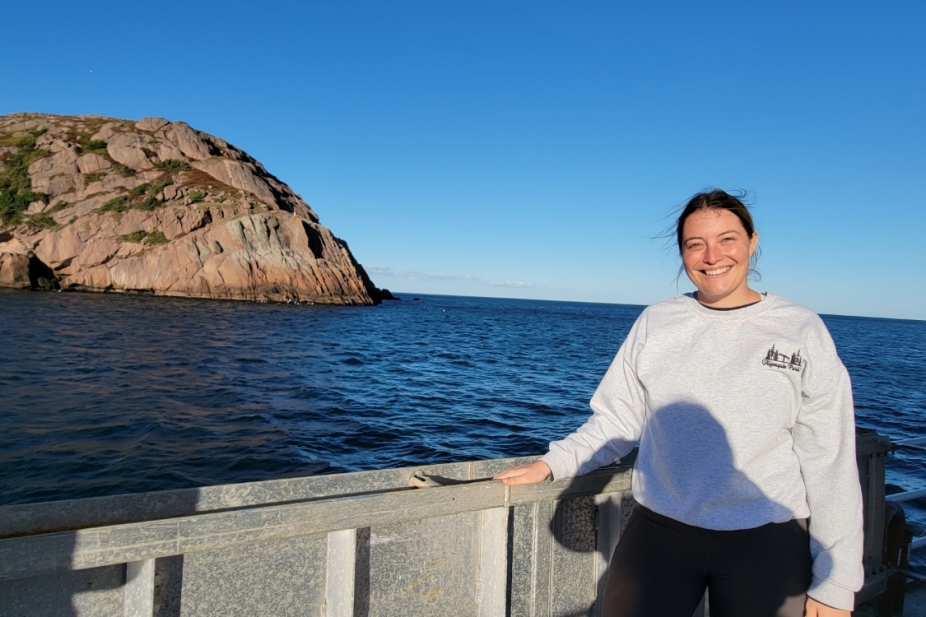
 Rachel Koop leaving St John's for a 10-day offshore trip. (Photo: Dylan O'Neill, Department of Fisheries and Oceans/University of Windsor)
By Sara Elliott
When they were children, Rachel Koop and Riley Beach unknowingly shared the same dream: becoming marine biologists.
Growing up by the Great Lakes, it seemed unlikely.
But after taking an undergraduate course with University of Windsor biology professor Dr. Dennis Higgs, their passion for ocean research was reignited.
Today, the two doctoral students divide their time between Higgs’ Windsor laboratory and ocean fieldwork.
Koop (BSc ’18, MSc ’20) studies how fish behaviour changes when exposed to seismic survey noise in the Northwest Atlantic.
To conduct seismic surveys, oil and gas companies use powerful air guns to map the ocean floor. While the effects on marine mammals have been studied, there is little known about their effects on free-ranging fish.
“I was looking at the fine scale reactions to see if there were any startle behaviours,” explains Koop.
Working in partnership with the Department of Fisheries and Oceans in Newfoundland, she drops baited underwater camera traps at depths of 100 to 350 metres to gauge fish reactions to the noise from the seismic surveys.
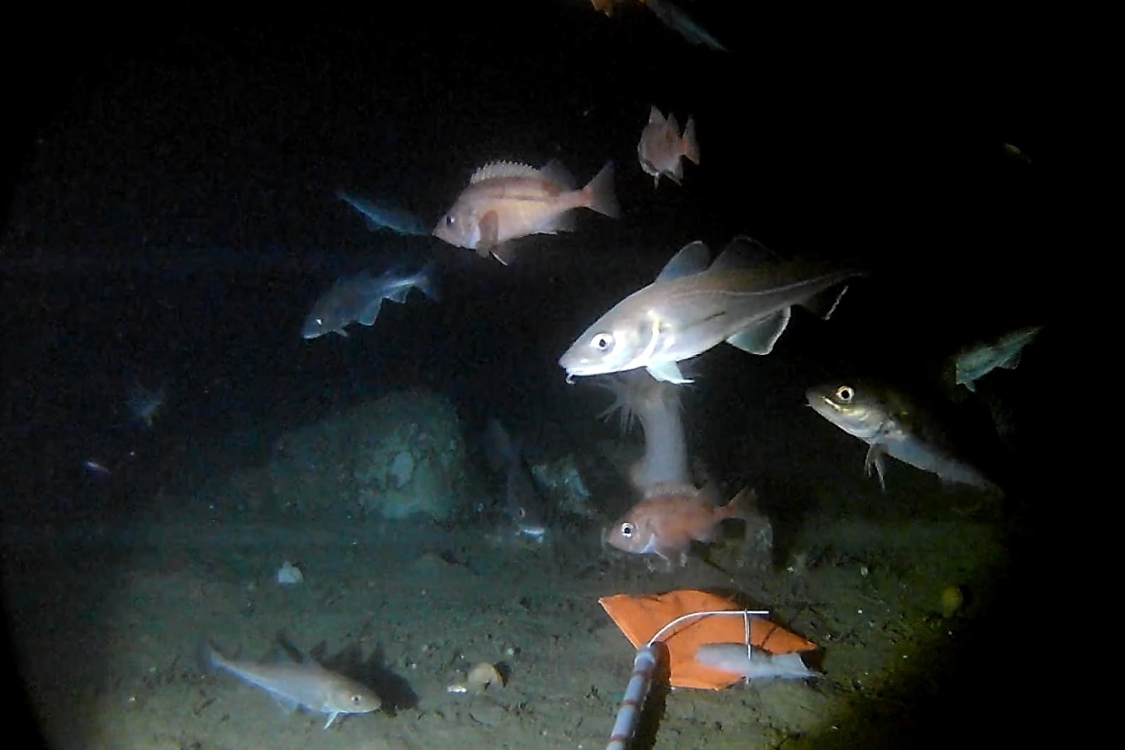
A screen capture from a baited remote underwater video (BRUV) deployment. (Photo courtesy of Rachel Koop/University of Windsor)
Her preliminary results suggest that immediate shock is species dependent.
“Some fish species have more sensitive hearing structures and they're able to detect sound [better],” she says.
“Eventually they get used to that kind of sound and recognize it as non-threatening.”
By comparing fish exposed to seismic surveys with fish in control sites, she found no evidence of damage to sensory cells in the ear. But mitigation measures, says Koop, must consider that not all animals have similar reactions.
“I think the fish are able to habituate to these loud sounds a lot better than marine mammals, which are much more sensitive,” says Koop.
“It’s interesting to think that this incredibly loud sound in their environments is maybe not as detrimental as we once thought.”
Koop also set out to answer a contested question in the field: do fish learn that seismic sounds pose no threat, or do they gradually lose their ability to hear them?
“I caught American plaice, a species of flounder, at both the seismic survey site and the quiet control site to see if there were any differences in the density of sensory cells within their ears, called hair cells,” says Koop.
“I didn't find a difference, so that does suggest behavioural habituation as opposed to deafening fish.”
On the other side of the world, Beach (BSc ’19, MSc ’22) studies how marine protected areas influence fish behaviour in New Zealand.
Working with researchers from the University of Auckland, she uses baited underwater video cameras to assess behaviour and transcriptomics, a field within molecular biology, to study which genes are responding when fish experience stress.
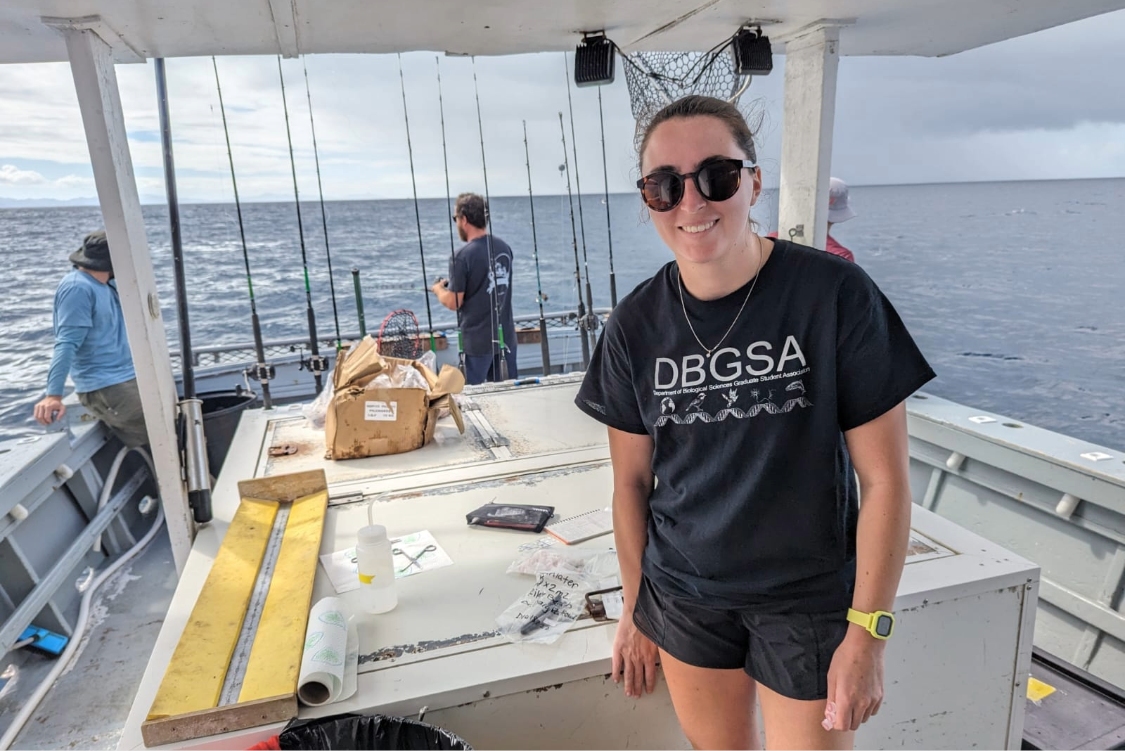
Riley Beach off the coast of Little Barrier Island in New Zealand, one of the areas being proposed as becoming a protected area. (Photo courtesy of Riley Beach/University of Windsor)
“We’re looking at which genes are being turned on and off,” she says.
Traditionally, transcriptomics research requires tissue samples, which result in the death of the fish. That approach is not permitted when working with protected species in marine reserves.
In her project, Beach is testing more minimally-invasive methods including gill swabs.
“This will push the field forward in terms of the kind of physiological data we're able to get non-invasively,” says Beach.
“Obviously, it can be different across species and across genes, but for the most part, it seems like a reasonable proxy, which is really promising.”
She focuses on the Australasian snapper, which plays a pivotal role in New Zealand's fisheries. Beach deployed baited underwater video cameras in two marine protected areas to determine if reserve age affects levels of stress.
She is particularly interested in how boat traffic and ecotourism may influence fish living inside protected areas. Anecdotally, she has observed that fish react differently to noise depending on the reserve.
In areas where visitors feed the fish, the animals will come right up to the boat.
“We can literally scoop them off the back of the boat with a net and take our samples and put them back,” says Beach.
Researchers found the oldest reserve had the highest level of ecotourism and the largest fish.
“They’re really friendly, which isn’t necessarily something you want to see in a wild animal,” she says.
“But it's interesting for us and it makes it easy to catch them.”
Commercial fisheries rely heavily on Australasian snapper, so it is important to understand their stress responses.
“They're a good indicator species of how marine protected areas are working,” says Beach.
“The better the marine protected area, the more fish you're going to see, the bigger fish you're going to see and the more abundance of species you're going to see.”
The researchers use the video footage to compare marine reserves with nearby non-protected areas and sites being considered for future protection.
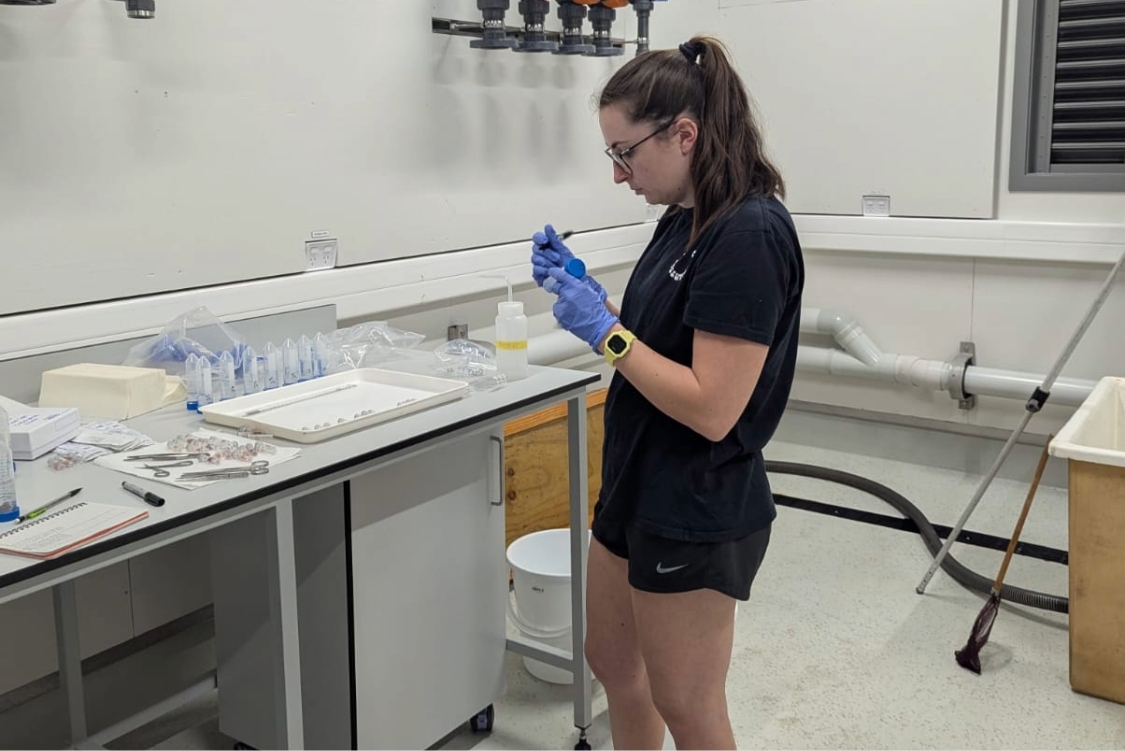
Riley Beach preparing to collect tissue samples from fish exposed to sound for up to three weeks to study stress-related gene activity at the Leigh Marine Laboratory in New Zealand. (Photo courtesy of Riley Beach/University of Windsor)
“We’re looking at baseline stress levels and fish responses in different areas to see whether the areas are effective at doing what they need to do or whether we can provide evidence to support the designation of new reserves,” says Beach.
There is one proposed area in New Zealand that has attracted strong interest from both the Department of Conservation and local Māori communities, making the research particularly relevant.
World Ocean Day 2026 unites millions around the globe on June 8 in support of protecting our blue planet.