
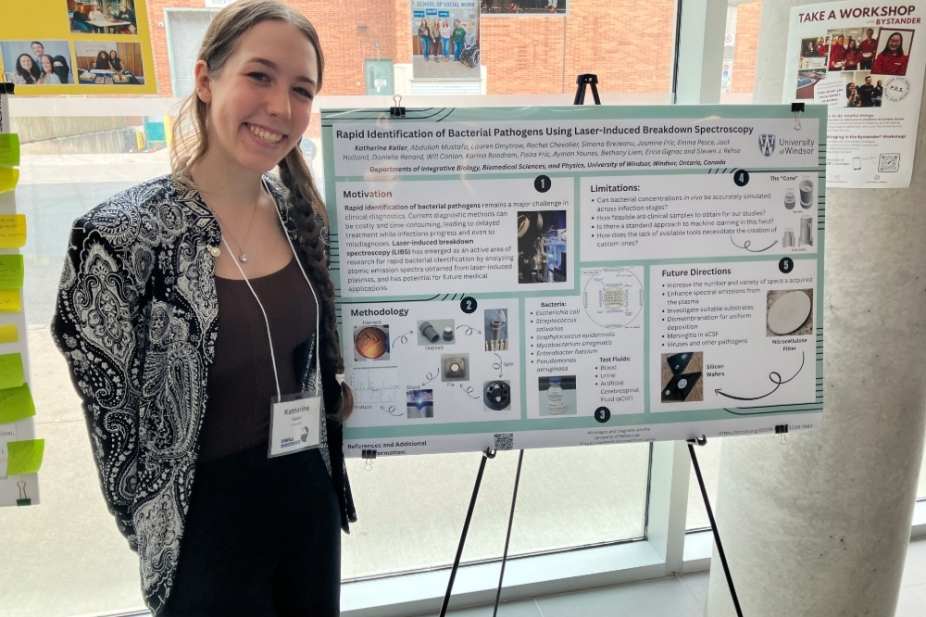
 Kitti Keller's research earned her an Undergraduate Student Research Award (USRA) from the Natural Sciences and Engineering Research Council of Canada. (Courtesy of Kitti Keller/University of Windsor)
By Sara Elliott
This summer, science student Kitti Keller learned a lesson on how melding biology and physics could one day help identify bacterial pathogens that threaten human health.
“We're hoping to develop a technology so one day you can go to the clinic, give a tiny blood or urine sample and get immediate results showing what's making you sick,” says the third-year biology student.
“That would speed up the diagnostic process significantly and you could get treatment a lot faster, which could prevent many infections from progressing.”
Keller is working in Dr. Steven Rehse’s biomedical physics lab with support from an Undergraduate Student Research Award (USRA) from the Natural Sciences and Engineering Research Council of Canada.
The lab includes biologists, biomedical science students and physicists among other majors. The bio students grow and prepare the bacteria; the physicists use lasers to identify the samples.
“We deposit the bacteria on tiny filters which get put on a steel plate, sent over to the laser side, where the physicists shoot the laser into the sample,” she says.
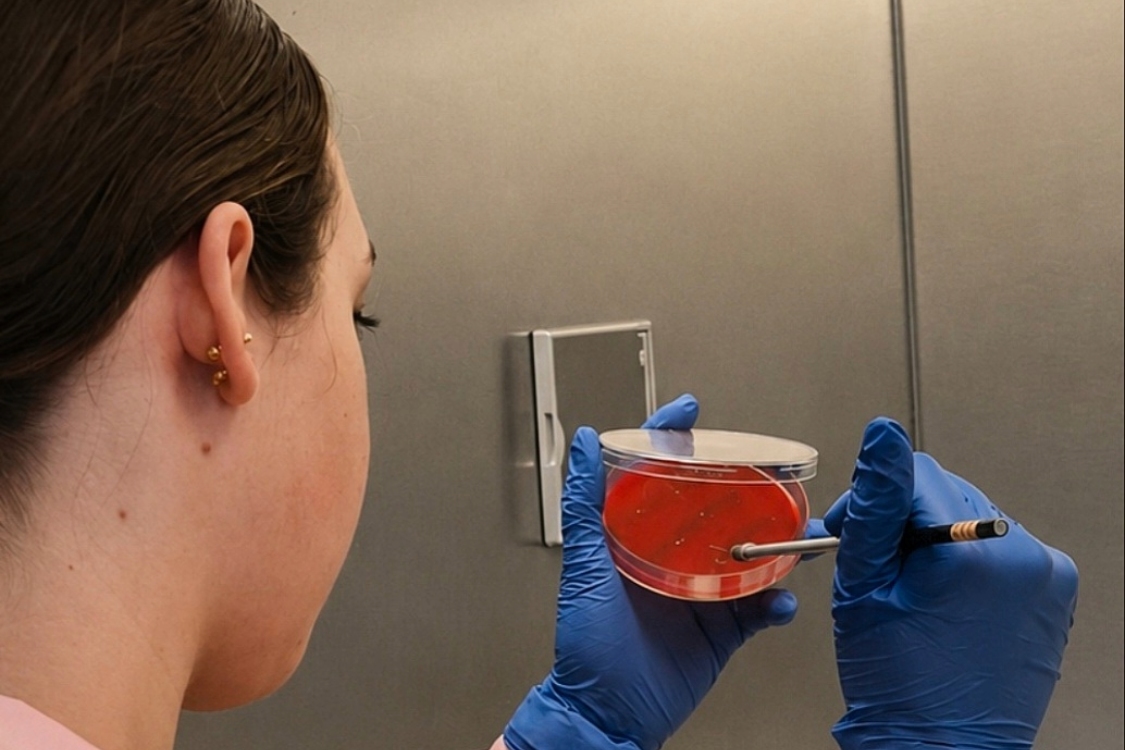
Kitti Keller helps grow and prepare the bacteria for the Rehse Lab. (Courtesy of Kitti Keller/University of Windsor)
Keller’s research involves laser-induced breakdown spectroscopy (LIBS), a technique for rapid bacterial identification. When the laser hits the sample, it creates a plasma that produces a unique spectrum of light.
“Our research group – the Rehse lab – has previously demonstrated the ability to detect and distinguish clinically relevant pathogens, including Escherichia coli, Staphylococcus epidermidis and Mycobacterium smegmatis, in blood and urine samples,” says Keller.
“Essentially, it's telling us what atoms are in the bacteria we're shooting and we're training the computer algorithm to be able to recognize what atoms and in what amounts are in certain kinds of bacteria.”
During first-year orientation, Keller, then an Outstanding Scholars candidate, heard a student from Rehse’s lab speak about the research, and she was hooked.
She started volunteering in his lab in her first semester. In second year, she became an Outstanding Scholar and continued working in the lab – this time as a paid undergraduate researcher.
Since then, she has presented her research and won first place with her research poster at the UWill Discover Conference.
That determination and focus extend beyond the lab. At 16, Keller won second place at the karate world championship in Ireland and again the following year in Florida. On campus, she co-leads the visual arts group Science Meets Art (SMArt), has served on the executive team of Crafting for a Cure and on the Outstanding Scholars gala committee.
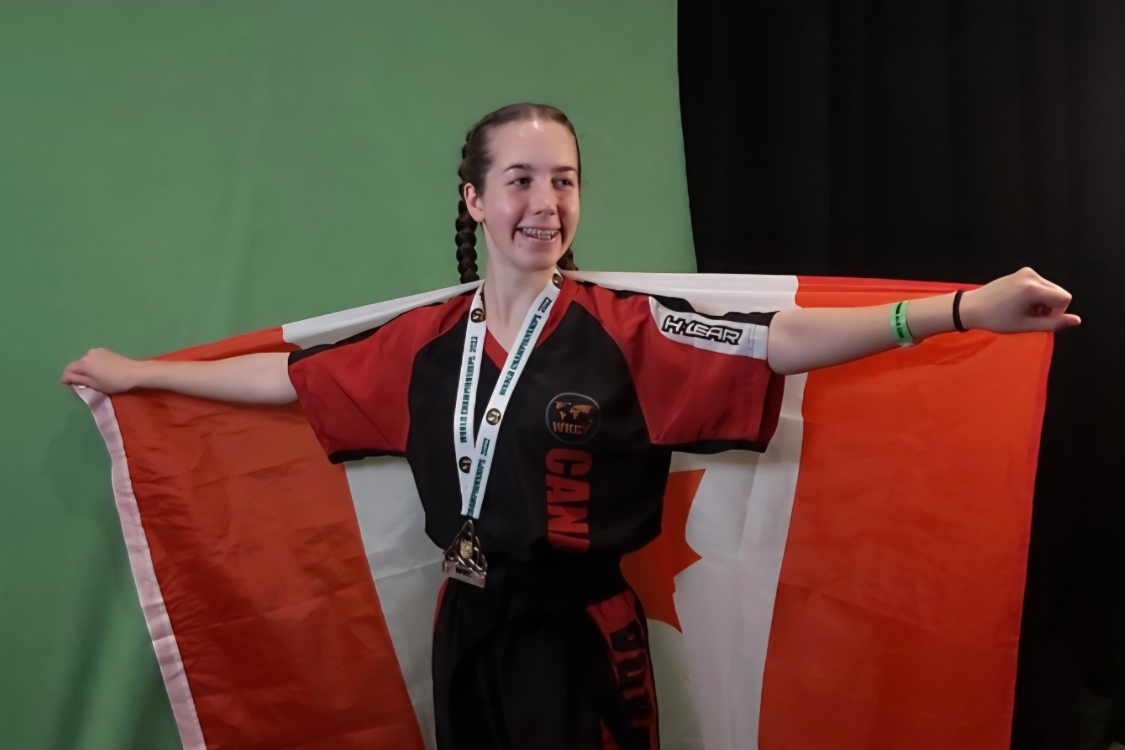
Kitti Keller is skilled beyond the lab. At 16, she won second place at the karate world championship in Ireland. (Courtesy of Kitti Keller/University of Windsor)
Looking down the road, Keller would like to pursue a graduate degree in microbiology as her passion for research continues to deepen.
Before graduate school, she plans to continue working in the Rehse lab and complete a fourth-year thesis focused on developing a novel silicon-wafer-based substrate for bacterial identification.
“The research has exciting potential to improve diagnostic technologies,” she says.
“The future is vast and I would love to see this technology applied sometime during my lifetime.”