
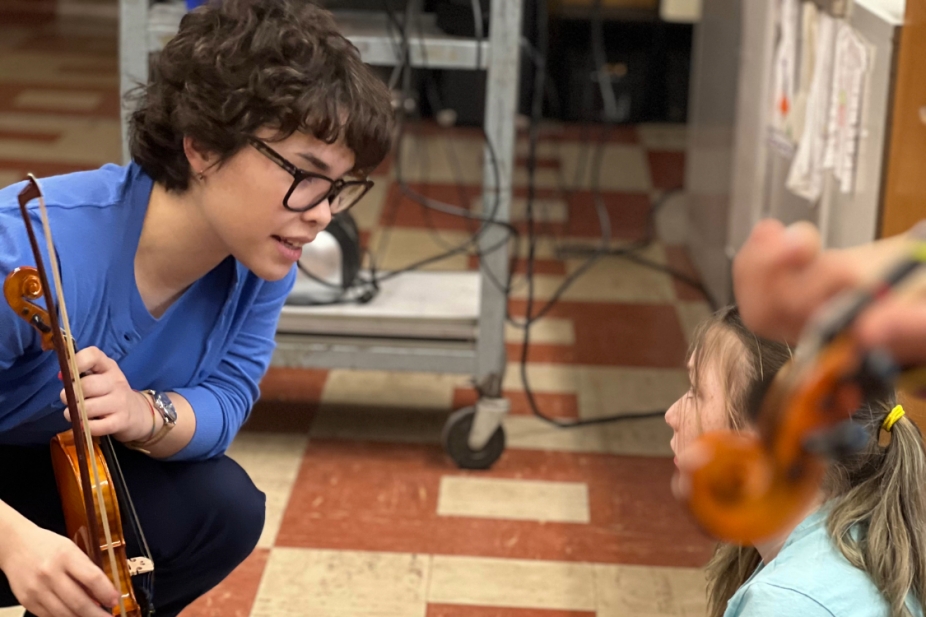
 Avery Ng has been a violin teaching assistant for the past four years in Windsor's The String Project. (REBECCA NG/University of Windsor)
By Sara Elliott
Offering free violin lessons to children is a “bright spot” in Avery Ng’s life.
The fourth-year integrative biology student has been involved with Windsor’s The String Project since its inception four years ago. Volunteers teach violin to pupils in grades 3 to 8 at Frank W. Begley and Marlborough.
“I love to teach and I chat with the kids and make them feel comfortable,” says Ng.
“Helping them surmount their challenges really helps with their self-confidence.”
Ng says the budding musicians perform for their peers and at community gatherings.
“You can see they have pride in what they do and feel like individuals with an important skill,” she says. “It is something I’ve been really happy to be a part of.”
Music is not the only way Ng blends creativity with her academic life. She is co-lead of Science Meets Art (SMArt) Windsor, an initiative that encourages young scientists to explore science education through visual art.
“I love using oils and pastels in my art,” says Ng.
“I am so honoured to be co-lead – it’s been a cool experience.”
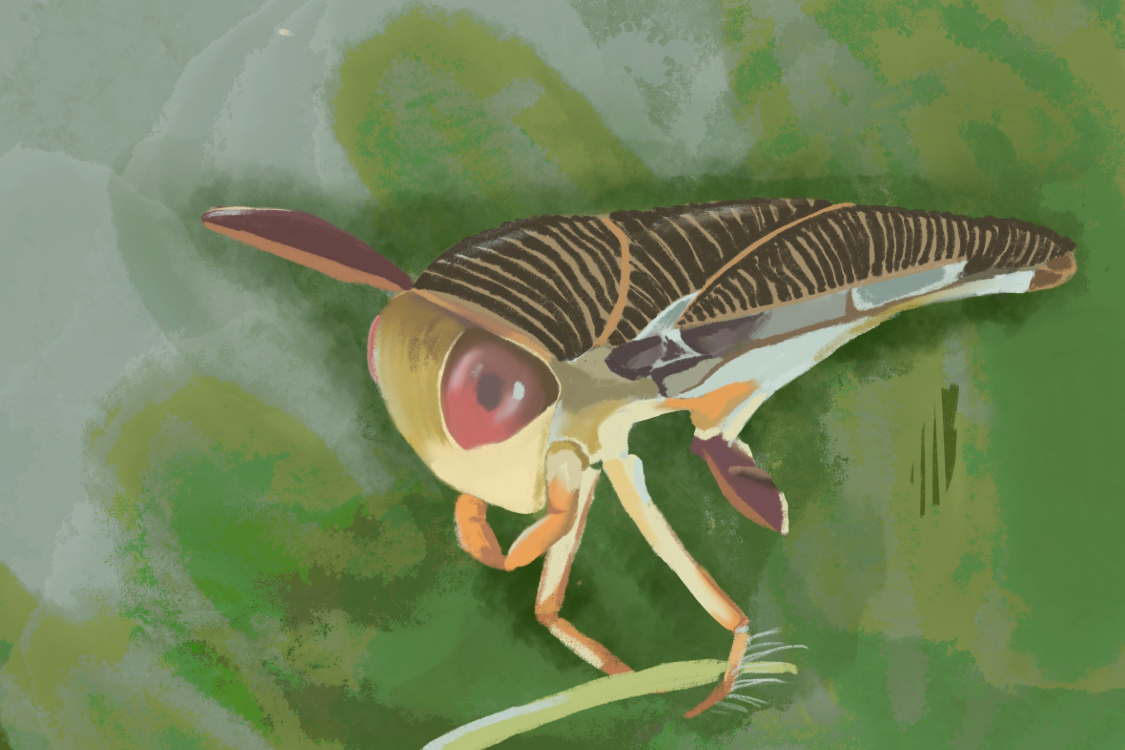
Avery Ng painted a corixid as part of a set of trading cards created for young lab visitors. (AVERY NG/University of Windsor)
As an Outstanding Scholar, Ng has been able to pursue research while completing her degree. She knew early on that she wanted to work in the Healthy Headwaters lab run by Dr. Catherine Febria.
“I emailed her on the third day of my first-year to ask if I could volunteer because her lab stood out to me,” she says.
“She wants to decolonize science and bring new perspectives – she brings scientific practices I didn’t expect, and I was so excited to work with her.”
Although Ng’s major is the Behaviour, Cognition and Neuroscience (BCN) program, her research is centred in a freshwater science lab.
Her interest in environmental science grew during the COVID-19 pandemic when she became grateful for the time she could spend in the natural spaces of Windsor-Essex.
“You couldn’t go anywhere but you could always go to Ojibway and Point Pelee,” she says.
“I’m so glad to have met people who want to preserve these spaces and being able to go out and build relationships with nature in our field work has been so fun for me.”
In Febria’s lab, Ng collects benthic invertebrate samples for the Ontario Benthos Biomonitoring Network (OBBN). The small aquatic organisms help scientists measure overall ecosystem health.
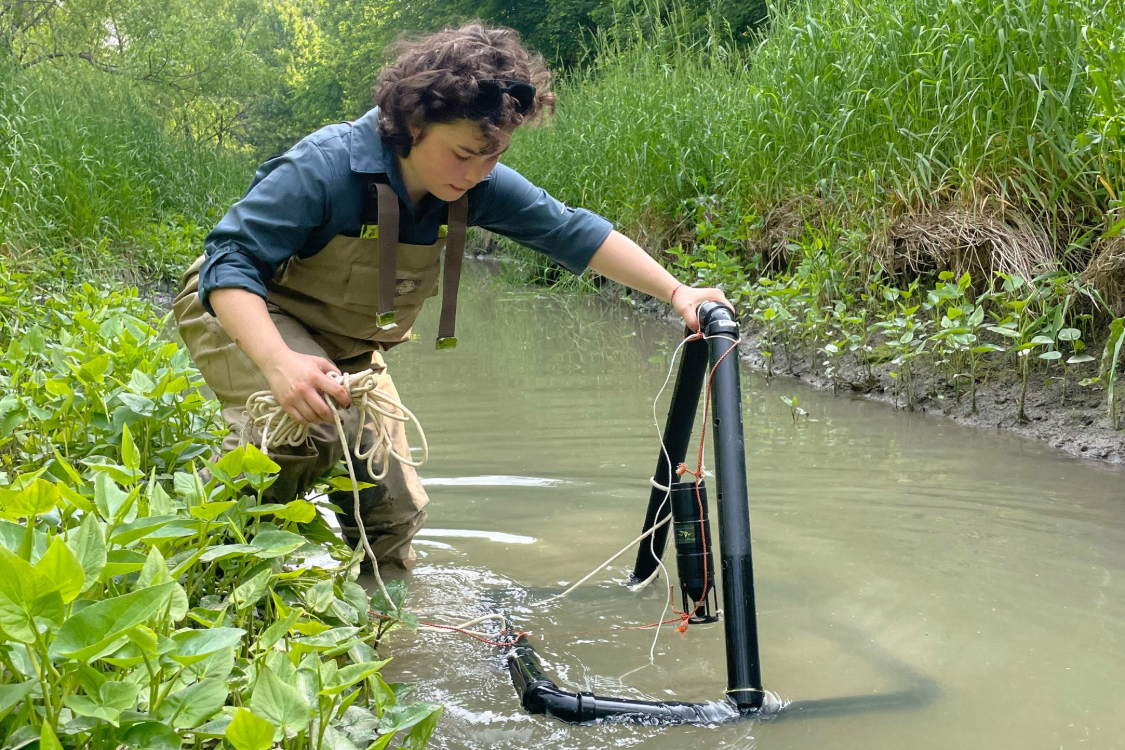
Avery Ng conducts summer field work in the River Canard. (ALEXIA MACRI/University of Windsor)
“Some of these bugs can tolerate a wide range of environments,” she says.
“We were out in a manure field and all we could find was chironomids – these bright red worms – and these guys can live in almost any environment with very little oxygen”
In a project with another research group, run by Dr. Dennis Higgs, Ng is investigating the significance of underwater soundscapes by taking sound samples.
“We know what invertebrates look like, but I hope to see more community interaction and how they live,” she says.
“I want to find as many ways as possible to monitor and make sure ecosystems are healthy and this sound version may be a less laborious way to do that. If it works we’ll get information out quicker.”
She has also helped the Essex Region Conservation Authority with mussel surveys, which track changes in local populations over time.
“Mussels are really good health indicators,” Ng says. “I feel they’re a little underrepresented in our view of conservation because you can’t see them. You have to dig them out.”
A highlight to her field work is getting to build relationships with community partners, including Caldwell First Nation.
“As land guardians they make enthusiastic partners and offer stories.”
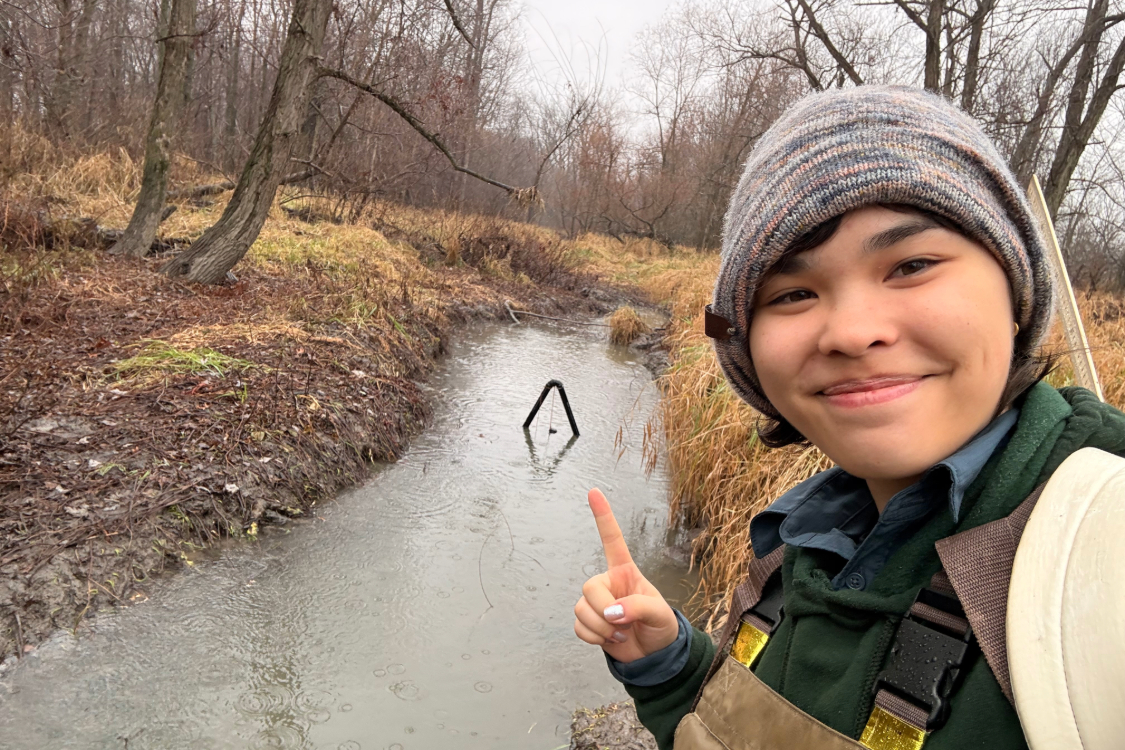
During field work, Avery Ng identifies a location along the River Canard. (AVERY NG/University of Windsor)
Although Ng’s major is BCN, she says studying environmental science has expanded the way she approaches research.
“What I love about my degree and my environmental work is that with both I can start to pull out what is important about these subjects,” she says.
“It has been great for my skills and honestly, for the friendships I’ve made.”
Now in the final year of her undergraduate degree, Ng is keeping her options open. She is considering pursuing a medical degree or doing her master’s in biology.