
 Students signal and shout trade orders during the Odette Outcry Trading Competition on April 21, simulating the intensity of a traditional trading floor. (ZEINAB KALAKECH/University of Windsor)
By Victor Romao
“Buy 10!”
“Sell 20!”
“Take it!”
The shouts echoed across the Odette School of Business trading pit April 21 as nearly 200 high school students stepped into the high-pressure world of stock trading — shouting orders, flashing hand signals and scrambling to outpace the market in the Outcry Trading Competition.
Designed to mirror the chaos of a traditional trading floor, the competition transformed theory into action, immersing students in a fast-moving simulation where split-second decisions could mean the difference between profit and loss — an approach organizers say is key to its impact.
“This is about bridging the gap between theoretical knowledge and real-world financial decision-making,” said Radha Patel (MEd ’17, BEd ’13, BComm ’09), student success co-ordinator at the Odette School of Business. “Students are developing critical thinking, teamwork and communication skills while gaining a deeper understanding of how markets respond to real-time information.”
That intensity was not lost on participants, who described the experience as fast-paced and demanding, requiring constant communication to keep up with the flow of information on the trading floor.

Hosted by the Odette Student Success Centre, the Odette Finance Association and the John Simpson Odette Student Investment Fund, the annual event drew participants from across school boards and regions.
Unlike digital simulations, the open outcry format forced participants to rely on one another.
Analysts relayed information from upstairs, while traders on the floor shouted instructions to brokers tasked with executing trades.
“The open outcry model is far more interactive than a purely digital simulation,” said Adriano Durante (MBA ’17), a finance sessional instructor who oversaw the brokers and trading process. “Every member has a role to play, rather than everyone sitting around a screen.”
Students said the collaborative format made the competition feel more realistic, with each decision carrying weight for the entire team, while also highlighting the challenge of interpreting breaking “news” and reacting before stock prices shifted.
The competition unfolded over timed rounds, each driven by simulated news updates that triggered fluctuations in stock prices.
Students had to interpret headlines, anticipate market reactions and act quickly — all while the noise level rose.
“We pre-design scenarios and release information throughout each round,” said Patel. “It creates a dynamic environment where no two rounds are the same.”
Behind the scenes, student leaders played a key role, with Odette Finance Association president Yuvi Gill and John Simpson Odette Investment Fund chief executive officer Jacob Sweet spearheading the initiative. Sweet developed the simulation by selecting stocks, crafting news headlines and assigning price impacts.
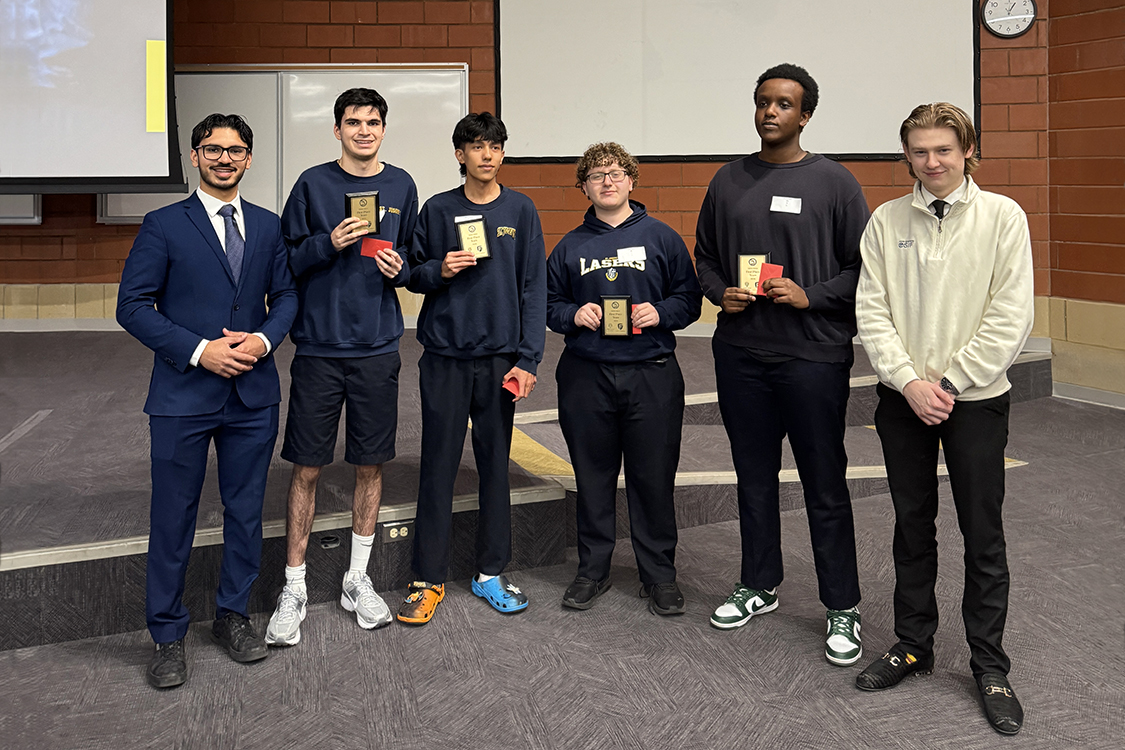
At the end of the day, a team from St. Joseph Catholic High School outpaced the field, navigating volatility with precision and teamwork to claim the top spot.
For organizers, however, the biggest win extended beyond the leaderboard.
“The purpose is to generate interest among high school students in pursuing a business degree,” said Durante. “It’s one of our main recruitment events of the year.”